This post has been revised to incorporate all the suggestions in the comments below, plus many more activities. Please update your bookmarks:
Or continue reading the original article…
This post has been revised to incorporate all the suggestions in the comments below, plus many more activities. Please update your bookmarks:
Or continue reading the original article…
Photo by Windell Oskay via Flickr (CC BY 2.0).
Math concepts: logic, patterns, divisibility
Number of players: 2
Equipment: 10 tokens, any sort, mix or match
Place the pile of tokens (pebbles, toothpicks, beans, pennies, dry cereal, etc.) on the table between the players.
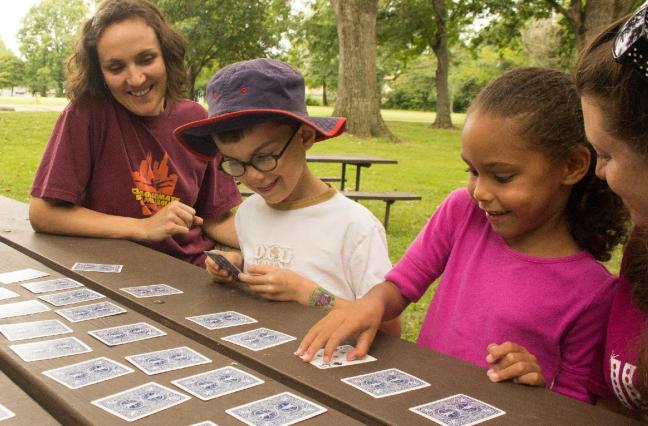
Math concepts: addition, number bonds for 10, visual memory
Number of players: any number, mixed ages
Equipment: math cards, one deck
Each player draws a card, and whoever choses the highest number will go first. Then shuffle the cards and lay them all face down on the table, spread out so no card covers any other card. There are 40 cards in a deck, so you can make a neat array with five rows of eight cards each, or you may scatter them at random.
Many of the games on this blog call for Math Cards. You do not need to look for these in stores or in your school supply catalog. Math cards are simply a modified deck of normal, poker-style playing cards. Remove all face cards and jokers from the deck, leaving the ace through ten of each suit. Or use a set of Rook cards, without the bird.
Using the ace as a one, this gives you four sets of numbers 1-10, and you will be ready to play your way to fluency in almost any arithmetical topic: addition, subtraction, multiplication, division, greater-than/less-than, fractions, negative numbers, and more.

Little hands often have trouble holding more than a few cards at a time. Your child may enjoy making and using a card holder.
Save the plastic lids from two large margarine tubs or similar containers. Place the lids together, top to top. Line up the edges, then staple them together, putting two or three staples near the center of the lids. Let your child decorate the card holder with stickers, if desired.
To use the card holder, slip playing cards between the two lids and fan them out. The lids will hold the cards upright, so the child can easily see them all.
* * *
This blog is reader-supported.
If you’d like to help fund the blog on an on-going basis, then please join me on Patreon for mathy inspiration, tips, and an ever-growing archive of printable activities.
If you liked this post, and want to show your one-time appreciation, the place to do that is PayPal: paypal.me/DeniseGaskinsMath. If you go that route, please include your email address in the notes section, so I can say thank you.
Which I am going to say right now. Thank you!
“How to Make Math Cards” copyright © 2007 by Denise Gaskins.
Alexandria Jones stood outside her father’s tent. The glare of the sun on the rocky desert hurt her eyes. Holding up a hand to shield her gaze, she spotted her dad (the world-famous archaeologist) arguing with the foreman.
Poor Dad, she thought. He was sure this was the right site, but so far he’s found nothing.
She looked down at her feet, where her faithful dog Ramus waited, panting. “Well, Rammy, it looks like Dad will be busy for while. What do you say? Shall we go exploring?”
Alexandria ducked into the tent for her backpack and canteen.
Thump! Something bounced against the side of the tent. Ramus barked.
Alex stepped outside and looked quickly around. No one was in sight. She saw a fist-sized rock beside the tent, with a note tied to it. She picked it up and read:
Ha! The real Pharaoh’s Treasure lies under a pyramid of stones, and it’s mine. You can’t stop me this time! —Simon Skulk
Continue reading The Secret of the Pharaoh’s Treasure, Part 1

[Rescued from my old blog. To read the entire series, click here: Elementary Problem Solving Series. Photo by Studio 757 via Flickr (CC BY 2.0).]
You can begin to teach your children algebraic thinking in preschool, if you treat algebra as a problem-solving game. Young children are masters at solving problems, at figuring things out. They constantly explore their world, piecing together the mystery of how things work. For preschool children, mathematical concepts are just part of life’s daily adventure. Their minds grapple with understanding the three-ness of three blocks or three fingers or one raisin plus two more raisins make three.
Wise homeschooling parents put those creative minds to work. They build a foundation for algebra with games that require the same problem-solving skills children need for abstract math: the ability to visualize a situation and to apply common sense.
Continue reading Elementary Problem Solving: The Early Years
[Rescued from my old blog.]
 A number bond is a mental picture of the relationship between a number and the parts that combine to make it. The concept of number bonds is very basic, an important foundation for understanding how numbers work. A whole thing is made up of parts. If you know the parts, you can put them together (add) to find the whole. If you know the whole and one of the parts, you take away the part you know (subtract) to find the other part.
Number bonds let children see the inverse relationship between addition and subtraction. Subtraction is not a totally different thing from addition; they are mirror images. To subtract means to figure out how much more you would have to add to get the whole thing.

[Rescued from my old blog.]
Would you like to introduce your students to negative numbers before they study them in pre-algebra? With a whimsical number line, negative numbers are easy for children to understand.
Get a sheet of poster board, and paint a tree with roots — or a boat on the ocean, with water and fish below and bright sky above. Use big brushes and thick poster paint, so you are not tempted to put in too much detail. A thick, permanent marker works well to draw in your number line, with zero at ground (or sea) level and the negative numbers down below.
The spring semester of homeschool co-op classes starts tomorrow, and I still have a couple of handouts to prepare and several pages of notes to go over in preparation. So naturally, I find myself flitting from here to there on my computer, browsing new links and cleaning out the old.
As the saying goes:
“I used to be an amateur crastinator, but now I’ve turned pro.”
In a dusty pile of long-neglected bookmarks, I rediscovered this treasure:
I love this game!

Have you and your children been struggling to learn the math facts? The game of Math Card War is worth more than a thousand math drill worksheets, letting you build your children’s calculating speed in a no-stress, no-test way.
Math concepts: greater-than/less-than, addition, subtraction, multiplication, division, fractions, negative numbers, absolute value, and multi-step problem solving.
 Denise Gaskins' Let's Play Math