Why I Love Math Games

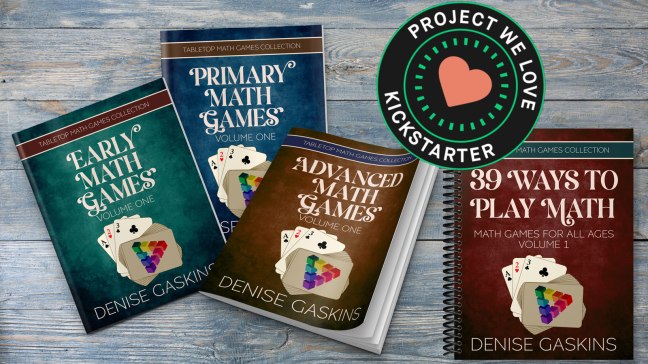
To everyone who has supported my Tabletop Math Games Collection Kickstarter project: thank you ever so much! We’ve blown past our funding target and the first two Stretch Goals. And the Kickstarter folks awarded us the “Project We Love” tag. 😻

If you haven’t backed the project yet, check out what you’re missing:

Visit the Kickstarter ❯

Why I Love Math Games

Math games build mental flexibility and strategic reasoning in players of all ages. And even people who hated math in school can enjoy the friendly challenge of a game.

I love how the challenge of a well-fought math game pushes players of all ages to think more creatively and build fluency.

Games Promote Mathematical Thinking

Math games push students to develop a creatively logical approach to solving problems. In the stress-free struggle of a game, players learn to analyze situations and draw conclusions.

Even more importantly, games help children learn to enjoy the challenge of thinking hard. Their vocabulary grows as they discuss options and strategies with their fellow players. With their attention focused on their next move, they don’t notice how much they are learning.

And games are good medicine for math anxiety. Everyone knows it takes time to master the fine points of a game, so players can get stuck or make mistakes without losing face.

What’s Special About These New Books?

Readers of my Math You Can Play series know the joy of gaming can transform a child’s attitude toward math. But many of you tell me the books get lost on your bookshelves or in your ebook reading device. You’ve begged me to make math gaming more open-and-go.

So my new Tabletop Math Games Collection is designed to make it easier than ever for busy families and over-stressed teachers to play with math.

These books are written directly for young gamers and require only common household supplies like cards, dice, and scratch paper. Children can open to any page and start playing right away.

Not to mention the swag! I’m excited about the items we’ve created to go along with the books. The “Gaming in the Enchanted Forest” coloring page by fantasy artist Tanya Hales is absolutely delightful, and the enamel pins are a fun and colorful way to share your playful math joy.

Order Your Copy Today

Whether you’re a busy parent or an overworked teacher, you’ll love the Tabletop Math Games Collection — the natural, no-stress way to build your children’s understanding and confidence.

These are NOT the typical memory-and-speed-based math games you’ve probably seen online, but true battles of wit and skill (plus a bit of luck). Even the preschool games can be fun for adults, too.

Most of the games take only seconds to learn and less than 15 minutes to play, making them perfect ice-breakers for family gatherings, classroom warmups, or for launching a group game night.

So what are you waiting for? Grab some cards, dice, or graph paper, and let’s play some math!

Visit the Kickstarter ❯

 
* * *

This blog is reader-supported.

If you’d like to help fund the blog on an on-going basis, then please join me on Patreon for mathy inspiration, tips, and an ever-growing archive of printable activities.

If you liked this post, and want to show your one-time appreciation, the place to do that is PayPal: paypal.me/DeniseGaskinsMath. If you go that route, please include your email address in the notes section, so I can say thank you.

Which I am going to say right now. Thank you!

“__________” copyright © __________ by Denise Gaskins. Image at the top of the post copyright © __________ / Depositphotos.


Playful Math Education 162: The Math Games Carnival

Welcome to the 162nd edition of the Playful Math Education Blog Carnival — a smorgasbord of delectable tidbits of mathy fun. It’s like a free online magazine devoted to learning, teaching, and playing around with math from preschool to high school.

Bookmark this post, so you can take your time browsing.

There’s so much playful math to enjoy!

By tradition, we start the carnival with a puzzle/activity in honor of our 162nd edition. But if you’d rather jump straight to our featured blog posts, click here to see the Table of Contents.

Try This Puzzle/Activity

The number 162 is a palindromic product:

162 = 3 x 3 x 2 x 3 x 3
and 162 = 9 x 2 x 9

  • How would you define palindromic products?
  • What other numbers can you find that are palindromic products?
  • What do you notice about palindromic products?
  • What questions can you ask?

Make a conjecture about palindromic products. (A conjecture is a statement you think might be true.)

Make another conjecture. How many can you make? Can you think of a way to investigate whether your conjectures are true or false?

Click here for all the mathy goodness!

Launch Day! Act Now To Get the Earlybird Bonus

And so it begins: Tabletop Math Games Collection is LIVE on Kickstarter!

Check It Out

To have a successful campaign, we need plenty of people to back the project early. The more supporters we get — especially on the first day — the more likely the Kickstarter service folks will help spread the news for us.

So I’m offering a special bonus printable activity guide for everyone who joins the campaign at any pledge level during the first 48 hours of the campaign:

Geometric Coloring Designs 5: Advanced Tessellations is one of my favorite open-ended math art activities, which works with students from elementary to high school. And adults enjoy it, too!

The rest of the Geometric Coloring Designs series will show up as bonuses in future weeks, and early backers get them all. Whether you pledge on day 1 or day 21, your credit card won’t be charged until the campaign ends, so join early to lock in your bonus perks.

Let’s show the whole world how much fun it can be to play around with math!

Go to the Kickstarter

New Project: The Tabletop Math Games Collection

Coming Soon! On January 30th, I’ll be launching a brand new book series, the Tabletop Math Games Collection.

And the Kickstarter prelaunch page is now live. That means you can sign up to get an email from Kickstarter as soon as the campaign launches:

Visit the Prelaunch Page ❯
(free Kickstarter account required)

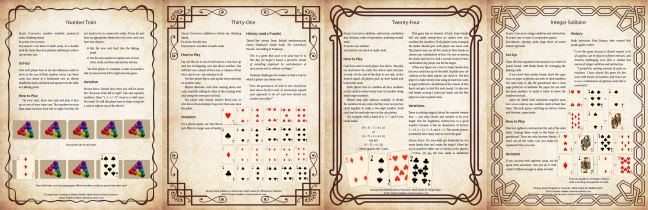
Test Out 4 Free Sample Games

Math games build mental flexibility and strategic reasoning in players of all ages. And even people who hated math in school can enjoy the friendly challenge of a game.

I’ve put together a free printable sampler file, with four ready-to-play card games you can enjoy today.

I think you’ll love it!

Download the Sample File ❯

Help Your Kids Learn Math the Playful Way

  • Are you a parent trying to help your child learn math?
  • Or a teacher looking for ways to encourage creative thinking?
  • Or a gamer ready to try something new with your friends?

Then the Tabletop Math Games Collection is perfect for you.

These are NOT the typical memory-and-speed-based math games you’ve probably seen online, but true battles of wit and skill (plus a bit of luck). Even the preschool games can be fun for adults, too.

Most of the games take only seconds to learn and less than 15 minutes to play, making them perfect ice-breakers for family gatherings, classroom warmups, or for launching a group game night.

Don’t miss the fun!

Hit the button to visit the prelaunch page and sign up for notifications:

Get Notified ❯

The Colors-of-Fall Carnival: Playful Math #160

Welcome to the 160th edition of the Playful Math Education Blog Carnival — a smorgasbord of delectable tidbits of mathy fun. It’s like a free online magazine devoted to learning, teaching, and playing around with math from preschool to high school.

Bookmark this post, so you can take your time browsing.

There’s so much playful math to enjoy!

By tradition, we start the carnival with a puzzle/activity in honor of our 160th edition. But if you’d rather jump straight to our featured blog posts, click here to see the Table of Contents.

Try This Puzzle/Activity

Appropriately for an October carnival, 160 is an evil number.

A number is evil if it has an even number of ones in binary form. Can you find the binary version of 160? (Hint: Exploding Dots.)

160 is also a polyiamond number. If you connect 9 equilateral triangles side-to-side, a complete set of 9-iamond shapes would have 160 pieces.

But sets that large can be overwhelming. Try playing with smaller sets of polyiamonds. Download some triangle-dot graph paper and see how many different polyiamond shapes you can make.

What do you notice? Does it make you wonder?

What designs can you create with your polyiamonds?


Photo by Daiga Ellaby on Unsplash

Click here for all the mathy goodness!

New to Playful Math? Start Here

Do you want your children to enjoy learning math? Teach them how to play!

After the troubles of recent years, it’s even more important for families to play together. So I’ve made the ebook version of Let’s Play Math Sampler: 10 Family-Favorite Games for Learning Math Through Play permanently free.

What a great way to introduce your child to the joy of learning!

With excerpts taken from my most popular books, the Let’s Play Math Sampler features ten kid-tested games covering math concepts from counting to prealgebra.

Pick up a copy today, and make math a playful family adventure.

Download Your FREE Copy

Or Shop Your Favorite Online Store
… or request a copy from your library or local bookshop.

“Math is so many things — beauty, structure, problem solving, communication, language, creativity — but here’s what I’ve learned as I’ve tried to help my children develop positive relationships with math: It All Begins With Play. Anything by Denise Gaskins is a fantastic place to start. These books are filled with the perfect combination of perspective and practicality.”

—Michele Johnson, Instagram post

 
* * *

This blog is reader-supported.

If you’d like to help fund the blog on an on-going basis, then please join me on Patreon for mathy inspiration, tips, and an ever-growing archive of printable activities.

If you liked this post, and want to show your one-time appreciation, the place to do that is PayPal: paypal.me/DeniseGaskinsMath. If you go that route, please include your email address in the notes section, so I can say thank you.

Which I am going to say right now. Thank you!

“New to Playful Math? Start Here” copyright © 2022 by Denise Gaskins.

Math War for Simultaneous Equations

Just updated my blog post Math Game: War with Special Decks to add a game I missed the first time around:

Math War is the most worksheety of all the math games I play with kids. But you can add a level of choice by playing the Trumps version.

Math War Trumps: Instead of playing for the highest sum, as in Julie’s original game, have each player draw 3 cards. The player whose turn it is first names “X” or “Y” as trump, then all players lay down a card. Highest trump value wins the skirmish.

Variation: Let the player naming trump also decide whether the highest or lowest value will win.

For more great math games, visit My Best (Free) Math Games for All Ages.

 
* * *

This blog is reader-supported.

If you’d like to help fund the blog on an on-going basis, then please join me on Patreon for mathy inspiration, tips, and an ever-growing archive of printable activities.

If you liked this post, and want to show your one-time appreciation, the place to do that is PayPal: paypal.me/DeniseGaskinsMath. If you go that route, please include your email address in the notes section, so I can say thank you.

Which I am going to say right now. Thank you!

“Math War for Simultaneous Equations” copyright © 2022 by Denise Gaskins. “Red playing cards” photo by José Pablo Iglesias via Unsplash.com.

Playful Math Carnival #154: The Math Journaling Edition

Welcome to the 154th edition of the Playful Math Education Blog Carnival — a smorgasbord of delectable tidbits of mathy fun. It’s like a free online magazine devoted to learning, teaching, and playing around with math from preschool to high school.

Bookmark this post, so you can take your time browsing.

There’s so much playful math to enjoy!

By tradition, we start the carnival with a puzzle/activity in honor of our 154th edition. But if you’d rather jump straight to our featured blog posts, click here to see the Table of Contents.

Try This Puzzle/Activity

Since 154 is a nonagonal number, I think you might enjoy visiting some of my old “Adventures of Alexandria Jones” posts about figurate numbers:

And then try this math journaling prompt: Build or draw your own nonagonal numbers — numbers built from 9-sided polygons.

How many nonagonal numbers can you find? What do you notice? Does it make you wonder?

Click here for all the mathy goodness!

Playful Math #152: Auld Lang Syne Edition

Welcome to the 152nd edition of the Playful Math Education Blog Carnival — a smorgasbord of delectable tidbits of mathy fun. It’s like a free online magazine devoted to learning, teaching, and playing around with math from preschool to high school.

Bookmark this post, so you can take your time browsing. There’s so much playful math to enjoy!

We didn’t have a volunteer host for January, so I’m squeezing this in between other commitments. This is my third no-host-emergency carnival in the last year, which is NOT sustainable. If you’d like to help keep the Playful Math Carnival alive, we desperately need hosts for 2022!

By tradition, we start the carnival with a puzzle or activity in honor of our 152nd edition. But if you’d rather jump straight to our featured blog posts, click here to see the Table of Contents.

Math Journaling with Prime Numbers

Cool facts about 152: The eighth prime number is 19, and 8 × 19 = 152. When you square 152, you get a number that contains all the digits from 0–4. You can make 152 as the sum of eight consecutive even numbers, or as the sum of four consecutive prime numbers.

But 152 has two real claims to fame:

  • It’s the smallest number that is the sum of the cubes of two distinct odd primes.
  • And it’s the largest known even number you can write as the sum of two primes in exactly four ways.

So here’s your math investigation prompt:

  • Play around with prime numbers. Explore their powers, their sums, and anything else about them you like.
  • What do you notice? What do you wonder?
  • What’s the most interesting number relationship you can find?

Continue reading Playful Math #152: Auld Lang Syne Edition

Playful Math Education Carnival 147

Welcome to the 147th edition of the Playful Math Education Blog Carnival — a smorgasbord of delectable tidbits of mathy fun. It’s like a free online magazine devoted to learning, teaching, and playing around with math from preschool to high school.

Bookmark this post, so you can take your time browsing. There’s so much playful math to enjoy!

By tradition, we start the carnival with a puzzle in honor of our 147th edition. But if you’d rather jump straight to our featured blog posts, click here to see the Table of Contents.

Continue reading Playful Math Education Carnival 147