Marking time is hard for children (and often for us adults, as well).
I don’t mean telling time, which has its own difficulties. But waiting, marking time until the Big Day or Important Event arrives.
Whether you’re counting down the days to Christmas, or the hours until New Year’s Day, or waiting for a birthday or visit to Grandma — it’s never easy to sit idly during the interim.
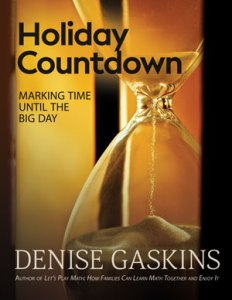
Holiday Countdown
Here’s a fun little craft that can make the waiting easier, or at least make it easier to keep track of how much longer until the time is right.
It’s a spinning time-piece for kids to decorate and put together (with a bit of adult help wielding a craft knife).
Holiday Countdown is a 28-page printable file includes illustrated instructions, along with countdown timers for birthday, Christmas, and New Year’s Eve celebrations, plus blank timers you can adapt to any occasion.
The ever-creative Manja designed a mandala-coloring version of the countdown timer for New Year’s Eve. Read all about it (and find the download links) on her Hattifant blog.
* * *
Are you looking for more creative ways to play math with your kids? Check out all my books, printable activities, and cool mathy merch at Denise Gaskins’ Playful Math Store. Or join my email newsletter.
This blog is reader-supported. If you’d like to help fund the blog on an on-going basis, then please join me on Patreon for mathy inspiration, tips, and an ever-growing archive of printable activities.
Are you looking for fun ways to keep your children busy (and learning!) through the holidays? Here are two printable activity guides you might enjoy:
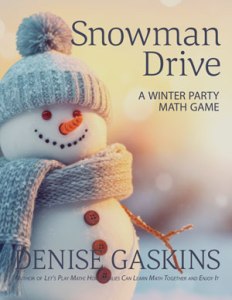
Snowman Drive
(My newest game activity.)
Players roll the dice and build their creative snowman (or snowbeast). Will you make a fearless pirate or a dapper aristocrat — or a high-scoring snow spider?
A Snowman Drive is a family-friendly party that can also serve as a fundraiser for your church, homeschool group, or organization. The Drive consists of several rounds of the Snowman Game played on a single worksheet, with prizes for the top-scoring players and overall champion.
This activity book includes game instructions and gameboard pages for single-family or group play.
For ages 5 and up.
* * *
Download a PDF preview file.
* * *
FORMAT: 13-page printable PDF file with your choice of 8.5″×11″ (letter size) or A4 pages.
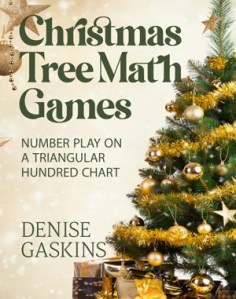
Christmas Tree Math Games features 4 easy-to-learn games and 6 additional activities for primary and middle-grade students. All you need is a set of dice and a few colorful markers.
Math games build mental flexibility and strategic reasoning in players of all ages. And even people who hated math in school can enjoy the friendly challenge of a game.
These are NOT the typical memory-and-speed-based math games you’ve probably seen online, but true battles of wit and skill (plus a bit of luck).
Perfect ice-breakers for family gatherings, classroom warmups, or for launching a group game night. You’ll be surprised how much fun thinking hard can be!
Christmas Tree Math Games includes instructions and tips for the teacher, math game pages for handouts or learning centers, plus a variety of dot-grid journaling paper.
For ages 6 and up.
* * *
Download a PDF preview file.
* * *
FORMAT: 30-page printable PDF file with your choice of 8.5″×11″ (letter size) or A4 pages.
Are you looking for more creative ways to play math with your kids? Check out all my books, printable activities, and cool mathy merch at Denise Gaskins’ Playful Math Store. Or join my email newsletter.
This blog is reader-supported. If you’d like to help fund the blog on an on-going basis, then please join me on Patreon for mathy inspiration, tips, and an ever-growing archive of printable activities.
Are your students doing anything special for Pi Day?
Back when we were homeschooling, my kids and I always felt stir-crazy after two months with no significant break. We needed a day off — and what better way could we spend it than to play math all afternoon?
I love any excuse to celebrate math!
Pi Day is March 14. If you write dates in the month/date format, then 3/14 at 1:59 is about as close as the calendar can get to 3.14159etc.
(Otherwise, you can celebrate Pi Approximation Day on July 22, or 22/7.)
Unfortunately, most of the activities on teacher blogs and Pinterest focus on the pi/pie wordplay or on memorizing the digits. With a bit of digging, however, I found a few puzzles that let us sink our metaphorical teeth into real mathematical meat.
What’s the Big Deal? Why Pi?
In math, symmetry is beautiful, and the most completely symmetric object in the (Euclidean) mathematical plane is the circle. No matter how you turn it, expand it, or shrink it, the circle remains essentially the same.
Every circle you can imagine is the exact image of every other circle there is.
This is not true of other shapes. A rectangle may be short or tall. An ellipse may be fat or slim. A triangle may be squat, or stand upright, or lean off at a drunken angle. But circles are all the same, except for magnification. A circle three inches across is a perfect, point-for-point copy of a circle three miles across, or three millimeters.
What makes a circle so special and beautiful? Any child will tell you, what makes a circle is its roundness. Perfectly smooth and plump, but not too fat.
The definition of a circle is “all the points at a certain distance from the center.” Can you see why this definition forces absolute symmetry, with no pointy sides or bumped-out curves?
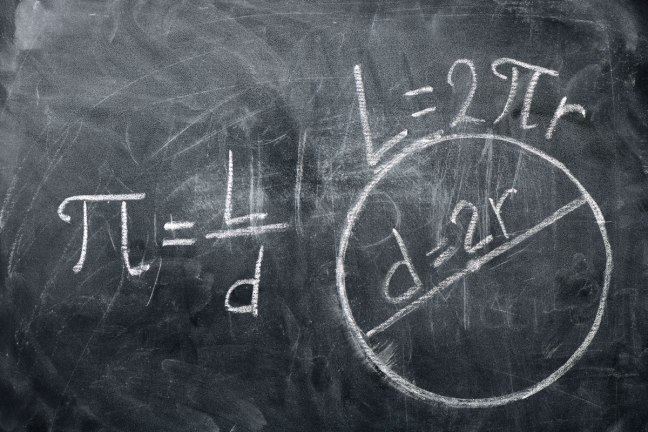
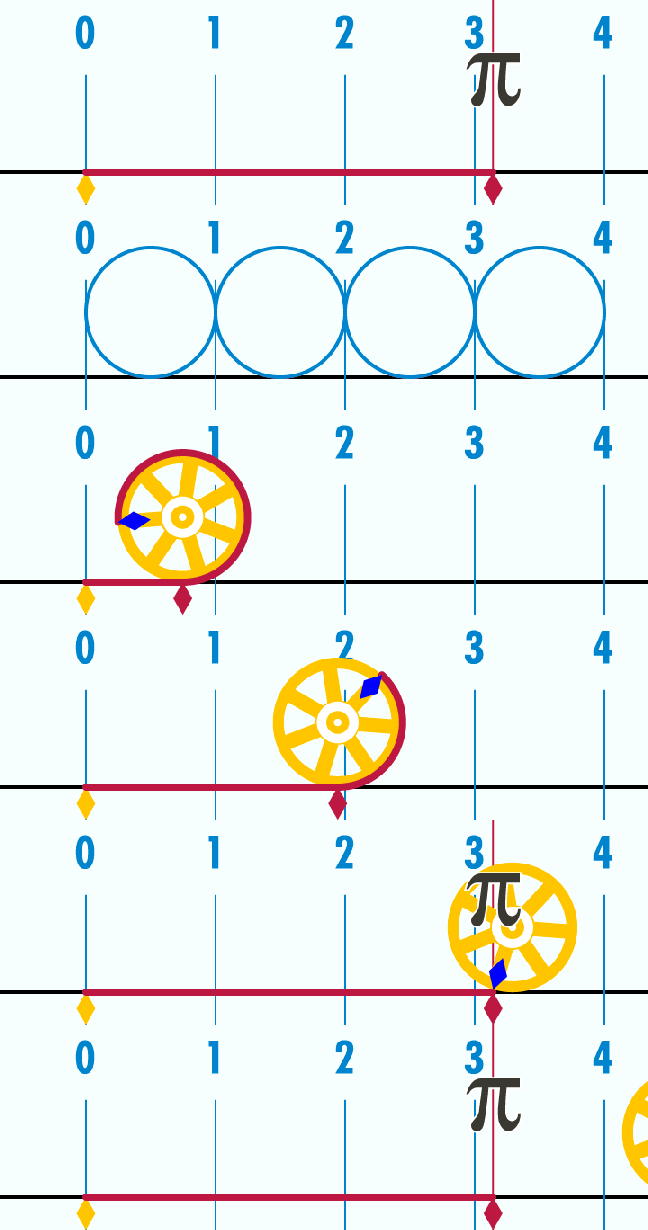
One way to express that perfect roundness in numbers is to compare it to the distance across. How many times would you have to walk back and forth across the middle of the circle to make the same distance as one trip around?
The ratio is the same for every circle, no matter which direction you walk.
That’s pi!
Puzzles with Pi
For all ages:
Sarah Carter created this fun variation on the classic Four 4s puzzle for Pi Day:
Using only the digits 3, 1, 4 once in each calculation, how many numbers can you make?
You can use any math you know: add, subtract, multiply, square roots, factorials, etc. You can concatenate the digits, putting them together to make a two-digit or three-digit number.
1. Imagine the Earth as a perfect sphere with a long rope tightly wrapped around the equator. Then increase the length of the rope by 10 feet, and magically lift it off the Earth to float above the equator. Will an ant be able to squeeze under the rope without touching it? What about a cat? A person?
2. If you ride a bicycle over a puddle of water, the wheels will leave wet marks on the road. Obviously, each wheel leaves a periodic pattern. How the two patterns are related? Do they overlap? Does their relative position depend on the length of the puddle? The bicycle? The size of the wheels?
3. Draw a semicircle. Along its diameter draw smaller semicircles (not necessarily the same size) that touch each other. Because there are no spaces in between, the sum of the diameters of the small semicircles must equal the diameter of the large one. What about their perimeter, the sum of their arc lengths?
4. Choose any smallish number N. How can you cut a circular shape into N parts of equal area with lines of equal lengths, using only a straight-edge and compass? Hint: The lines don’t have to be straight.
Once again, the delightful Nrich Maths website offers a seasonal selection of activities to encourage your children’s (and your own!) mathematical creativity.
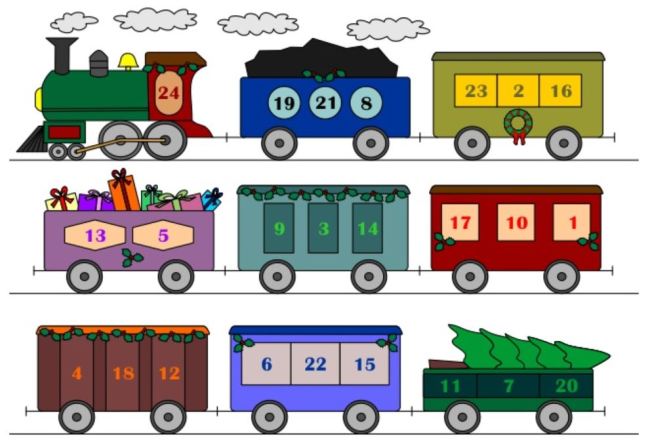
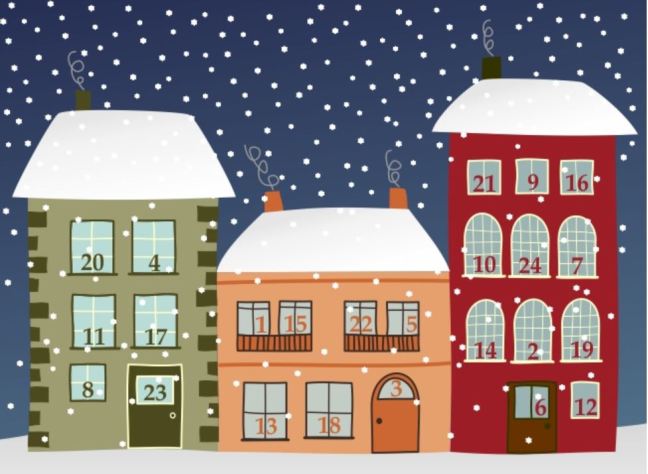
Click the images below to visit the corresponding December Math Calendar pages.
For Primary Students
Here are twenty-four activities for elementary and middle school, one for each day in December during the run-up to Christmas.
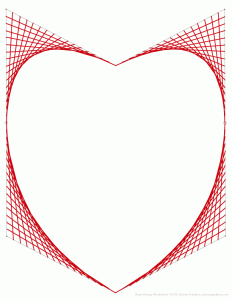
Mary Everest Boole first wrote about string art in her 1904 book, The preparation of the child for science.
My February playful math newsletter went out yesterday morning to all subscribers.
This month’s issue featured a couple of string art projects for Valentine’s Day, the cardioid curve, make-your-own math art, and the link between string art and calculus.
If you didn’t see it, check your Updates or Promotions tab (in Gmail) or your Spam folder. And to make sure you get all the future newsletters, add denise (dot) gaskins (at) tabletopacademypress (dotcom) to your contacts or address book.
Not a subscriber? Don’t miss next month’s playful math activities! Click the link below to sign up today, and we’ll send you our free math and writing booklets, too.
As a Bonus: You’ll receive my 8-week email series “Playful Math for Families” and be one of the first to hear about any new books, revisions, and sales or other promotions

 Here’s a fun little craft that can make the waiting easier, or at least make it easier to keep track of how much longer until the time is right.





 Denise Gaskins' Let's Play Math