Homeschool Memories: Bill Gates Proportions II

Woman on a shopping spree to buy books

Once upon a time, when my kids and I were young…

Later the same year, not too long after our discussion of the Bill Gates proportions, I stumbled on some more data. I discovered that the median American family’s net worth was $93,100 in 2004, most of that being home equity.

This gave me another chance to play around with proportions. And since I was preparing a workshop for our regional homeschooling conference, I wrote a sample problem:

The median American family has a net worth of about $100 thousand. Bill Gates has a net worth of $56 billion. If Average Jane Homeschooler spends $100 in the vendor hall, what would be the equivalent expense for Gates?

In the last post, I explained that a proportion sets two ratios equal to each other, like equivalent fractions. Each ratio must compare similar thing to similar thing in the same order.

In this case, we are interested in the ratio “Expense compared to Net Worth.”

Continue reading Homeschool Memories: Bill Gates Proportions II

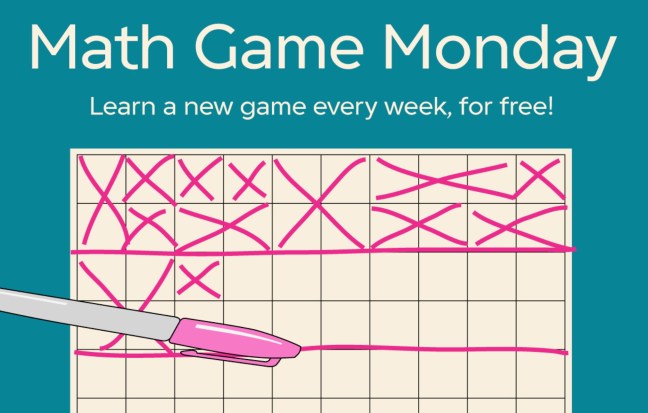
Math Game Monday: Odd–Even–Prime Race

Learn a new math game every week, for free

This game challenges upper-elementary and middle school students to practice strategy and mental math as they race across a number chart.

Many parents remember struggling to learn math. We hope to provide a better experience for our children.

And one of the best ways for children to enjoy learning is through hands-on play.

Odd–Even–Prime Race

Math Concepts: addition, subtraction, multiplication, odd and even, prime and composite numbers, strategic thinking.

Players: two or more.

Equipment: printed hundred chart of your choice, 2 six-sided dice, small toy or token for each player.

Continue reading Math Game Monday: Odd–Even–Prime Race

Homeschool Memories: Putting Bill Gates in Proportion

Money Bag, dollar banknotes and stacked coins on wooden table

Once upon a time…

We were getting ready for the annual homeschool co-op speech contest, and a friend emailed me for help.

“Can you help us figure out how to figure out this problem?

    “This is related to C’s speech. I think we have all the information we need, but I’m not sure:

      “The average household income in the United States is $60,000/year. And a man’s annual income is $56 billion.

        “Is there a way to figure out what this man’s value of a million dollars would be, compared to the person who earns $60,000/year? In other words, I would like to say—$1,000,000 to us is like 10 cents to Bill Gates.”

        We found out later that her son’s numbers weren’t exactly right. He hadn’t understood the difference between income and net worth, so he made Gates sound richer than reality.

        But the basic math principles never change, and it’s fun to play with big numbers.

        Continue reading Homeschool Memories: Putting Bill Gates in Proportion

        Math Game Monday: Blockout

        Learn a new math game every week, for free

        In this game, players practice multiplication facts and use strategic planning as they build 2-D shapes to block their opponent.

        Many parents remember struggling to learn math. We hope to provide a better experience for our children.

        And one of the best ways for children to enjoy learning is through hands-on play.

        Blockout

        Math Concepts: multiplication, area, 2-D shapes.

        Players: two players.

        Equipment: square graph paper (lined or dotty).

        Continue reading Math Game Monday: Blockout

        Math Game Monday: Domino Fraction War

        Learn a new math game every week, for free

        This game offers upper-elementary and middle school students plenty of practice doing estimation and mental math with fractions.

        Many parents remember struggling to learn math. We hope to provide a better experience for our children.

        And one of the best ways for children to enjoy learning is through hands-on play.

        Domino Fraction War

        Math Concepts: proper fractions, comparing fractions.

        Players: two or more.

        Equipment: one set of double-six or double-nine dominoes.

        Continue reading Math Game Monday: Domino Fraction War

        Musings: Math is Communication

        Young boy writing math expressions

        The question came up on a homeschool math forum:

        “My first grader and I were playing with equivalent expressions. We were trying to see how many ways we could write the value ‘3.’

          “He wrote down 10 – 2 × 3 + 1.

            “When I tried to explain the problem with his calculation, he got frustrated and didn’t want to do math.

              “How can I help him understand order of operations?”

              [If you think this sounds like too complex of a math expression for a first grader, you may want to read my blog post about math manipulatives and big ideas.]

              Order of operations doesn’t matter in this instance. What matters is communication.

              The mother didn’t know how to read what her son wrote.

              He could help her understand by putting parentheses around the part he wanted her to read first.

              He doesn’t need to know abstract rules for arbitrary calculations, or all the different ways we might possibly misunderstand each other. He just needs to know how to say what is in his mind.

              Continue reading Musings: Math is Communication

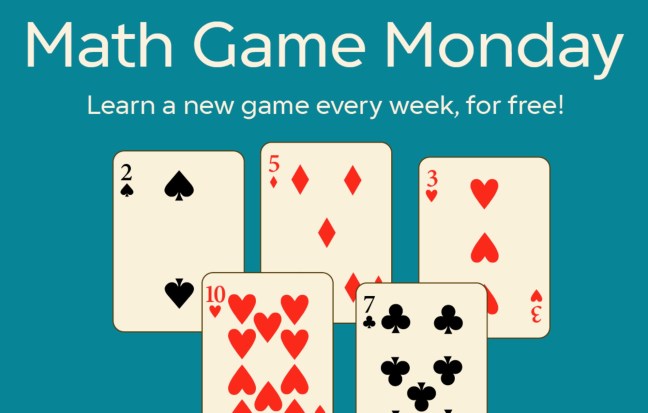
              Math Game Monday: Nine Cards

              Learn a new math game every week, for free

              This game helps young children build mental math skills. And it’s fun for older kids or adults to play along!

              Many parents remember struggling to learn math. We hope to provide a better experience for our children.

              And one of the best ways for children to enjoy learning is through hands-on play.

              Nine Cards

              Math Concepts: addition, number bonds for ten.

              Players: two or more.

              Equipment: one deck of playing cards, face cards and jokers removed.

              Continue reading Math Game Monday: Nine Cards

              FAQ: The Value of Math Rebellion

              Math Rebels fight for truth, justice, and creative reasoning

              I’ve been getting questions about my Math Journaling Adventures books:

              “I’m so excited to try math journaling! We bought your Logbook Alpha, and my 11-year-old math-averse son is trying to be a math rebel at every turn.

                “But I feel uncomfortable with the idea of rebellion. Doesn’t he need to learn how to solve math problems the right way?”

                One of my favorite things about math is that there really is no “right” way to solve math problems.

                As I pointed out in my ongoing Mental Math series, even a problem as basic as 6+8 can be approached from many directions. So perhaps I should say, the “right” way is however the student wants to make sense of the problem.

                In math, sense-making and reasoning are always the most important things.

                Continue reading FAQ: The Value of Math Rebellion

                Math Game Monday: Hidden Hexagon

                Learn a new math game every week, for free

                This game offers a fun twist on the old classic Battleship. Can you discover your opponent’s secret shape before they find yours?

                Many parents remember struggling to learn math. We hope to provide a better experience for our children.

                And one of the best ways for children to enjoy learning is through hands-on play.

                Hidden Hexagon

                Math Concepts: coordinate graphing (first quadrant), simple linear equations, irregular polygons.

                Players: two players or two teams.

                Equipment: printed gameboard or square grid paper for each player, pencils, ruler or other straightedge.

                Continue reading Math Game Monday: Hidden Hexagon

                Mental Math: Do’s and Don’ts

                Father and son working on math homework

                Over the course of this series, we’ve seen how mental math relies on a child’s own creative ways of thinking. In mental math, children develop understanding of how numbers interact with each other in many ways.

                In this way, they learn the true 3R’s of math: to Recognize and Reason about the Relationships between numbers.

                And the principles that underlie mental calculation are also fundamental to algebra, so that flexibility and confidence in mental math is one of the best predictors of success in high school math and beyond.

                But as we went through the various example problems, did you find the written-out calculations hard to follow?

                Don’t force your children to write down their mental math. It looks dreary when I write the calculations out step by step, but that’s not how it works in a child’s mind. With regular practice, this sort of thinking becomes second nature.

                Continue reading Mental Math: Do’s and Don’ts