Musings: Mathematical Beauty

photo of child making footprints on the beach

Memories…

We were eclectic homeschoolers back in the Dark Ages before there was an internet. Our primary curriculum was the public library.

As we went along, I noticed how many of our homeschooling friends felt uncomfortable with math, and even hated or feared the subject.

Math anxiety runs rampant in Western culture. By one researcher’s estimate, more than 90% of adults experience some level of math anxiety — that is, discomfort, avoidance, and even emotional pain when faced with a math calculation.

So I became a sort of “math evangelist” in the homeschooling community, spreading the news that we can find beauty and fun even in math.

Continue reading Musings: Mathematical Beauty

Skit: The Handshake Problem

The handshake problem

If seven people meet at a party, and each person shakes the hand of everyone else exactly once, how many handshakes are there in all?

Our homeschool co-op held an end-of-semester assembly. Each class was supposed to demonstrate something they had learned.

I threatened to hand out a ten question pop quiz on integer arithmetic, but instead my pre-algebra students presented this skit.

Download a Printable Script

Cast

1-3 narrators (or more, if you have a large group)
7 friends (non-speaking parts, adjust to fit your group)

Props

Each friend will need a sheet of paper with a number written on it big and bold enough to be read by the audience. The numbers needed are 0, 1, 2, 3, … up to one less than the number of friends. Each friend keeps his paper in a pocket until needed.

Continue reading Skit: The Handshake Problem

Charlotte Mason Math: Living Books

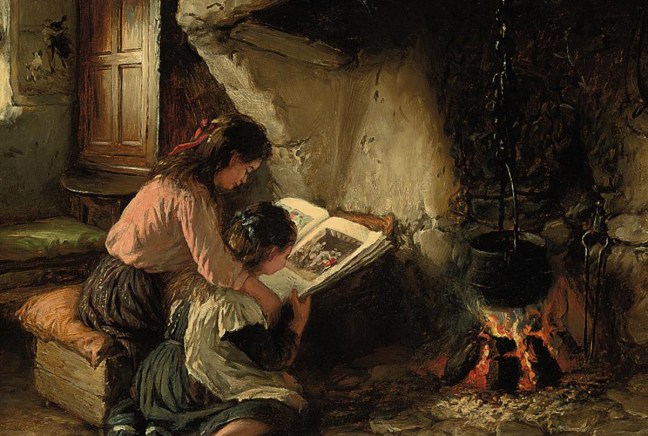
“The Reading Lesson” painting by Jonathan Pratt, public domain

[An addendum to my earlier Charlotte Mason Math series.]

“Our business is to give [children] mind-stuff, and both quality and quantity are essential. Naturally, each of us possesses this mind-stuff only in limited measure, but we know where to procure it; for the best thought the world possesses is stored in books; we must open books to children, the best books; our own concern is abundant provision and orderly serving.”

— Charlotte Mason, Toward A Philosophy of Education

Most homeschool teachers, whatever our curriculum or schooling approach, understand the importance of teaching with living books. We read aloud biographies, historical fiction, or the classics of literature. We scour library shelves for the most creative presentations of scientific topics that interest our children, and encourage our high school students to go back to the original documents whenever possible.

And we teach math with a textbook.

Not that textbooks are inherently bad, because math is an abstract science. We need to meet the ideas  — the “mind-stuff” — of math on their own terms, and textbooks can help with that.

But it’s not enough.

Continue reading Charlotte Mason Math: Living Books

Musings: Math Is a Social Game

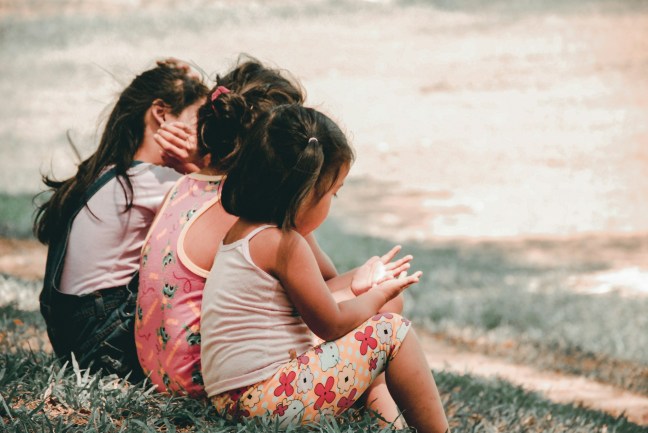
photo of three young girls talking about numbers

Childhood Memories

When I was in school, math was something each person did on their own for homework, quizzes or tests.

Even when the teacher sent us to work on the chalkboard, each person did their own problem. We would never think to collaborate on math.

To look at someone else’s answer was considered cheating.

Continue reading Musings: Math Is a Social Game

Only Two Days Left for Math Journaling Adventures

Math Journaling Adventures series by Denise Gaskins
  • If you’re a parent trying to help your child learn math…
  • Or a teacher looking for creative ideas for your classroom…
  • Or a homeschooling parent hoping to enrich your student’s understanding…

Then you’ll love the Math Journaling Adventures series because these logbooks guide your children to explore mathematics at a deeper level, building a strong foundation to support future learning.

It’s a fun way to enrich any math curriculum, and great for unschoolers, too.

But you have to ACT FAST: The Kickstarter campaign ends in 2 days!

Order Your Copy Today ❯

Continue reading Only Two Days Left for Math Journaling Adventures

Math Journal: Playing with My Own Ignorance

photo of a girl wondering about math

Mary Everest Boole, wife of English mathematician George Boole, once described algebra as “thinking logically about the fact of our own ignorance.”

This definition made me chuckle. Like any human being, I am ignorant on many things, but I usually avoid thinking about that.

So I wondered what would happen if I took Mrs. Boole’s advice and tried thinking logically about my ignorance.

How far could I go?

Perhaps you’d like to try this experiment with your children. All you need is a pen and paper or a whiteboard and markers and a bit of curiosity.

Math Journaling Adventures series by Denise GaskinsAnd if you enjoy this exploration, check out my Math Journaling Adventures project to discover how playful writing activities can help your students learn mathematics. Preorder your books today!

Continue reading Math Journal: Playing with My Own Ignorance

Math Journaling Adventures Launched: Order Your Copy Today

Math Journaling Adventures: Creative Logbooks for All Ages

And so it begins: the Math Journaling Adventures is LIVE on Kickstarter!

Check It Out ❯

⭐ Don’t delay! First-day backers get the best deals. Choose one of the Earlybird rewards:

  • Earlybird 2-Logbook Sets in Digital, Paperback, Spiral-Bound, or Hardcover
  • Earlybird Everything Bundles in Digital or Paperback

To have a successful campaign, we need plenty of people to back the project early. The more supporters we get in these early days, the more likely the Kickstarter platform folks will help spread the news for us.

Continue reading Math Journaling Adventures Launched: Order Your Copy Today

Playful Math 179: Our Sweet Sixteen Carnival

Welcome to the sweet-16 birthday edition of the Playful Math Carnival. Originally called Math Teachers at Play, our first carnival was published in February 2009.

Each Playful Math Carnival offers a smorgasbord of delectable tidbits of mathy fun. It’s like a free online magazine devoted to learning, teaching, and playing around with math from preschool to high school.

There’s so much playful math to enjoy!

By tradition, we start the carnival with a math activity in honor of our 179th edition. But if you’d rather jump straight to our featured blog posts, click here to see the Table of Contents.

NOTE: Our wonderful volunteer hosts have kept the Playful Math Carnival going when so many other blog carnivals died off. If you’d like to sign up to host the carnival for a month, email Denise for information.

Try These Prime Puzzles

Did you know there are 179 even-numbered days this year?

  • How many even-numbered days will there be in a leap year?
  • But there are 365 days in a standard year and 366 in a leap year. Shouldn’t there be half that many even-numbered days?

179 is a prime number, and it’s also a knockout prime. You can knock out any of the digits, and what’s left is still prime: 17, 19, or 79.

  • Can you find another knockout prime number?

179 is a twin prime. That means that one of its odd-numbered neighbors is also prime.

  • Is the other twin 177 or 181? Can you tell without looking it up?
  • Why are twin primes limited to the odd numbers? That doesn’t seem fair!

179 is also an emirp. That’s a special kind of prime that forms a different prime number when you write it backwards: 971 is also prime.

  • How many emirps can you find?

“A palindrome is a word that when written in reverse results in the same word. for example, ‘racecar’ reversed is still ‘racecar’. Related to palindromes are semordnilaps. These are words that when written in reverse result in a distinct valid word. For example, ‘stressed’ written in reverse is ‘desserts’. Not all words are palindromes or semordnilaps.

    “While certainly not all numbers are palindromes, all non-palindromic numbers when written in reverse will form semordnilaps.

      “Narrowing to primes brings back the same trichotomy as with words: some numbers are emirps, some numbers are palindromic primes, but some are neither.”

      The On-Line Encyclopedia of Integer Sequences A006567

      Click here for all the mathy goodness!