Happy Pythagorean Triple Day!

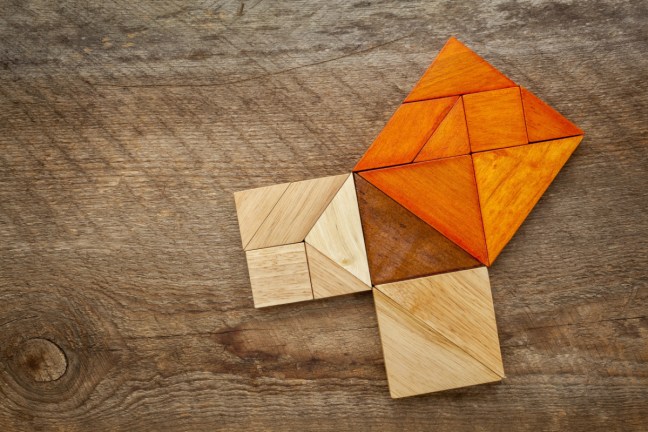
Pythagorean Theorem demonstrated with tangrams

Thursday is Pythagorean Triple Day, one of the rarest math holidays.

The numbers of Thursday’s date: 7/24/25 or 24/7/25, fit the pattern of the Pythagorean Theorem: 7 squared + 24 squared = 25 squared.

Any three numbers that fit the a2 + b2 = c2 pattern form a Pythagorean Triple.

Continue reading Happy Pythagorean Triple Day!

Morning Coffee: What Is Mathematics?

Morning Coffee Lifelong Learning for Parents

One of the best ways we can help our children learn mathematics (or anything else) is to be lifelong learners ourselves.

Here are a few stories to read as you sip your morning brew. . .

Download your printable Morning Coffee journal

This week’s rabbit hole started with a thought-provoking blog post by Sara Van Der Werf…

“We are all mathematicians. We all have the power to notice, describe, and generalize patterns. You have all had this ability since birth.

    “If we believe this then every day we must plan lessons that allow students to act as mathematicians. We must put something in front of our students to notice. We must put something in front of our students to describe, to generalize.”

    —Sara Van Der Werf

    Read more about how to develop mathematical thinking in this fourth installment of professional development for homeschooling parents.

     
    * * *

    Are you looking for more creative ways to play math with your kids? Check out all my books, printable activities, and cool mathy merch at Denise Gaskins’ Playful Math Store. Or join my email newsletter.

    This blog is reader-supported. If you’d like to help fund the blog on an on-going basis, then please join me on Patreon for mathy inspiration, tips, and an ever-growing archive of printable activities.

    “Morning Coffee: What Is Mathematics?” copyright © 2025 by Denise Gaskins. Image at the top of post copyright © Kira auf der Heide / Unsplash.

    Morning Coffee: Anyone Can Learn Math

    Morning Coffee Lifelong Learning for Parents

    One of the best ways we can help our children learn mathematics (or anything else) is to be lifelong learners ourselves.

    Here are a few stories to read as you sip your morning brew:

    Once again, my rabbit hole started with a thought-provoking blog post from Dan Finkel…

    “Not everyone can become a great artist — but a great artist can come from anywhere.”
    —Ego, from Ratatouille

      “Ego’s parsing of the phrase anyone can cook is not obvious, and it’s not really the primary meaning of the phrase. The truth is, there are really three meanings all wrapped up there: anyone can learn to have the joy and pleasure of cooking in their life, even if they don’t become a master chef. Some people will get serious about it. And the visionaries who change the way we think about the art can come from anywhere — lock them out of the field and we all suffer.”
      —Dan Finkel

      Read more about how anyone can learn math in this third installment of professional development for homeschooling parents.

       
      * * *

      Are you looking for more creative ways to play math with your kids? Check out all my books, printable activities, and cool mathy merch at Denise Gaskins’ Playful Math Store. Or join my email newsletter.

      This blog is reader-supported. If you’d like to help fund the blog on an on-going basis, then please join me on Patreon for mathy inspiration, tips, and an ever-growing archive of printable activities.

      “Morning Coffee: Anyone Can Learn Math” copyright © 2025 by Denise Gaskins. Image at the top of post copyright © Kira auf der Heide / Unsplash.

      Math Journal: The 1-2-3 Puzzle

      colorful numbers 1, 2, 3

      Math Journaling Adventures series by Denise GaskinsThere’s still time to check out my Math Journaling Adventures project and discover how playful writing activities will help your students learn mathematics. Preorder your books today!

      Meanwhile, here’s a math puzzle to share with your kids…

      Write down any whole number. It can be a single-digit number, or as big as you like. For example:

      64,861,287,124,425,928

      Now, count up the number of even digits (including zeros), the number of odd digits, and the total number of digits your number contains. Write those counted numbers down in order, like this:

      64,861,287,124,425,928
      even 12, odd 5, total 17

      Continue reading Math Journal: The 1-2-3 Puzzle

      Only Two Days Left for Math Journaling Adventures

      Math Journaling Adventures series by Denise Gaskins
      • If you’re a parent trying to help your child learn math…
      • Or a teacher looking for creative ideas for your classroom…
      • Or a homeschooling parent hoping to enrich your student’s understanding…

      Then you’ll love the Math Journaling Adventures series because these logbooks guide your children to explore mathematics at a deeper level, building a strong foundation to support future learning.

      It’s a fun way to enrich any math curriculum, and great for unschoolers, too.

      But you have to ACT FAST: The Kickstarter campaign ends in 2 days!

      Order Your Copy Today ❯

      Continue reading Only Two Days Left for Math Journaling Adventures

      Podcast: Using Math Journals and Games

      mother and daughter math journaling

      I have a new podcast interview, and I think you’ll enjoy it!

      Check out Cindy Rollins’s The New Mason Jar on your favorite podcast app, or listen on the website:

      Go to the podcast ❱

      Here’s an excerpt…

      Writing to Learn

      Just as a nature journal records our children’s explorations and discoveries in nature, so a math journal tracks our children’s explorations in the world of mathematics.

        In a math journal, children record their experiences with numbers, shapes, and patterns through drawing or writing. Journaling teaches them to see with mathematical eyes — not just to remember what we adults tell them, but to create their own math.

          The process of writing forces children to pin down their thoughts, to transform nebulous concepts into firm ideas, to struggle with vagueness and build understanding.

            As William Zinsser says in his book Writing to Learn: “Writing is how we think our way into a subject and make it our own. Writing enables us to find out what we know, and what we don’t know.”

              Through journaling, children develop a richer mathematical mindset. They begin to see connections and grow confident in their ability to think through new problems.

              We had a great discussion! Listen to the whole thing:

              Go to the podcast ❱

               
              * * *

              Are you looking for more creative ways to play math with your kids? Check out all my books, printable activities, and cool mathy merch at Denise Gaskins’ Playful Math Store. Or join my free email newsletter.

              This blog is reader-supported. If you’d like to help fund the blog on an on-going basis, then please join me on Patreon for mathy inspiration, tips, and an ever-growing archive of printable activities.

              “Podcast: Using Math Journals and Games” copyright © 2025 by Denise Gaskins. Image at the top of the post copyright © AntonLozovoy / Depositphotos.

              Math Journal: Three Quick Number Games

              photo of family playing a dice game

              Math Journaling Adventures Kickstarter projectHere are three quick math games you can fit in whenever you have a few minutes’ free time. Have fun playing math with your kids!

              And if you enjoy these games, check out my Math Journaling Adventures project to discover how similar playful writing activities can help your students learn mathematics. Preorder your books today!

              Continue reading Math Journal: Three Quick Number Games

              Math Journal: Playing with My Own Ignorance

              photo of a girl wondering about math

              Mary Everest Boole, wife of English mathematician George Boole, once described algebra as “thinking logically about the fact of our own ignorance.”

              This definition made me chuckle. Like any human being, I am ignorant on many things, but I usually avoid thinking about that.

              So I wondered what would happen if I took Mrs. Boole’s advice and tried thinking logically about my ignorance.

              How far could I go?

              Perhaps you’d like to try this experiment with your children. All you need is a pen and paper or a whiteboard and markers and a bit of curiosity.

              Math Journaling Adventures series by Denise GaskinsAnd if you enjoy this exploration, check out my Math Journaling Adventures project to discover how playful writing activities can help your students learn mathematics. Preorder your books today!

              Continue reading Math Journal: Playing with My Own Ignorance

              Morning Coffee: When Math Makes You Feel Stupid

              Morning Coffee Lifelong Learning for Parents

              One of the best ways we can help our children learn mathematics (or anything else) is to be lifelong learners ourselves.

              Here are a few stories to read as you sip your morning brew. . .

              Download your printable Morning Coffee journal

              This week’s rabbit hole started with a thought-provoking newsletter from Dan Finkel, which led me to his blog…

              “Everyone who learns math is familiar with the experience of being stuck on some new idea or problem, banging their head against it, and then, when they finally understand the answer (or having someone tell them), feeling stupid. There’s something fundamental in the nature of mathematics that makes it easy once you get it, and impossible before.

                “These jumps in comprehension can be thrilling, and they’re one reason math is so fun. But they do create a challenge for the student. The evidence that you learned something hard is that you feel like you’re stupid. That stupidity is essential to the process. Students need to know this feeling is the norm when it comes to learning math.”

                —Dan Finkel and Katherine Cook, The centrality of stupidity in mathematics

                Read more about the value of feeling stupid in this second installment of professional development for homeschooling parents.

                 
                * * *

                Are you looking for more creative ways to play math with your kids? Check out all my books, printable activities, and cool mathy merch at Denise Gaskins’ Playful Math Store. Or join my email newsletter.

                This blog is reader-supported. If you’d like to help fund the blog on an on-going basis, then please join me on Patreon for mathy inspiration, tips, and an ever-growing archive of printable activities.

                “Morning Coffee: When Math Makes You Feel Stupid” copyright © 2025 by Denise Gaskins. Image at the top of post copyright © Kira auf der Heide / Unsplash.

                Why I Love the Math Journaling Adventures Series

                Mother and daughter doing homework outdoors

                Math Journaling Adventures series by Denise GaskinsMy Math Journaling Adventures Series is now available on Kickstarter.

                I love these books!

                Writing is one of the best ways to learn math deeply, because wrestling our thoughts into words forces us to figure out what we really believe.

                It’s the natural, no-stress way to build our children’s understanding and confidence.

                Hit the button to visit the campaign and order your books:

                Math Journaling Adventures Kickstarter ❯

                Continue reading Why I Love the Math Journaling Adventures Series