Why I Love the Math Journaling Adventures Series

Mother and daughter doing homework outdoors

Math Journaling Adventures series by Denise GaskinsMy Math Journaling Adventures Series is now available on Kickstarter.

I love these books!

Writing is one of the best ways to learn math deeply, because wrestling our thoughts into words forces us to figure out what we really believe.

It’s the natural, no-stress way to build our children’s understanding and confidence.

Hit the button to visit the campaign and order your books:

Math Journaling Adventures Kickstarter ❯

Continue reading Why I Love the Math Journaling Adventures Series

Math Journaling Adventures Launched: Order Your Copy Today

Math Journaling Adventures: Creative Logbooks for All Ages

And so it begins: the Math Journaling Adventures is LIVE on Kickstarter!

Check It Out ❯

⭐ Don’t delay! First-day backers get the best deals. Choose one of the Earlybird rewards:

  • Earlybird 2-Logbook Sets in Digital, Paperback, Spiral-Bound, or Hardcover
  • Earlybird Everything Bundles in Digital or Paperback

To have a successful campaign, we need plenty of people to back the project early. The more supporters we get in these early days, the more likely the Kickstarter platform folks will help spread the news for us.

Continue reading Math Journaling Adventures Launched: Order Your Copy Today

Coming Soon: Math Journaling Adventures

Math Journaling Adventures Kickstarter

Coming Soon! On March 3, I’ll be launching the first installment in my new book series, the Math Journaling Adventures.

You’ll love these books because they make creative math investigations open-and-go for busy parents and teachers.

And the Kickstarter prelaunch page is now live. That means you can sign up to get an email from Kickstarter as soon as the campaign launches:

Visit the Prelaunch Page ❯

If you back the campaign on launch day, you can catch a great deal with the Earlybird discount pledge levels.

Continue reading Coming Soon: Math Journaling Adventures

Morning Coffee: Professional Development for Homeschooling Parents and Other Teachers

Morning Coffee Lifelong Learning for Parents

Lately, I’ve spent most of my writing time thinking about the value of narration—the Charlotte Mason approach to teaching by getting kids to put ideas in their own words.

For students, I’m writing a new series of Math Adventure Journals to get them thinking about math and putting those thoughts into words. If you’re interested, sign up to be notified when the Kickstarter goes live.

But we parents can harness the value of narration in our own learning. After all, one of the best ways we can help our children learn mathematics (or anything else) is to be lifelong learners ourselves.

To that end, I’ve decided to relaunch my “Morning Coffee” series of professional development posts for homeschooling parents.

Continue reading Morning Coffee: Professional Development for Homeschooling Parents and Other Teachers

Why Thinking Thursday?

Thinking Thursday math journal prompt

There’s a new math journaling prompt this week.

Have your kids tried it yet?

This week’s prompt features one of my favorite quotations to get kids thinking (and writing) about the value of mistakes in learning. Or you might prefer last week’s prompt, featuring a classic math brainteaser and encouraging students to create their own related puzzles.

Or, if you’re reading this post later and missed those, there’s another great new prompt this week for you to explore.

Check it out:

Visit Thinking Thursday

Continue reading Why Thinking Thursday?

Playful Math Carnival #154: The Math Journaling Edition

Welcome to the 154th edition of the Playful Math Education Blog Carnival — a smorgasbord of delectable tidbits of mathy fun. It’s like a free online magazine devoted to learning, teaching, and playing around with math from preschool to high school.

Bookmark this post, so you can take your time browsing.

There’s so much playful math to enjoy!

By tradition, we start the carnival with a puzzle/activity in honor of our 154th edition. But if you’d rather jump straight to our featured blog posts, click here to see the Table of Contents.

Try This Puzzle/Activity

Since 154 is a nonagonal number, I think you might enjoy visiting some of my old “Adventures of Alexandria Jones” posts about figurate numbers:

And then try this math journaling prompt: Build or draw your own nonagonal numbers — numbers built from 9-sided polygons.

How many nonagonal numbers can you find? What do you notice? Does it make you wonder?

Click here for all the mathy goodness!

How To Respond to Your Child’s Math Writing

In previous posts, I encouraged parents, homeschoolers, and teachers to explore the world of math and introduced one of my favorite learning tools, the math journal. Then I shared several of my favorite types of journaling prompts to get your kids started writing about math.

Math journal prompts offer a wide range of options for students to explore. Most of the prompts do not have a “right” or “wrong” answer. Our goal is to root around in some small corner of the world of math, to lift a stone and peek underneath it, just to see what we can find.

The idea that being good at math means finding the right answers is a huge myth. Of course, many problems in math do have a single right answer. But even for those problems, the answer is not the real math of the problem.

Math is all about thinking.

It’s like taking a road trip. You may have a destination, but there are many paths you could take to get there. Different students may take different paths — they may think about the problem in different ways.

It’s this reasoning that is the real math, and the right answer is just a side effect of reasoning well.

Continue reading How To Respond to Your Child’s Math Writing

It’s Here! Math Journaling for All Ages

“Denise Gaskins’s work is consistently lovely and playful, so go check it out if you do any journaling or any other sort of mathematical writing with children.”

—Christopher Danielson, author of Which One Doesn’t Belong?

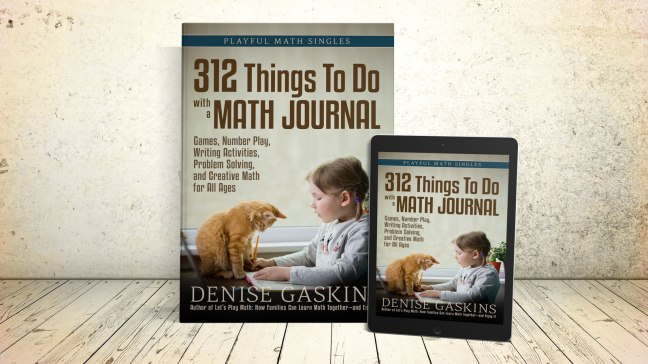
It’s finally here! 312 Things To Do with a Math Journal includes number play prompts, games, math art, story problems, mini-essays, geometry investigations, brainteasers, number patterns, research projects, and much more.
These activities work at any grade level, and most can be enjoyed more than once. It doesn’t matter whether your students are homeschooled or in a classroom, distance-learning, or in person. Everyone can enjoy the experience of playing around with math.

Get It Now in Ebook or Paperback

Get Your Copy Today!

5 Ways To Enrich Your Student’s Experience of Math

In previous posts, I encouraged parents, homeschoolers, and teachers to explore the world of math and introduced one of my favorite learning tools, the math journal.

But you may be wondering, what can my students do with their journal? How do I find good math prompts?

Here are five different ways your children can explore math through writing, classified by the type of reasoning involved.

#1: Game Prompts

Ask your children to play a number or strategy game and then write about it.

Game prompts break through the idea that math is dull and boring. They help students develop a positive attitude toward math while practicing their number skills or strategic thinking.

Continue reading 5 Ways To Enrich Your Student’s Experience of Math

What Is a Math Journal?

In my previous post, I encouraged parents, homeschoolers, and teachers to think of math as a nature walk through an infinite world of wonder.

A math journal is a record of your child’s journey through this world of mathematics.

In a math journal, children explore their own concepts about numbers, shapes, and patterns through drawing or writing in response to a question. Journaling teaches them to see with mathematical eyes — not just to remember what we adults tell them, but to create their own math.

Journaling brings math back into the liberal arts. It makes abstract ideas accessible and stretches children’s understanding, building math fluency and creating a solid foundation for future learning.

Continue reading What Is a Math Journal?