Trouble with Times Tables

[feature photo above by dsb nola via flickr.]

Food for thought:

Imagine that you wanted your children to learn the names of all their cousins, aunts and uncles. But you never actually let them meet or play with them. You just showed them pictures of them, and told them to memorize their names.

Each day you’d have them recite the names, over and over again. You’d say, “OK, this is a picture of your great-aunt Beatrice. Her husband was your great-uncle Earnie. They had three children, your uncles Harpo, Zeppo, and Gummo. Harpo married your aunt Leonie … yadda, yadda, yadda.

— Brian Foley
Times Tables – The Worst Way to Teach Multiplication

On the other hand, if you want your children to develop relationships with the numbers, to learn the math facts naturally, then be sure to tell lots of math stories. And when you are ready to focus on multiplication, be sure to study the patterns and relationships within the times tables.

PUFM 1.5 Multiplication, Part 1

Photo by Song_sing via flickr. In this Homeschooling Math with Profound Understanding (PUFM) Series, we are studying Elementary Mathematics for Teachers and applying its lessons to home education.

My apologies to those of you who dislike conflict. This week’s topic inevitably draws us into a simmering Internet controversy.

Thinking my way through such disputes helps me to grow as a teacher, to re-think on a deeper level concepts that I thought I understood. This is why I loved Liping Ma’s book when I first read it, and it’s why I thoroughly enjoyed Terezina Nunes and Peter Bryant’s book Children Doing Mathematics.

repeatedaddition

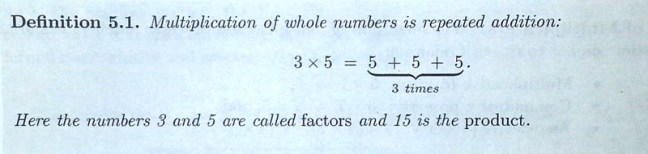
Multiplication of whole numbers is defined as repeated addition…

— Thomas H. Parker & Scott J. Baldridge
Elementary Mathematics for Teachers

Multiplication simply is not repeated addition, and telling young pupils it is inevitably leads to problems when they subsequently learn that it is not… Adding numbers tells you how many things (or parts of things) you have when you combine collections. Multiplication is useful if you want to know the result of scaling some quantity.

— Keith Devlin
It Ain’t No Repeated Addition

Continue reading PUFM 1.5 Multiplication, Part 1

Multiplication Challenge

Can you explain why the multiplication method in the following video works? How about your upper-elementary or middle school students — can they explain it to you?

Pause the video at 4:30, before he gives the interpretation himself. After you have decided how you would explain it, hit “play” and listen to his explanation.

Continue reading Multiplication Challenge

How to Conquer the Times Table, Part 5

Photo of Lex times 11, by Dan DeChiaro, via flickr.

We are finishing up an experiment in mental math, using the world’s oldest interactive game — conversation — to explore multiplication patterns while memorizing as little as possible.

Take your time to fix each of these patterns in mind. Ask questions of your student, and let her quiz you, too. Discuss a variety of ways to find each answer. Use the card game Once Through the Deck (explained in part 3)as a quick method to test your memory. When you feel comfortable with each number pattern, when you are able to apply it to most of the numbers you and your child can think of, then mark off that row and column on your times table chart.

So far, we have studied the times-1 and times-10 families and the Commutative Property (that you can multiply numbers in any order). Then we memorized the doubles and mastered the facts built on them. And then last time we worked on the square numbers and their next-door neighbors.

Continue reading How to Conquer the Times Table, Part 5

How to Conquer the Times Table, Part 4

Photo of Miss Karen (and computer) times 3, by Karen, via flickr.

If you remember, we are in the middle of an experiment in mental math. We are using the world’s oldest interactive game — conversation — to explore multiplication patterns while memorizing as little as possible. So far, we have studied the times-1 and times-10 families and the Commutative Property (that you can multiply numbers in any order). Then we memorized the doubles and mastered the facts built on them.

Continue reading How to Conquer the Times Table, Part 4

How to Conquer the Times Table, Part 3

Photo of Javier times 4, by Javier Ignacio Acuña Ditzel, via flickr.

If you remember, we are in the middle of an experiment in mental math. We are using the world’s oldest interactive game — conversation — to explore multiplication patterns while memorizing as little as possible. Talk through these patterns with your student. Work many, many, many oral math problems together. Discuss the different ways you can find each answer, and notice how the number patterns connect to each other.

So far, we have mastered the times-1 and times-10 families and the Commutative Property (that you can multiply numbers in any order).

Continue reading How to Conquer the Times Table, Part 3

How to Conquer the Times Table, Part 2

Photo of Eeva times 6, by Eric Horst, via flickr.

The question is common on parenting forums:

My daughter is in 4th grade. She has been studying multiplication in school for nearly a year, but she still stumbles over the facts and counts on her fingers. How can I help her?

Many people resort to flashcards and worksheets in such situations, and computer games that flash the math facts are quite popular with parents. I recommend a different approach: Challenge your student to a joint experiment in mental math. Over the next two months, without flashcards or memory drill, how many math facts can the two of you learn together?

We will use the world’s oldest interactive game — conversation — to explore multiplication patterns while memorizing as little as possible.

Continue reading How to Conquer the Times Table, Part 2

How to Conquer the Times Table, Part 1

Photo of Evil Erin times 5 (and dog times 2), via flickr.

Perhaps the biggest challenge for any middle-elementary math student is to master the multiplication facts. It can seem like an unending task to memorize so many facts and be able to pull them out of mental storage in any order on demand. Too often, the rote aspect of such memory work overwhelms students, eclipsing their view of the principles behind the math. Yet rote memory is not enough: A student may be able to recite the times tables perfectly and still be reduced to counting on fingers in the middle of a long division problem.

We will use the world’s oldest interactive game — conversation — to learn the multiplication facts one bite at a time. But first, let’s take some time to think about what multiplication really means.

Continue reading How to Conquer the Times Table, Part 1

Game: Times Tac Toe

Photo by jma.work via flickr.

I’ve been working on a book of math games for homeschoolers and other teachers. I hope to get it published later this year, but the editing drags on. Would anybody like to draw the illustrations?

Meanwhile, here’s a 2-player game your students may enjoy…

Set Up

Print out a blank times table chart and place it between the players. Each player will need a colored marker, and the colors must be different enough to be easily distinguished.

Remove the jokers and kings from a deck of poker-style playing cards, but leave the jacks (= 11) and queens (= 12). Shuffle the deck, and place the stack face down as a draw pile.

Continue reading Game: Times Tac Toe