Playing Complex Fractions with Your Kids

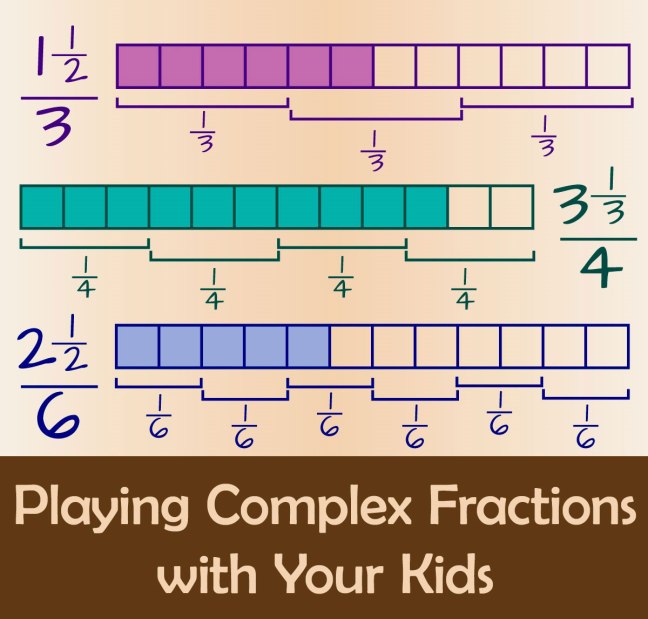
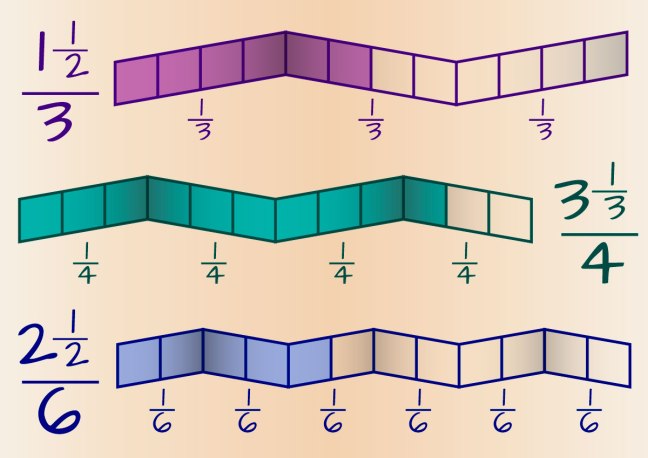
This week, I’m working on graphics for my upcoming book 70+ Things to Do with a Hundred Chart. I had fun with this complex fraction image.

It looks a bit cluttered. Possible tweak: Remove the brackets and instead use a thicker dividing line to show the thirds.

While I’m thinking about that, would you like a sneak peek at an activity from the book?

Make Your Own Math

You don’t need a set of worksheets or lesson plans to learn math. All you need is an inquiring mind and something interesting to think about.

Play. Discuss. Notice. Wonder.

Enjoy.

Here’s how you can play complex fractions with your kids…

Start with Fraction Strips
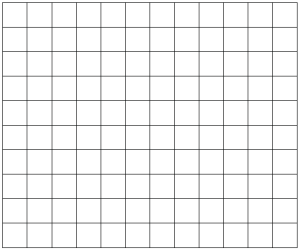
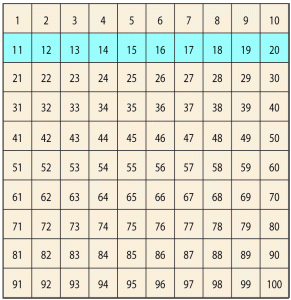
Print a few blank 120 charts and turn them sideways, so each chart has ten rows with twelve squares in each row.

Cut out the rows to make fraction strips with twelve squares on each strip.

Color a different set of squares on each strip. On some strips, arrange the colored squares all together at one end. On other strips, mix them around.

If we count each strip as one whole thing, what fraction of its squares are colored?

Match the strips that represent the same fraction.

On some of the strips, there will be more than one way to name the fraction. For example, if six squares are colored, we can call that 6/12 or 2/4 or 1/2 of the strip. These alternate names are easiest to see when the colored squares are all at one end of the strip, because you can fold the strip to show the halves or fourths.

How many different fraction names can you find for each set of colored squares?

Look for Complex Fractions

We could also call the strip with six colored squares “1 1/2 thirds” of the whole strip. Can you show by folding why that name makes sense?

Or we could call the strip with five colored squares “2 1/2 sixths.”

When we have a fraction within a fraction like this, we call it a complex fraction, because it is more complicated than a common (or simple) fraction.

Another way to say it: Complex fractions have other fractions inside them.

A complex fraction is like a puzzle, challenging us to find its secret identity — the common fraction that names the same amount of stuff.

For example, how much is 3 1/3 fourths? One fourth would be three of the twelve squares on a fraction strip. So three fourths would be three sets of those three squares, or nine squares. Then we need to add one-third of the final fourth, which is one of the remaining three squares. So 3 1/3 fourths must be ten squares in all.

3 1/3 fourths = 10/12 = 5/6

How many complex fractions can you find in your set of fraction strips?
Challenge Puzzles

Can you figure out how much a one-and-a-halfth would be?

That is one piece, of such a size that it takes one and one-half pieces to make a complete fraction strip.

A one-and-a-halfth is a very useful fraction and was a favorite of the ancient Egyptian scribes, who used it to solve all sorts of practical math problems.

How about a one-and-a-thirdth? How many of those pieces make a whole strip? What common fraction names the same amount of stuff?

Or how much would a two-thirdth be? In that case, it only takes two-thirds of a piece to make a complete strip. So the whole piece must be greater than one. A two-thirdth’s secret identity is a mixed number. Can you unmask it?

Make up some challenge fraction mysteries of your own.

Complex2

Update…

I’m still working on the graphics for my hundred chart book. Here’s the latest version of the complex fraction strips.

I like this one much better.

What do you think?
CREDITS: The slogan “Make Math Your Own” comes from Maria Droujkova, founder and director of the Natural Math website. Maria likes to say: “Make math your own, to make your own math!”

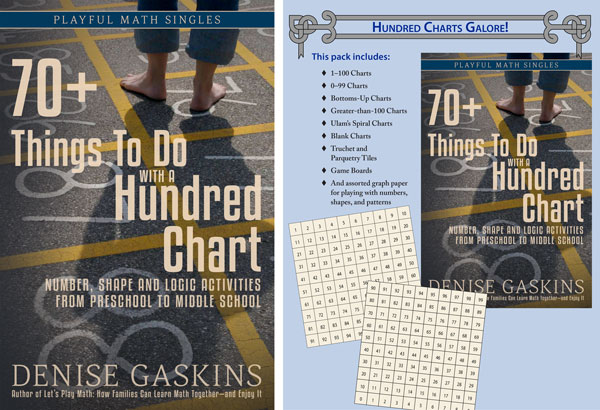
70+ Things to Do with a Hundred Chart is now available from Tabletop Academy Press.
Math Journals for Elementary and Middle School

This fall, my homeschool co-op math class will play with math journaling.

But my earlier dot-grid notebooks were designed for adults. Too thick, too many pages. And the half-cm dot grid made lines too narrow for young writers.

So I created a new series of paperback dot-grid journals for my elementary and middle school students.

I hope you enjoy them, too!

Click here for more information

Math Journaling Prompts

So, what can your kids do with a math journal?

Here are a few ideas: 

I’m sure we’ll use several of these activities in my homeschool co-op math class this fall.

Noticing and Wondering

Learning math requires more than mastering number facts and memorizing rules. At its heart, math is a way of thinking.

So more than anything else, we need to teach our kids to think mathematically — to make sense of math problems and persevere in figuring them out.

Help your children learn to see with mathematical eyes, noticing and wondering about math problems.

Whenever your children need to learn a new idea in math, or whenever they get stuck on a tough homework problem, that’s a good time to step back and make sense of the math.

Kids can write their noticings and wonderings in the math journal. Or you can act as the scribe, writing down (without comment) everything child says.

For more tips on teaching students to brainstorm about math, check out these online resources from The Math Forum:

Problem-solving is a habit of mind that you and your children can learn and grow in. Help your kids practice slowing down and taking the time to fully understand a problem situation.

Puzzles Are Math Experiments

Almost anything your child notices or wonders can lead to a math experiment.

For example, one day my daughter played an online math game…

a math experiment
Click the image to read about my daughter’s math experiment.

A math journal can be like a science lab book. Not the pre-digested, fill-in-the-blank lab books that some curricula provide. But the real lab books that scientists write to keep track of their data, and what they’ve tried so far, and what went wrong, and what finally worked.

Here are a few open-ended math experiments you might try:

Explore Shapes
  • Pick out a 3×3 set of dots. How many different shapes can you make by connecting those dots? Which shapes have symmetry? Which ones do you like the best?
  • What if you make shapes on isometric grid paper? How many different ways can you connect those dots?
  • Limit your investigation to a specific type of shape. How many different triangles can you make on a 3×3 set of dots? How many different quadrilaterals? What if you used a bigger set of dots?
Explore Angles

  • On your grid paper, let one dot “hold hands” with two others. How many different angles can you make? Can you figure out their degree without measuring?
  • Are there any angles you can’t make on your dot grid? If your paper extended forever, would there be any angles you couldn’t make?
  • Does it make a difference whether you try the angle experiments on square or isometric grid paper?
Explore Squares
  • How many different squares can you draw on your grid paper? (Don’t forget the squares that sit on a slant!) How can you be sure that they are perfectly square?
  • Number the rows and columns of dots. Can you find a pattern in the corner positions for your squares? If someone drew a secret square, what’s the minimum information you would need to duplicate it?
  • Does it make a difference whether you try the square experiments on square or isometric grid paper?

Or Try Some Math Doodles

Create math art. Check out my math doodling collection on Pinterest and my Dot Grid Doodling blog post. Can you draw an impossible shape?

How Would YOU Use a Math Journal?

I’d love to hear your favorite math explorations or journaling tips!

Please share in the comments section below.

 
* * *

P.S.: Do you have a blog? If you’d like to feature a math journal review and giveaway, I’ll provide the prize. Send a message through my contact form or leave a comment below, and we’ll work out the details.

This blog is reader-supported.

If you’d like to help fund the blog on an on-going basis, then please head to my Patreon page.

If you liked this post, and want to show your one-time appreciation, the place to do that is PayPal: paypal.me/DeniseGaskinsMath. If you go that route, please include your email address in the notes section, so I can say thank you.

Which I am going to say right now. Thank you!

“Math Journals for Elementary and Middle School” copyright © 2018 by Denise Gaskins. Photos of children © original artists / Pixabay.

Math Debate: Adding Fractions

Cover image by Thor/ geishaboy500 via Flickr (CC BY 2.0)

I’ve been working on my next Playful Math Singles book, based on the popular Things to Do with a Hundred Chart post.

My hundred chart list began many years ago as seven ideas for playing with numbers. Over the years, it grew to its current 30+ activities.

Now, in preparing the new book, my list has become a monster. I’ve collected almost 70 ways to play with numbers, shapes, and logic from preschool to middle school. Just yesterday I added activities for fraction and decimal multiplication, and also tips for naming complex fractions. Wow!

Gonna have to edit that cover file…

In the “Advanced Patterns” chapter, I have a section on math debates. The point of a math debate isn’t that one answer is “right” while the other is “wrong.” You can choose either side of the question — the important thing is how well you support your argument.

Here’s activity #69 in the current book draft.

Have a Math Debate: Adding Fractions

When you add fractions, you face a problem that most people never consider. Namely, you have to decide exactly what you are talking about.

For instance, what is one-tenth plus one-tenth?

1/10 of 100

Well, you might say that:

\frac{1}{10}  of one hundred chart
+ \frac{1}{10}  of the same chart
= \frac{2}{10}  of that hundred chart

But, you might also say that:

\frac{1}{10}  of one chart
+ \frac{1}{10}  of another chart
= \frac{2}{20}  of the pair of charts

That is, you started off counting on two independent charts. But when you put them together, you ended up with a double chart. Two hundred squares in all. Which made each row in the final set worth \frac{1}{20}  of the whole pair of charts.

So what happens if you see this question on a math test:

\frac{1}{10}  + \frac{1}{10}  = ?

If you write the answer “\frac{2}{20}”, you know the teacher will mark it wrong.

Is that fair? Why, or why not?

CREDITS: Feature photo (above) by Thor/geishaboy500 via Flickr (CC BY 2.0). “One is one … or is it?” video by Christopher Danielson via TED-Ed. This math debate was suggested by Marilyn Burns’s blog post Can 1/3 + 1/3 = 2/6? It seemed so!

Let’s Play Math in Korean

Ooo, look at my shiny new book! Let’s Play Math is now out in Korean. How cool is that?

You can find the book at these two major bookstores:

And probably in other places where Korean education or parenting books are sold.

I’m sorry to say I can’t read Korean — but I did play math there a couple years back. My daughter teaches English through EPIK, and I had a wonderful visit with her in Jeju. If you’re interested, you can see a few of my photos here, and my fraction-math sidewalk puzzle here.

And if you know a Korean-speaking family who wants to play math with their kids, I’d be honored if you share my book.

New Book: Word Problems from Literature

The posts on my Let’s Play Math blog are, for the most part, first-draft material. Of course, I’ve proofread each post — many times! because I’m a perfectionist that way, and yet I still miss typos :-/ — but these articles haven’t gotten the sort of feedback that polishes a book manuscript.
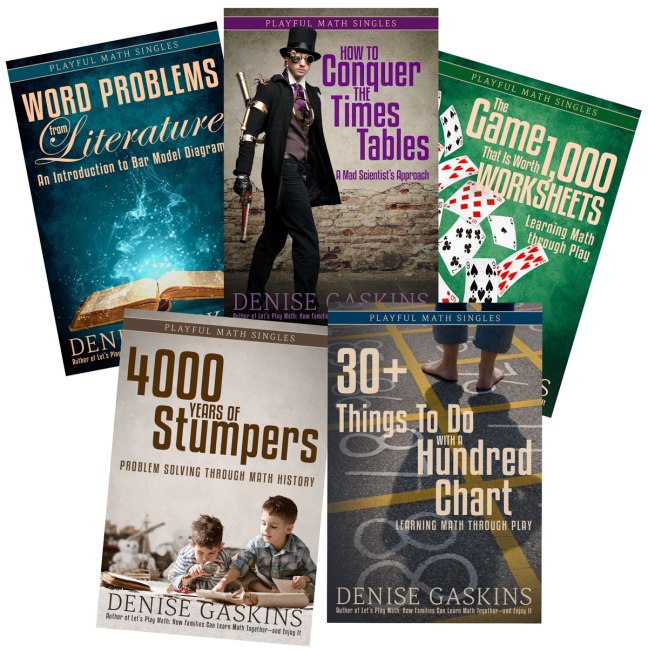
Well, now I’m taking some of the best of my old blog posts, expanding them with a few new games or activities, and giving them that book-quality polish. Let me introduce my newest series, the Playful Math Singles.

Under Construction …

The Playful Math Singles from Tabletop Academy Press will be short, topical books featuring clear explanations and ready-to-play activities.

I’m hoping to finish up two or three of these this year. Watch for them at your favorite online bookstore.

The first one is done …

Word Problems from Literature: An Introduction to Bar Model Diagrams

You can help prevent math anxiety by giving your children the mental tools they need to conquer the toughest story problems.

Young children expect to look at a word problem and instantly see the answer. But as they get older, their textbook math problems also grow in difficulty, so this solution-by-intuitive-leap becomes impossible.

Too often the frustrated child concludes, “I’m just not good at math.”

But with guided practice, any student can learn to master word problems.

Word Problems from Literature features math puzzles for elementary and middle school students from classic books such as Mr. Popper’s Penguins and The Hobbit.

For each puzzle, I demonstrate step by step how to use the problem-solving tool of bar model diagrams, a type of pictorial algebra. For children who are used to playing with Legos or other blocks — or with computer games like Minecraft — this approach reveals the underlying structure of a math word problem. Students can make sense of how each quantity in the story relates to the others and see a path to the solution.

And when you finish the puzzles in this book, I’ll show you how to create your own word problems from literature, based in your children’s favorite story worlds.

Buy now at your favorite online bookstore.

If you’re using these word problems with your children, consider buying them the paperback companion Word Problems from Literature Student Workbook.

… and People Like It!

A screen shot from this past weekend:

“I found this method really clarified for me what was going on visually and conceptually. Particularly when it came to more complex questions, for which I would normally write out an equation, I felt that thinking about what was going on with the bars actually made more sense … This is a wonderful book for those who want to support their children in finding better ways to work on word problems.”

—Miranda Jubb, Amazon customer reviewer

How To Break In Your New Math Journal

I love my new paperback math journal series. The books are sturdy, inexpensive, and fit nicely in my purse.

But as with any paperback book, these have one problem. How do I use them without cracking the spine?

When we exercise, we need to warm up our bodies with a bit of stretching to prevent injury. In the same way, we need to warm up a new book to protect it. The process is called “breaking it in.”

It only takes a few minutes to break in a paperback book:

Step by Step

Never force the book but help it limber up gradually, and it will serve you well.

Because my journals are working books, I take the breaking-in process a bit further than shown in the video:

(1) Set the book on its back and follow the process above. Press down each cover, but not completely flat — let it bend at the fold line, about 1 cm from the actual spine. Then press a couple pages at a time, alternating front and back, down flat on each cover.

(2) Flip through the pages of the book forward and backward to limber them up.

(3) Repeat the steps of the video. This time, gently lean the main part of the book away from the part you are pressing down. Aim for a 130–140 degree angle.

(4) Flip through the pages again. For paperbacks, you can even roll the whole book back and forth a bit — gently curving the cover and pages almost as if you’re trying to fold the book in half — to encourage flexibility.

(5) Optional: Repeat the breaking-in process one more time. This time, fold each section back as close to 180 degrees as it will go.

And you’re done!

The pages will still curve in at the fold line, where they connect to the spine of the book. You want that because it makes the book strong. But now they’ll also open up to provide a nice, wide area for writing or math doodling.

Dot Grid Doodling

What can you DO with a page full of dots?

Yesterday, I mentioned my new series of paperback dot grid notebooks, and I promised to share a few ideas for mathematical doodling.

But first, let me share my new dot-grid journals for kids. Aren’t they pretty?

Click Here for More Information

Doodling gives our minds a chance to relax, wander, and come back to our work refreshed. And though it goes against intuition, doodling can help us remember more of what we learn.

Math doodles let us experiment with geometric shapes and symmetries. We can feel our way into math ideas gradually, through informal play. Through doodles, our students will explore a wide range of mathematical structures and relationships.

Our own school experiences can make it hard for us to teach. What we never learned in school was the concept of playing around with math, allowing ideas to “percolate,” so to speak, before mastery occurs, and that process may take time.

—Julie Brennan

I like to doodle on dotty grid paper, like the pages in my math journals, but there’s No Purchase Necessary! You can design your own printable dot page at Incompetech’s PDF generator.

Patterns in Shape and Angle

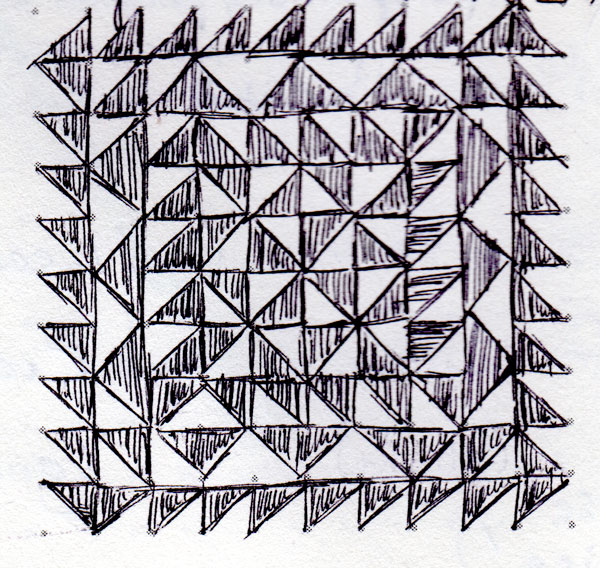
To make a faceted mathematical gemstone, start with any shape you like. Then build other shapes around it. What do you notice? Does your pattern grow outward from its center? Or flow around the corner of your page? How is each layer similar, and how is it different?

Arbitrary constraints can lead to mathematically interesting doodles. For instance, create a design out of 45-45-90 triangles by coloring exactly half of every grid square. How many variations can you find?

Symmetry Challenge

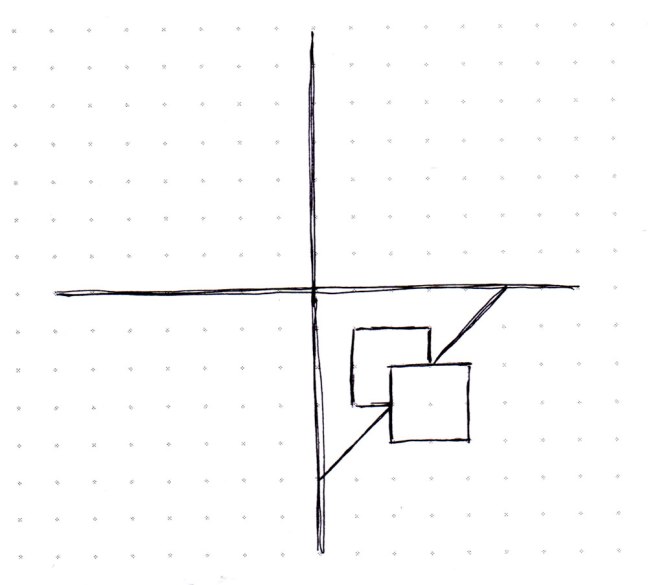
Play a symmetry puzzle game. Draw a line of symmetry and fill in part of the design. Then trade with a partner to finish each other’s doodles.

Make more complex symmetry puzzles with additional reflection lines.

Math Doodle Links

  • Who can talk about mathematical doodling without mentioning Vi Hart? If you’ve never seen her “Doodling in Math Class” video series, you’re in for a treat!
  • See if you can draw a rotational-symmetry design, like Don’s “Order 4” graphs.
  • Or experiment with the more flexible rules in John’s “Knot Fun” lesson.
  • And my latest obsession: the “ultimate” tutorial series on Celtic Knotwork, which explores the link between knots and their underlying graphs.
My favorite knot doodle so far.
Inspirations: A Recreational Mathematics Journal
Reflections: A Math Teacher’s Journal
Explorations: A Math Student’s Journal
Contemplations: A Homeschooler’s Journal

Before you start doodling: How to Break In Your New Math Journal.

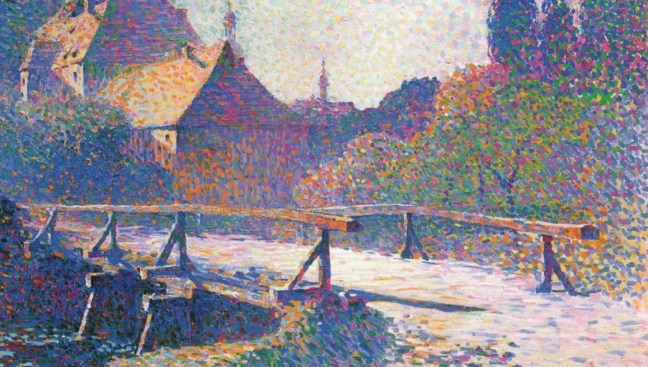
Feature photo (top): Sommermorgen (Alte Holzbrücke in Pretzfeld) by Curt Herrmann, via Wikimedia Commons. [Public domain]

Dot Grid Journals with Coloring Pages

My newest book project began with a few simple coloring pages for my homeschool co-op kids. You may recall when I collected those into a downloadable coloring book last December. Well, I kept tinkering with the designs into January. And then it was time to buy a new planner…

The problem is, I’m not a naturally organized person. I like making lists and plans, but sticking to them is tougher. And I’ve never found a planner or organizational system that I could follow for longer than two weeks at a go. That is until I heard of bullet journaling.

But journaling requires a journal — a notebook of some sort. And I couldn’t find any that I liked. Either the pages were too narrow and felt cramped, or the thing didn’t fit even in my oversized purse. Or the fancy, hardcover binding made it heavy to lug around. Or there weren’t enough pages to last more than a few weeks. Or the lines were too dark, or too widely spaced.

Never quite what I wanted.

So I decided to make my own.

I started with dot-grid pages for flexible layouts and for doodling. I scattered some of my favorite math and education quotations through each book. And then I added several of my most flexible geometric coloring pages (loosely based on Islamic tessellation designs).

And I had so much fun I couldn’t stop with just one. So let me introduce my Dot Grid Notebook with Coloring Pages series:

Inspirations: A Recreational Mathematics Journal
Reflections: A Math Teacher’s Journal
Explorations: A Math Student’s Journal
Contemplations: A Homeschooler’s Journal

With 170 roomy pages, each book gives you plenty of space to record memories, plan projects, and keep track of tasks. The dot grid makes it easy to draw graphs or diagrams. Take notes, jot down ideas, copy your favorite quotations, or doodle to your heart’s content.

  • Light gray dots at 5 mm spacing provide guidance for flexible page layouts.
  • 11 geometric coloring pages allow a multitude of artistic possibilities.
  • 31 favorite quotes offer a vision for creative math education.
  • 6 × 9 inch (about 15 × 23 cm) pages are wider than many journals, yet still fit comfortably into a large purse or bag.
  • Paperback binding makes the journal sturdy but lightweight. Carry it anywhere!

Prevent cracked spines: How to Break In Your New Math Journal.

The ebook edition features all 124 quotations (31 from each journal) about mathematics, education, and problem solving. Read through for your own pleasure, post them by your workspace, or use them as writing prompts for yourself or your students. [Yes, all of the ebooks are the same.]

But, what can you DO with all those nice, dotty pages?

Of course, you can use them for bullet journaling. That’s why I originally created the books, because I couldn’t find planners that fit my personal style. My bullet journal is basically an anthology of To-Do lists, bound together so they don’t get lost in the clutter. It’s the only planner system I’ve been able to stick with for more than two weeks at a go.

Or you could use the dotty pages for a commonplace book. That’s my favorite kind of journaling. Like a magpie, I collect shiny tidbits from books, websites, conversations overheard, and more. Passages. Definitions. Poems. Recipes. Proverbs. Things I’m wondering about. Cute kid sayings. It all goes into the mix.

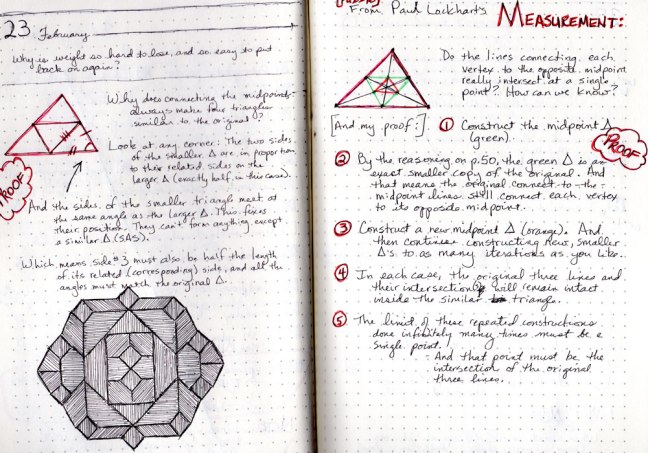
And math puzzles, of course! Below, I’m playing my way through Paul Lockhart’s Measurement. I use the cloud-like labels in the outer margins of each page for keywords that identify what I’m writing, because someday I’ll need to skim back and find an old note.

But where dot grid pages really excel is at doodling — I’m sure you noticed the faceted design filling the lower half of my journal page above and the gem almost overrunning my February calendar. So watch for tomorrow’s blog post featuring a variety of ways to create your own mathematical doodles.

Best wishes, and happy mathing!


P.S.: Do you have a blog? If you’d like to feature a Dot Grid Journal review and giveaway, I’ll provide the prize. Leave a comment below, and we’ll work out the details.

Playful Family Math on Facebook

If you want to know more about my playful math books, check out my new author page. You can post comments or send me a message. I’d love to hear from you!

Visit Denise Gaskins on Facebook

You can also join the Playful Family Math discussion group or find plenty of online mathy goodness at my original Let’s Play Math Facebook page.

🙂 See you there!