Parents and teachers, are you looking for new ways to help your children learn math?
In a math journal, children explore their own ideas about numbers, shapes, and patterns through drawing or writing in response to a question.
Journaling encourages students to develop a rich mathematical mindset. They begin to see connections and make sense of math concepts. They grow confident in their ability to think through new ideas.
All they need is a piece of paper, a pencil, and a good prompt to launch their mathematical journey.
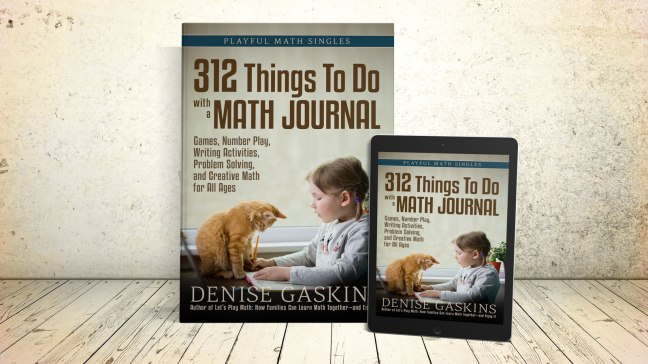
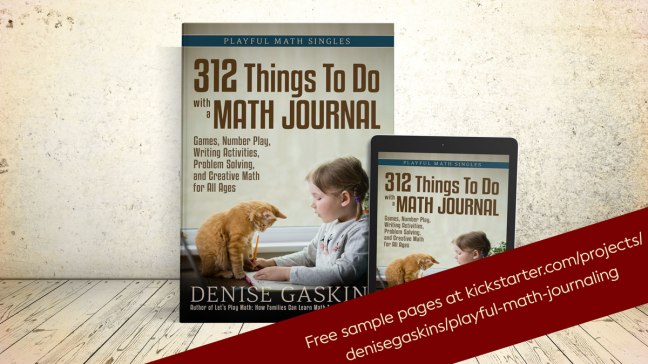
My new book 312 Things To Do with a Math Journal includes number play prompts, games, math art, story problems, mini-essays, geometry investigations, brainteasers, number patterns, research projects, and much more.
These activities work at any grade level, and most can be enjoyed more than once. It doesn’t matter whether your students are homeschooled or in a classroom, distance-learning, or in person. Everyone can enjoy the experience of playing around with math.
Earlier this week, I sent out my last Playful Math Newsletter to email subscribers.
Most months, my newsletter includes tips and activity ideas for playing math with your kids. But from time to time, I give away a free sample of whatever I’ve been working on — an early draft of something that will eventually show up in one of my books or printable activity guides.
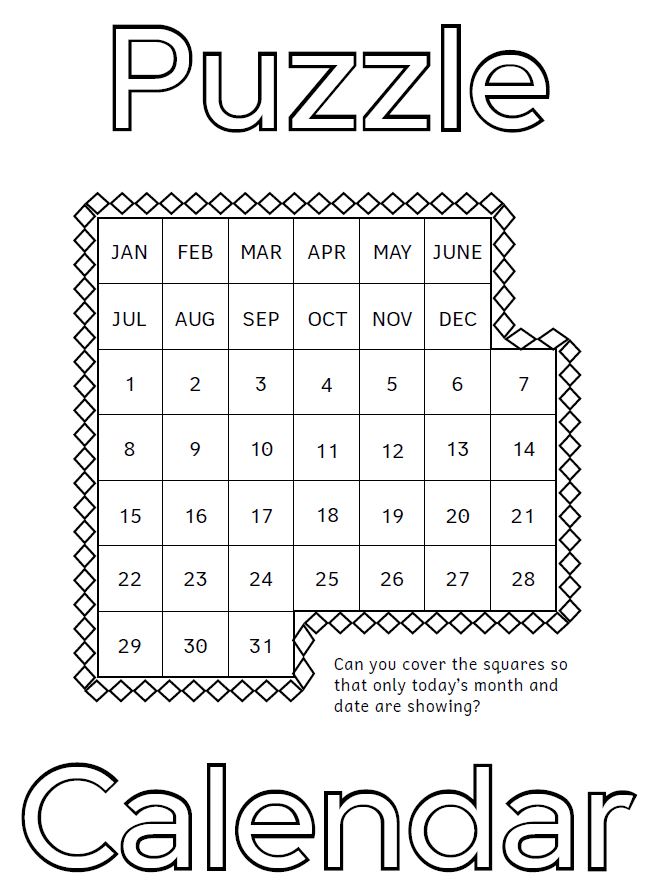
This month’s gift was a Pentomino Puzzle Calendar, a daily adventure in spatial reasoning.
(If you’re a subscriber, be sure to check your inbox!)
For those who haven’t signed up yet, follow this link for more information:
‘Tis the season for discount sales. I usually ignore the annual Black Friday push, because NOT shopping is an even better way to save money.
But this year, my publishing company Tabletop Academy Press has decided to join in the fun.
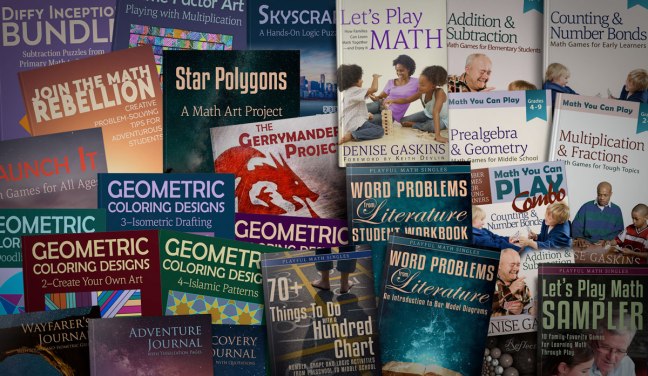
So if you’re looking for new math activities to play with your kids, I’ve just added several new books and discount bundles to our online store — including a huge variety of math journaling resources.
And for the next week or so, you can get 15% off anything in our store by using the coupon code TABLETOP15 at checkout.
But act fast! The discount code expires December 5th.
Help your children discover how much fun thinking hard can be!
You have slightly more than 24 hours left to grab the early-release 312 Things To Do with a Math Journal book on Kickstarter and pick up some great discounts on the rest of my playful math journaling books — including the popular Math Prompt Task Card sets.
But act fast! The deal disappears Thursday evening, U.S. Central Time.
“It doesn’t matter whether your students are homeschooled or in a classroom, distance-learning or in person. Everyone can enjoy the experience of playing around with math.”
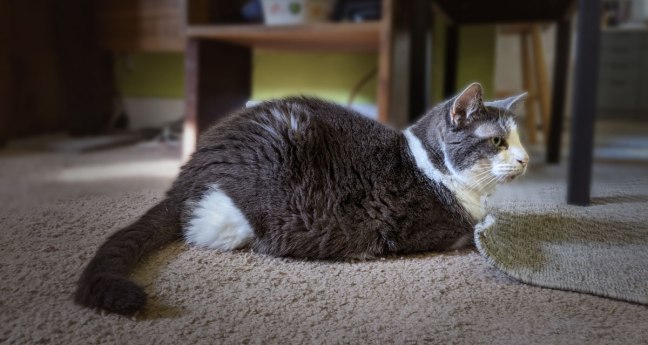
As queen of the house, Cimorene insists on being involved in anything that happens in her domain. This includes promoting the Playful Math Journaling Kickstarter.
So she created a cat math journaling prompt to help your children experience the fun of playing around with math.
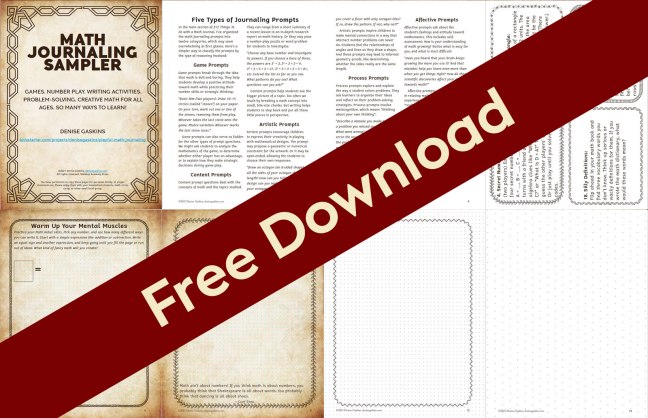
But first, she encourages you to visit the Kickstarter page and download the free 16-page printable Math Journaling Sampler file. Your kids will love solving Cimorene’s puzzle on one of the parchment-style pages!
[The free download will always be there, even after the Kickstarter project ends.] Visit the Kickstarter
Here is Cimorene’s Puzzle
“The Princess of Cats has a luxuriously soft tail about 12 inches (30 cm) long. Her tail is three times the length of her noble head. Her beautiful, furry body is as long as head and tail together. How long is the Princess from her delicate nose to the tip of her majestic tail?”
So, how does math journaling work? What do children do with a problem like this?
They may want to make a list of the things they know from the story. Perhaps they will draw a picture of the cat and label the proportions. Each will take their own approach to figure it out.
And then the best part of any math journal prompt is when kids make their own math.
Can they write a new puzzle about their own pet?
Or about their favorite animal?
Encourage your children to share their math creations with their friends and family.
Cimorene would love to read it, too! If you share your story in the comments section below, I will be sure to show it to her.
Are you looking for new ways to explore math with your kids?
Would you like an easy, no-prep resource for creative problem-solving, number play, math art, word problems, mini-essays, math poetry, geometry investigations, research projects, and much more?
I’ve just launched a Kickstarter project for people to preorder my new book, 312 Things To Do with a Math Journal. It just might transform your child’s experience of math.
In a math journal, children explore their own ideas about numbers, shapes, and patterns through drawing or writing in response to a question. Journaling teaches them to see with mathematical eyes. Not just to remember what we adults tell them, but to create their own math.
Scroll down the Kickstarter project page to download the free 16-page printable “Math Journaling Sampler” file. It includes one of my all-time favorite math activities. [The Sampler will remain available after the Kickstarter campaign ends.]
If you like what you see, I’d love to have your support. Please help share the project and encourage everyone to play math with their kids!
For more math journaling tips and information, scroll through the Math Journals posts on my blog.
Are you looking for new ways to explore math with your kids?
Would you like an easy, no-prep resource for creative problem-solving, number play, math art, word problems, mini-essays, math poetry, geometry investigations, research projects, and much more?
I’ve just launched a Kickstarter project for people to preorder my new book, 312 Things To Do with a Math Journal. It just might transform your child’s experience of math.
In a math journal, children explore their own ideas about numbers, shapes, and patterns through drawing or writing in response to a question. Journaling teaches them to see with mathematical eyes. Not just to remember what we adults tell them, but to create their own math.
Scroll down the Kickstarter project page to download the free 16-page printable “Math Journaling Sampler” file. It includes one of my all-time favorite math activities.
If you like what you see, I’d love to have your support. The more people we can get to share the project in the early days, the more likely Kickstarter will join in and promote it to new readers.
Are you a parent who wants to help your children learn math?
Or a teacher looking for new activities to try with your students?
Or perhaps you’d like to discover for yourself the playful side of math that school never showed you?
Tune in next week to discover how to help children explore their own ideas about numbers, shapes, and patterns. Or go to the Kickstarter Preview page, where you can sign up to be notified as soon as the project launches.
Would anyone have guessed we’d still be under pandemic social restrictions after a year?
Certainly not me!
And now that spring is in the air … Well, at least it is in the northern hemisphere. Would that be called “Up Yonder,” as opposed to “Down Under”? … Anyway, whatever you call it, everyone is getting antsy. We’re all ready to be set free, whenever our governments give in.
To help your family keep busy through the final (we hope!) lockdowns, my publisher is offering a 30% discount coupon on everything at our Tabletop Academy Press online store.




 Denise Gaskins' Let's Play Math