Musings: Math is Communication

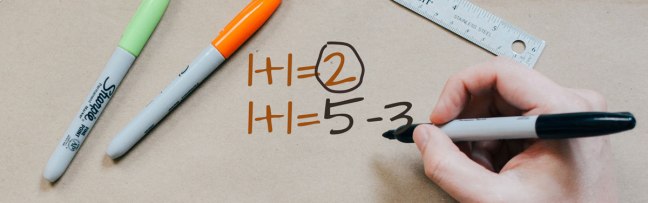
Young boy writing math expressions

The question came up on a homeschool math forum:

“My first grader and I were playing with equivalent expressions. We were trying to see how many ways we could write the value ‘3.’

    “He wrote down 10 – 2 × 3 + 1.

      “When I tried to explain the problem with his calculation, he got frustrated and didn’t want to do math.

        “How can I help him understand order of operations?”

        [If you think this sounds like too complex of a math expression for a first grader, you may want to read my blog post about math manipulatives and big ideas.]

        Order of operations doesn’t matter in this instance. What matters is communication.

        The mother didn’t know how to read what her son wrote.

        He could help her understand by putting parentheses around the part he wanted her to read first.

        He doesn’t need to know abstract rules for arbitrary calculations, or all the different ways we might possibly misunderstand each other. He just needs to know how to say what is in his mind.

        Continue reading Musings: Math is Communication

        Happy Pythagorean Triple Day!

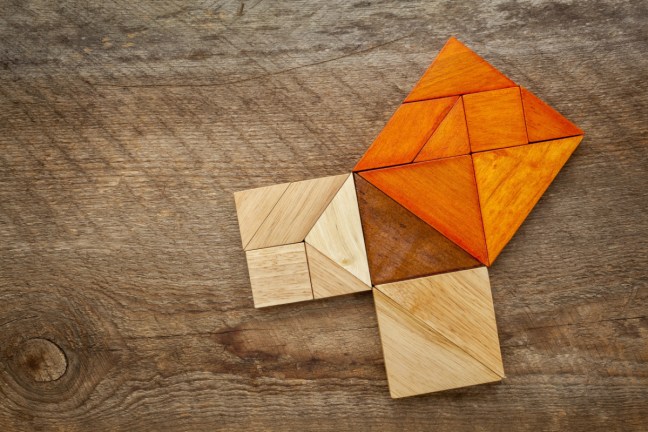
        Pythagorean Theorem demonstrated with tangrams

        Thursday is Pythagorean Triple Day, one of the rarest math holidays.

        The numbers of Thursday’s date: 7/24/25 or 24/7/25, fit the pattern of the Pythagorean Theorem: 7 squared + 24 squared = 25 squared.

        Any three numbers that fit the a2 + b2 = c2 pattern form a Pythagorean Triple.

        Continue reading Happy Pythagorean Triple Day!

        Math Journal: Playing with My Own Ignorance

        photo of a girl wondering about math

        Mary Everest Boole, wife of English mathematician George Boole, once described algebra as “thinking logically about the fact of our own ignorance.”

        This definition made me chuckle. Like any human being, I am ignorant on many things, but I usually avoid thinking about that.

        So I wondered what would happen if I took Mrs. Boole’s advice and tried thinking logically about my ignorance.

        How far could I go?

        Perhaps you’d like to try this experiment with your children. All you need is a pen and paper or a whiteboard and markers and a bit of curiosity.

        Math Journaling Adventures series by Denise GaskinsAnd if you enjoy this exploration, check out my Math Journaling Adventures project to discover how playful writing activities can help your students learn mathematics. Preorder your books today!

        Continue reading Math Journal: Playing with My Own Ignorance

        The Best Math Game Ever

        The Substitution Game features low-floor, high-ceiling cooperative play that works with any age (or with a mixed-age group) — and you can use it while distance learning, too. It’s great for building algebraic thinking.

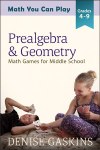
        Excerpted from my new book, Prealgebra & Geometry: Math Games for Middle School. Look for it at your favorite online bookstore.

        The Substitution Game

        Math Concepts: addition, subtraction, multiplication, division, order of operations, integers, fractions, equivalence and substitution.

        Players: any number (a cooperative game).

        Equipment: whiteboard and markers (preferred) or pencil and paper to share. Calculator optional.

        Continue reading The Best Math Game Ever

        Math Game: Hit Me

        I believe this was the first math game I ever invented. Of course, ideas are common currency, so I’m sure other math teachers thought of it before I did. But to me, it was original.

        I’ve blogged about the game before, but here’s the updated version as it appears in my new book Prealgebra & Geometry: Math Games for Middle School — scheduled for publication in early 2021. Sign up for my newsletter to get updates.

        Hit Me

        Math Concepts: integer addition, absolute value.

        Players: two or more.

        Equipment: playing cards (two decks may be needed for a large group).

        Continue reading Math Game: Hit Me

        Math Game: What Two Numbers?

        Here’s a simple, conversational game you can play anywhere — no equipment necessary. It’s great for helping your children develop number fluency and algebraic thinking.

        Excerpted from my upcoming book, Prealgebra & Geometry: Math Games for Middle School, scheduled for publication in early 2021. Sign up for my newsletter to get updates.

        What Two Numbers?

        Math Concepts: addition, multiplication, inverse operations, positive and negative numbers.

        Players: two or more.

        Equipment: no equipment needed.

        Continue reading Math Game: What Two Numbers?

        Reblog: The Handshake Problem

        [Feature photo above by Tobias Wolter (CC-BY-SA-3.0) via Wikimedia Commons.]

        Seven years ago, our homeschool co-op held an end-of-semester assembly. Each class was supposed to demonstrate something they had learned. I threatened to hand out a ten question pop quiz on integer arithmetic, but instead my pre-algebra students voted to perform a skit.

        I hope you enjoy this “Throw-back Thursday” blast from the Let’s Play Math! blog archives:


        If seven people meet at a party, and each person shakes the hand of everyone else exactly once, how many handshakes are there in all?

        In general, if n people meet and shake hands all around, how many handshakes will there be?

        Cast

        1-3 narrators
        7 friends (non-speaking parts, adjust to fit your group)

        Props

        Each friend will need a sheet of paper with a number written on it big and bold enough to be read by the audience. The numbers needed are 0, 1, 2, 3, … up to one less than the number of friends. Each friend keeps his paper in a pocket until needed.

        [Click here to go read Skit: The Handshake Problem.]

        Math Teachers at Play #70

        800px-Brauchtum_gesteck_70_1[Feature photo above by David Reimann via Bridges 2013 Gallery. Number 70 (right) from Wikimedia Commons (CC-BY-SA-3.0-2.5-2.0-1.0).]

        Do you enjoy math? I hope so! If not, browsing this post just may change your mind.

        Welcome to the 70th edition of the Math Teachers At Play math education blog carnival — a smorgasbord of 42+ links to bloggers all around the internet who have great ideas for learning, teaching, and playing around with math from preschool to pre-college. Let the mathematical fun begin!

        By tradition, we start the carnival with a puzzle in honor of our 70th edition. But if you would like to jump straight to our featured blog posts, click here to see the Table of Contents.

        Click here to continue reading.

        Math Teachers at Play #66

        [Feature photo above by Franz & P via flickr. Route 66 sign by Sam Howzit via flickr. (CC BY 2.0)]
        Route 66 Sign

        Welcome to the Math Teachers At Play blog carnival — which is not just for math teachers! If you like to learn new things and play around with ideas, you are sure to find something of interest.

        By tradition, we start the carnival with a couple of puzzles in honor of our 66th edition.

        Let the mathematical fun begin!

        Puzzle 1

        how crazy 66

        Our first puzzle is based on one of my favorite playsheets from the Miquon Math workbook series. Fill each shape with an expression that equals the target number. Can you make some cool, creative math?

        Click the image to download the pdf playsheet set: one page has the target number 66, and a second page is blank so you can set your own target number.

        Continue reading Math Teachers at Play #66