There’s still time to check out my Math Journaling Adventures project and discover how playful writing activities will help your students learn mathematics. Preorder your books today!
Meanwhile, here’s a math puzzle to share with your kids…
Write down any whole number. It can be a single-digit number, or as big as you like. For example:
64,861,287,124,425,928
Now, count up the number of even digits (including zeros), the number of odd digits, and the total number of digits your number contains. Write those counted numbers down in order, like this:
Welcome to the sweet-16 birthday edition of the Playful Math Carnival. Originally called Math Teachers at Play, our first carnival was published in February 2009.
Each Playful Math Carnival offers a smorgasbord of delectable tidbits of mathy fun. It’s like a free online magazine devoted to learning, teaching, and playing around with math from preschool to high school.
There’s so much playful math to enjoy!
By tradition, we start the carnival with a math activity in honor of our 179th edition. But if you’d rather jump straight to our featured blog posts, click here to see the Table of Contents.
Perhaps you’ve heard me mention the oral story problem game. It was one of my favorite ways to get my children thinking about math, back in our early days of homeschooling. We played in the car on the way to soccer practice, or while we washed dishes, or sitting in the lobby waiting for a doctor’s appointment.
The rules are simple: I’ll make up a math problem for you to solve. And then you make up one for me.
The kids always loved trying to stump me.
This problem from Henry Ernest Dudeney’s Amusements in Mathematics reminded me of those days. This is exactly the way my eldest loved to torture me…
English mathematician and puzzle-meister Henry Ernest Dudeney once wrote:
“It may be said generally that a game is a contest of skill for two or more persons, into which we enter either for amusement or to win a prize. A puzzle is something to be done or solved by the individual.
“The example that I give here is apparently a game, but, as in every case one player may win if he only play correctly, it is in reality a puzzle. The interest, therefore, lies in attempting to discover the leading method of play.”
Below is the puzzle game as Dudeney explained it.
Play it for fun at first, then see if you can solve the puzzle.
Homeschooling families naturally build patterns and routines that help us keep our sanity as we go through our homeschooling day.
No matter what resources we choose or which curriculum packages we buy, we never end up following the book exactly as it is written. So don’t worry if you find yourself wandering away from the lesson plan. You’re not getting behind; you’re just discovering your family’s natural learning style.
If you and your children have fallen into the rut of traditional math lessons, have patience. Give yourself time to adjust to a more relaxed mindset about math.
And when you find the rhythm that fits your family, you’ll discover that math lessons flow so much more smoothly.
Farzanah and the 17 Camels celebrates the excitement and the rewards of solving a challenging and intriguing math problem. Set against the backdrop of the ancient Silk Road, with bustling markets, stunning carpets, fun characters, and camels, the story draws readers into the magic of Farzanah’s surroundings.
Welcome to the 172nd edition of the Playful Math Blog Carnival, a buffet of delectable tidbits of mathy fun. It’s like a free online magazine devoted to learning, teaching, and playing around with math from preschool to high school.
The carnival went on hiatus for a couple of months due to unexpected life issues facing our volunteer hosts. But we’re back now, and ready to celebrate!
By tradition, we start the carnival with a puzzle in honor of our 172nd edition. But if you’d rather jump straight to our featured blog posts, click here for the Table of Contents.
Welcome to the 171st edition of the Playful Math Education Blog Carnival — a smorgasbord of delectable tidbits of mathy fun. It’s like a free online magazine devoted to learning, teaching, and playing around with math from preschool to high school.
Bookmark this post, so you can take your time browsing over the next week or so.
There’s so much playful math to enjoy!
By tradition, we start the carnival with a puzzle/activity in honor of our 171st edition. But if you’d rather jump straight to our featured blog posts, click here to see the Table of Contents.
Try This Puzzle/Activity
171 is a triangular number, the sum of all the numbers from 1 to 18:
1 + 2 + 3 + … + 17 + 18 = 171.
Can you think why a number like this is called “triangular”?
What other triangular numbers can you find?
Also, 171 is a palindrome number, with the same digits forward and backward. It’s also a palindrome of powers:
171 = 52 + 112 + 52
171 = 23 + 43 + 33 + 43 + 23
So in honor of our 171st Playful Math Carnival, here is a palindrome puzzle that leads to an unsolved question in math:
Does every number turn into a palindrome eventually?
Welcome to the 170th edition of the Playful Math Education Carnival — a smorgasbord of delectable tidbits of mathy fun. It’s like a free online magazine devoted to learning, teaching, and playing around with math from preschool to high school.
Bookmark this post, so you can take your time browsing.
There’s so much playful math to enjoy!
By tradition, we start the carnival with a puzzle/activity in honor of our 170th edition. But if you’d rather jump straight to our featured blog posts, click here to see the Table of Contents.
Puzzle: Prime Permutations
According to Tanya Khovanova’s Number Gossip, 170 is the smallest composite number where exactly four permutations of its digits make prime numbers.
To find permutations, think of all the different ways you can arrange the digits 1, 7, 0 into three-digit numbers. (When the zero comes first, those permutations actually make two-digit numbers, which DO also count.)
Can you figure out which permutations make prime numbers?
Hint: The permutation that makes the number “170” is not prime, but it is the product of three prime numbers. Which ones?
For Younger Children: The 170 Square
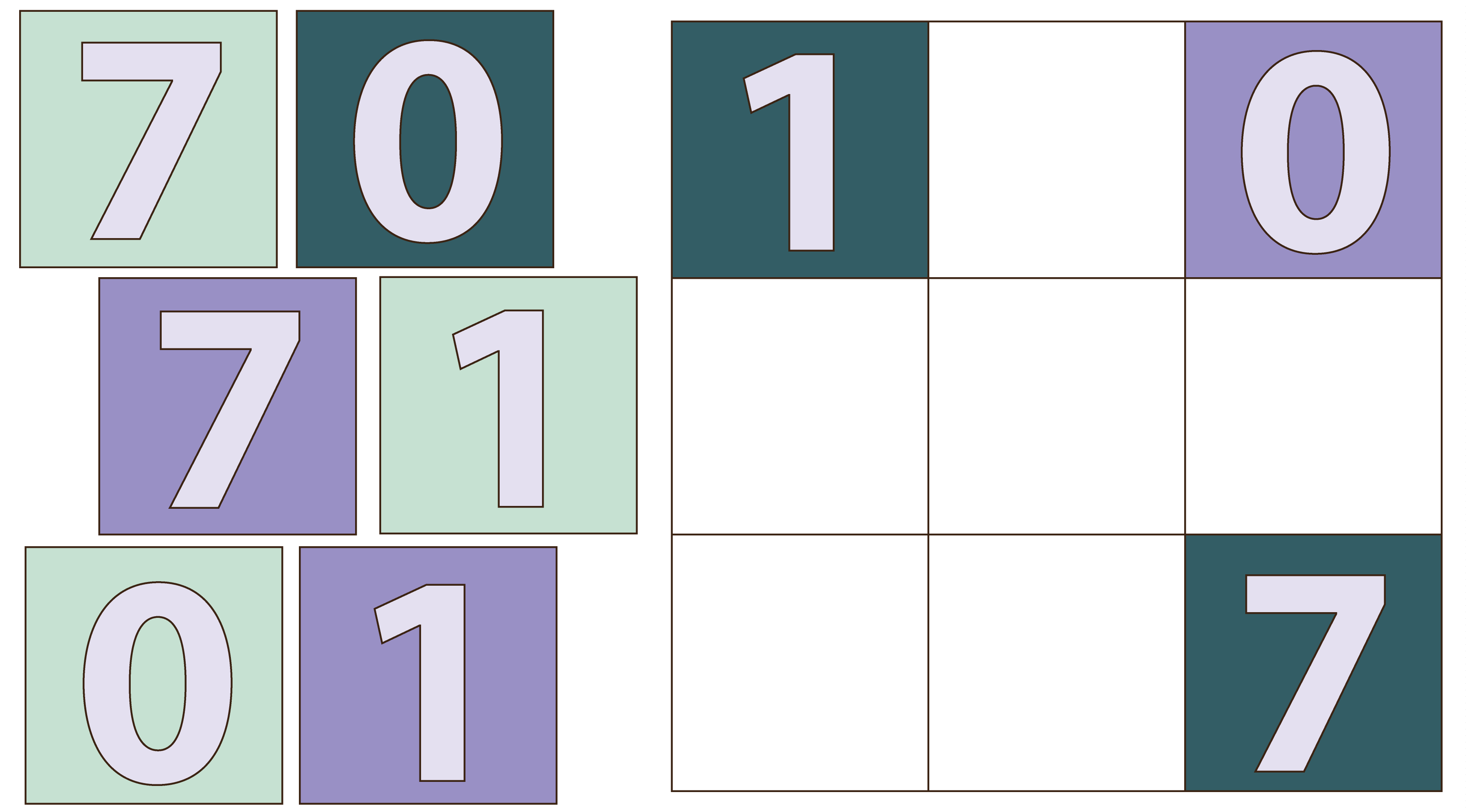
A Latin square is a grid filled with permutations: letters, numbers, or other symbols so that no row or column contains more than one of any character. You’ve probably seen the popular Latin-square puzzle called Sudoku. A Graeco-Latin square (also called an Euler square) is two independent Latin squares overlapping each other.
Can you complete this Euler square made by overlapping permutations of the digits of 170 with winter colors? Don’t repeat the same color OR the same number in any row or column.
Click the picture to get a larger image you can print.
 There’s still time to check out my Math Journaling Adventures project and discover how playful writing activities will help your students learn mathematics. Preorder your books today!