Quotable: On Teaching

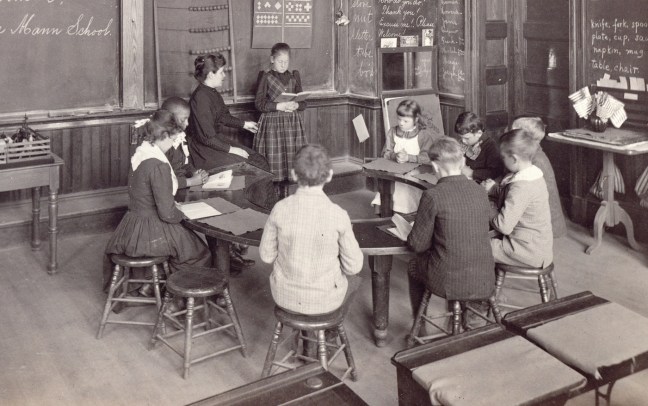
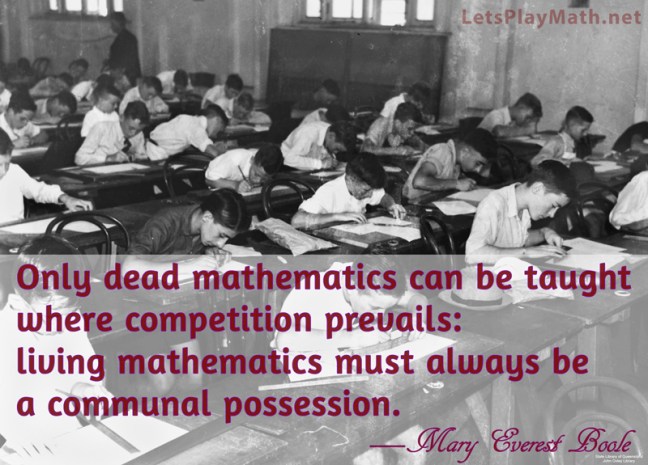
classroom scene

[Photo by City of Boston Archives via Flickr (CC BY 2.0).]

I’ve started collecting quotes about teaching math for the chapter pages in my next Math You Can Play book. Here are a couple snippets that don’t fit the theme of “Multiplication & Fractions,” but they struck my fancy anyway:

If teachers would only encourage guessing. I remember so many of my math teachers telling me that if you guess, it shows that you don’t know. But in fact there is no way to really proceed in mathematics without guessing. You have to guess! You have to have intuitive judgment as to the way it might go. But then you must be willing to check your guess. You have to know that simply thinking it may be right doesn’t make it right.

teaching

[Photo by Nathan Russell via Flickr (CC BY 2.0).]

One of the big misapprehensions about mathematics that we perpetrate in our classrooms is that the teacher always seems to know the answer to any problem that is discussed. This gives students the idea that there is a book somewhere with all the right answers to all of the interesting questions, and that teachers know those answers. And if one could get hold of the book, one would have everything settled. That’s so unlike the true nature of mathematics.

Leon Henkin
from “Round and Round at the Round Table”
Teaching Teachers, Teaching Students: Reflections on Mathematical Education

What Are Your Favorite Quotes?

Do you have some favorite quotes on math and teaching? I’d love to hear them! Please share in the Comments section below.

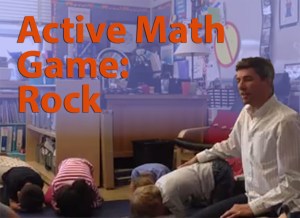
Active Math Game: Rock

Gordon Hamilton of Math Pickle posted Rock – Low unique number game for grades K–2. If you have a set of active kids and a few minutes to spare, give it a try!

How to Play Rock

  • Everyone makes a rock shape with eyes closed.
  • Everyone chooses a number: 0, 1, 2, 3, 4, 5, 6, 7, 8 …
  • Teacher calls out numbers consecutively, starting at 0.
  • When a student hears their number being called they immediately raise a hand. When the teacher tags the hand, they stand up.
  • If more than one hand was raised, those students lose. They become your helpers, tagging raised hands.
  • If only one hand was raised, that child wins the round.

Rock-game

“Each game takes about 45 seconds,” Hamilton says. “This is part of the key to its success. Children who have not learned the art of losing are quickly thrown into another game before they have a chance to get sad.”

The experience of mathematics should be profound and beautiful. Too much of the regular K-12 mathematics experience is trite and true. Children deserve tough, beautiful puzzles.

Gordon Hamilton

What Happens When Grownups Play Rock

What are the best numbers to pick? Patrick Vennebush hosted on online version of the game at his Math Jokes 4 Mathy Folks blog a few years back, though we didn’t have to bend over into rocks‌—‌which is a good thing for some of us older folks.

Vennebush also posted a finger-game version suitable for small groups of all ages, called Low-Sham-Bo:

  • On the count of 1-2-3, each person “throws” out a hand showing any number of fingers from zero to five.
  • The winner is the person who throws the smallest unique number.

You may want to count “Ready, set, go!” for throwing out fingers, so the numbers in the count don’t influence the play.

The official name for this sort of game is Lowest Unique Bid Auction.

 
* * *

This blog is reader-supported.

If you’d like to help fund the blog on an on-going basis, then please join me on Patreon for mathy inspiration, tips, and an ever-growing archive of printable activities.

If you liked this post, and want to show your one-time appreciation, the place to do that is PayPal: paypal.me/DeniseGaskinsMath. If you go that route, please include your email address in the notes section, so I can say thank you.

Which I am going to say right now. Thank you!

“Active Math Game: Rock” copyright © 2015 by Denise Gaskins. .

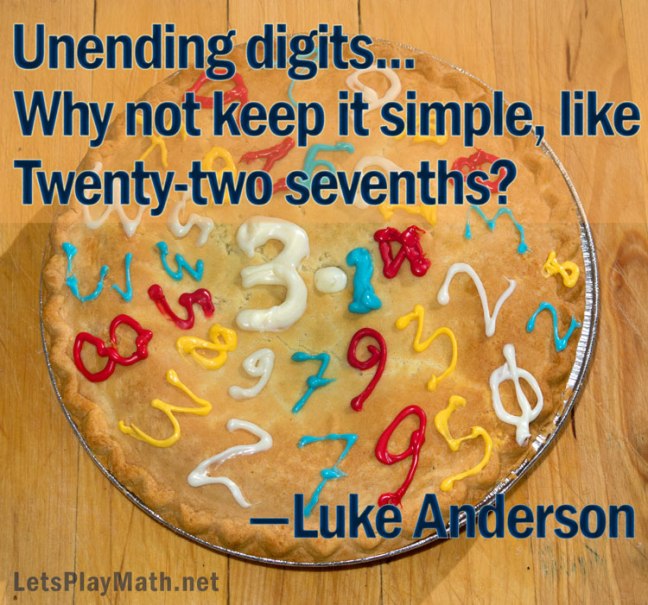
Unending Digits… Why Not Keep It Simple?

Unending-digits

Unending digits …
Why not keep it simple, like
Twenty-two sevenths?

—Luke Anderson

Math Poetry Activity

Encourage your students to make their own Pi Day haiku with these tips from Mr. L’s Math:

And remember, Pi Day is also Albert Einstein’s birthday! Check out this series of short videos about his life and work: Happy Birthday, Einstein.

CREDITS: Today’s quote is from Luke Anderson, via TeachPi.org. Background photo courtesy of Robert Couse-Baker via Flickr, text added (CC BY 2.0).

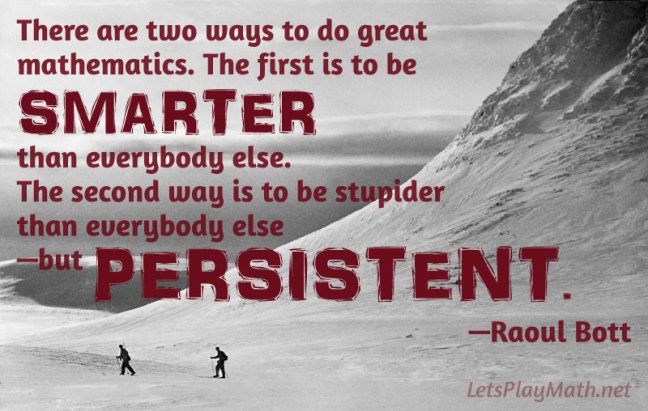
Two Ways to Do Math

Two-Ways-to-Do-Math

There are two ways to do great mathematics. The first is to be smarter than everybody else. The second way is to be stupider than everybody else — but persistent.

— Raoul Bott

CREDITS: Today’s quote is from Raoul Bott, via The MacTutor History of Mathematics archive. Background photo courtesy of Swedish National Heritage Board (no known copyright restrictions) via Flickr.

Ruth Beechick on Teaching

Here’s one more quote from homeschooling guru Ruth Beechick. It applies to classroom teachers, too!

Everyone thinks it goes smoothly in everyone else’s house, and theirs is the only place that has problems.

I’ll let you in on a secret about teaching: there is no place in the world where it rolls along smoothly without problems. Only in articles and books can that happen.

you can

— Ruth Beechick
You Can Teach Your Child Successfully (Grades 4-8)

Teaching the Standard Algorithms

[Feature photo above by Samuel Mann, Analytical Engine photo below by Roͬͬ͠͠͡͠͠͠͠͠͠͠͠sͬͬ͠͠͠͠͠͠͠͠͠aͬͬ͠͠͠͠͠͠͠ Menkman, both (CC BY 2.0) via Flickr.]

Babbage's Analytical Engine

An algorithm is a set of steps to follow that produce a certain result. Follow the rules carefully, and you will automatically get the correct answer. No thinking required — even a machine can do it.

This photo shows one section of the first true computer, Charles Babbage’s Analytical Engine. Using a clever arrangement of gears, levers, and switches, the machine could crank out the answer to almost any arithmetic problem. Rather, it would have been able to do so, if Babbage had ever finished building the monster.

One of the biggest arguments surrounding the Common Core State Standards in math is when and how to teach the standard algorithms. But this argument is not new. It goes back at least to the late 19th century.

Here is a passage from a book that helped shape my teaching style, way back when I began homeschooling in the 1980s…

Ruth Beechick on Teaching Abstract Notation

“Understanding this item is the key to choosing your strategy for the early years of arithmetic teaching. The question is: Should you teach abstract notation as early as the child can learn it, or should you use the time, instead, to teach in greater depth in the mental image mode?

Beechick-EasyStartArithmetic

“Abstract notation includes writing out a column of numbers to add, and writing one number under another before subtracting it. The digits and signs used are symbols. The position of the numbers is an arbitrary decision of society. They are conventions that adult, abstract thinkers use as a kind of shorthand to speed up our thinking.

“When we teach these to children, we must realize that we simply are introducing them to our abstract tools. We are not suddenly turning children into abstract thinkers. And the danger of starting too early and pushing this kind of work is that we will spend an inordinate amount of time with it. We will be teaching the importance of making straight columns, writing numbers in certain places, and other trivial matters. By calling them trivial, we don’t mean that they are unnecessary. But they are small matters compared to real arithmetic thinking.

“If you stay with meaningful mental arithmetic longer, you will find that your child, if she is average, can do problems much more advanced than the level listed for her grade. You will find that she likes arithmetic more. And when she does get to abstractions, she will understand them better. She will not need two or three years of work in primary grades to learn how to write out something like a subtraction problem with two-digit numbers. She can learn that in a few moments of time, if you just wait.”

— Ruth Beechick
An Easy Start in Arithmetic (Grades K-3)
(emphasis mine)

Quotable: I Do Hate Sums

MrsLaTouche

I’ve been looking for quotes to put at the beginning of each chapter in my math games books. I found a delightful one by Mrs. LaTouche on the Mathematical Quotations Server, but when I looked up the original source, it was even better:

I am nearly driven wild with the Dorcas accounts, and by Mrs. Wakefield’s orders they are to be done now.

I do hate sums. There is no greater mistake than to call arithmetic an exact science. There are Permutations and Aberrations discernible to minds entirely noble like mine; subtle variations which ordinary accountants fail to discover; hidden laws of Number which it requires a mind like mine to perceive.

For instance, if you add a sum from the bottom up, and then again from the top down, the result is always different.

Again if you multiply a number by another number before you have had your tea, and then again after, the product will be different. It is also remarkable that the Post-tea product is more likely to agree with other people’s calculations than the Pre-tea result.

Try the experiment, and if you do not find it as I say, you are a mere sciolist*, a poor mechanical thinker, and not gifted as I am, with subtle perceptions.

Of course I find myself not appreciated as an accountant. Mrs. Wakefield made me give up the book to [my daughter] Rose and her governess (who are here), and was quite satisfied with the work of those inferior intellects.

— Maria Price La Touche
The Letters of A Noble Woman
London: George Allen & Sons, 1908

*sciolist: (archaic) A person who pretends to be knowledgeable and well informed. From late Latin sciolus (diminutive of Latin scius ‘knowing’, from scire ‘know’) + -ist.