WordPress.com bloggers have a new toy: the ability to embed TED talks…
How DO We Learn Math?

What makes it possible to learn advanced math fairly quickly is that the human brain is capable of learning to follow a given set of rules without understanding them, and apply them in an intelligent and useful fashion. Given sufficient practice, the brain eventually discovers (or creates) meaning in what began as a meaningless game.
— Keith Devlin
Should Children Learn Math by Starting with Counting?
It seems obvious that our children must have a wide range of experience with real world objects before counting, addition, or subtraction mean anything to them. But are other topics, such as calculus, better learned as abstract rules — as a game that we play with symbols? And what about the topics in the middle? For instance, how best can we break our algebra students of common errors such as distributing the square or canceling out addition terms?
To teach effectively, I need to understand how students learn. Do different approaches work best with different concepts? Or at different ages or stages of development? I can think of at least 3 ways that I have learned math — what about you? How do you and your children learn?
Math Teachers at Play #2
[Photo by Sister72.]
Welcome to the second Math Teachers At Play blog carnival! Some articles were submitted by their authors, other were drawn from the back-log in my blog reader, and I’ve spiced it all up with a few of my favorite quotations.
Let the mathematical fun begin…
Quotations XXIII: The Poetry of Logical Ideas
[Photo by pshutterbug.]
It’s been ages since I posted any blackboard quotes, so here are a few gems from last semester. [Hat tip: I found most of the quotes in this list at The Quote Garden’s Quotations about Math page.]
Pure mathematics is, in its way, the poetry of logical ideas.
Continue reading Quotations XXIII: The Poetry of Logical Ideas
Quotations Archive — Browse and Enjoy!
[Photo by PhillipC.]
I love quotations, don’t you? Everything I might possibly want to say, someone else has already said it better than I ever could. Now I’ve put together all of my blackboard quotes from the homeschool co-op classes, as well as a few longer quotations I used in past blog posts, and archived them in one convenient place.
I hope you have as much fun reading the quotes as I have had collecting them.
Quotations XXII: Six Months in the Dark
[Photo by frozenchipmunk.]
School is in session, which means I am once again searching out pithy, inspirational quotations for my chalkboard. Some recent tidbits…
The more I work and practice, the luckier I seem to get.
— Gary Player
Quoted in Precalculus Mathematics in a Nutshell
Quotes XXI: How Is Logic Like Whiskey?
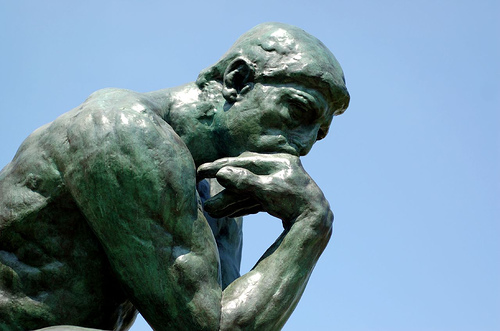
Photo by Brian – Progressive Spin.
Logic is the science of making valid deductions and proofs — and it is also a fruitful topic for blackboard quotes. Here are a few of my favorites:
You can only find truth with logic if you have already found truth without it.
Quotations XX: How Old Was Erdös?

Photo by foundphotoslj.
Here are a few mathematical gems from my co-op class blackboard:
I must study politics and war that my sons may have liberty to study mathematics and philosophy.
When I was a child, the Earth was said to be two billion years old. Now scientists say it’s four and a half billion. So that makes me two and a half billion.
Quotations XIX: How Do We Learn Math?
He doesn’t learn algebra
in the algebra course;
he learns it in calculus.
I have been catching up on my Bloglines reading [procrastinating blogger at work — I should be going over the MathCounts lesson for Friday’s homeschool co-op class], and found the following quotation at Mathematics under the Microscope [old blog posts are no longer archived].
Quotations XVIII: The Art of Asking Questions
Priorities, motivation, and a little bit of math from my blackboard…
We make a living by what we get, but we make a life by what we give.
In mathematics, the art of asking questions is more valuable than solving problems.
Continue reading Quotations XVIII: The Art of Asking Questions
 Denise Gaskins' Let's Play Math