Introduction to Charlotte Mason Math

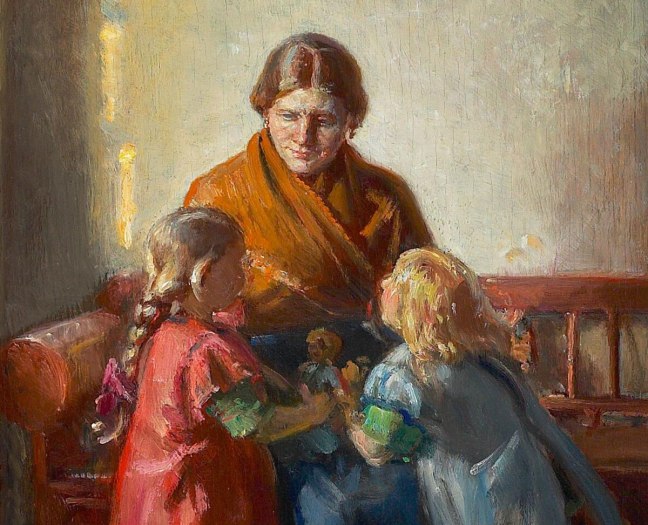
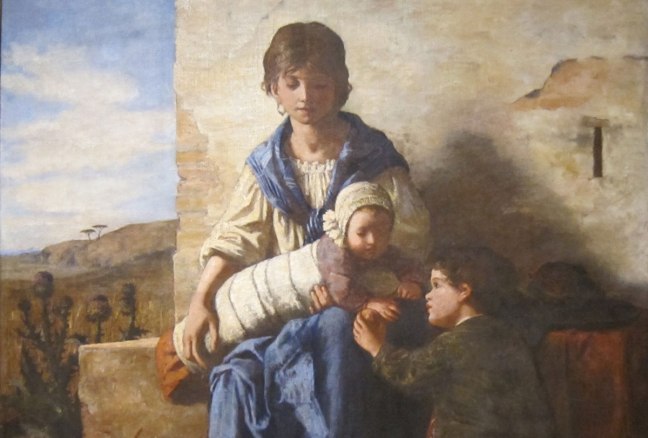
Woman with children, painting by Michael Ancher

“The Principality of Mathematics is a mountainous land, but the air is very fine and health-giving. People who seek their work or play in this principality find themselves braced by effort and satisfied with truth.”

— Charlotte Mason, Ourselves

Charlotte Mason (1842-1923) was a British school reformer at the turn of the twentieth century, a contemporary of William James and John Dewey. She advocated strongly for poor children, arguing they were equally capable of learning a wide and liberal curriculum as were the children of privilege.

Mason believed that all children from the time they are born share a natural curiosity and hunger for learning, and the adult’s role is to spread a “wide and generous feast” of inspiring ideas.

She was also a homeschooling pioneer, and the homeschooling revival of the late twentieth century rediscovered and popularized her books. Many found her principles a refreshing balance to the dominant educational paradigm of pragmatism.

Continue reading Introduction to Charlotte Mason Math

Podcast: From Right Answers to Adventure

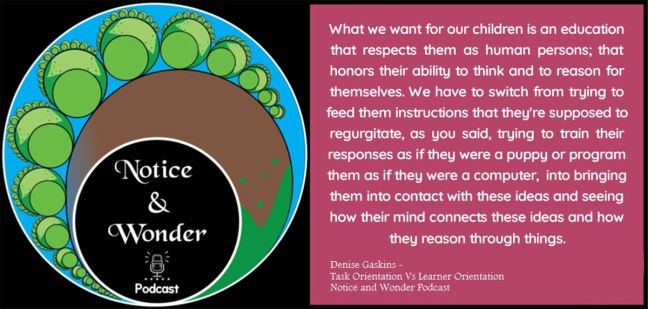
Notice and Wonder podcast logo with quote by Denise Gaskins

If you find a free hour this week, you may enjoy listening to my latest Notice & Wonder podcast discussion with Sonya and Della about the power of playful math:

We share plenty of tips, stories, and practical advice for bringing a sense of curiosity and exploration into your math lessons.

Plus, the Best Math Game Ever!

I love this podcast, because it always feels like sitting down to chat over coffee with good friends who love kids and love teaching.

Taking our focus off answer-getting can be hard for the adult, because that right answer gives us security that we know what we’re doing. It’s hard to give ourselves the freedom of saying, “I’m going to go into this lesson, and I have no idea where it’s going to go. I have this puzzle, I have this problem, but I don’t know where it will lead.’’

    That’s a scary situation to be in as the adult who’s used to being in control of everything.

      But we’re exploring this landscape of math. There are a lot of cool things to discover, and we’ll find something. We may not find the answer, but we’ll find something interesting, if we just explore it.

      — Denise Gaskins,
      “From Right Answers to Adventure”

       
      * * *

      If you enjoy listening to podcasts, check out my other interviews here.

      Are you looking for more creative ways to play math with your kids? Check out all my books, printable activities, and cool mathy merch at Denise Gaskins’ Playful Math Store.

      This blog is reader-supported. If you’d like to help fund the blog on an on-going basis, then please join me on Patreon for mathy inspiration, tips, and an ever-growing archive of printable activities.

      If you liked this post, and want to show your one-time appreciation, the place to do that is PayPal: paypal.me/DeniseGaskinsMath. If you go that route, please include your email address in the notes section, so I can say thank you.

      “Podcast: From Right Answers to Adventure” copyright © 2024 by Denise Gaskins. Podcast logo copyright © 2024 Sonya Post.

      New Podcast: Notice and Wonder

      Quotation from Notice and Wonder podcast

      When I was a novice homeschooler, our local Moms’ Night Out provided mentoring and kept me sane. We’d leave the children home with their dads and meet up at a local restaurant for a cup of coffee, a slice of pecan pie, and a robust discussion of educational philosophy.

      This spring, my friend Sonya Post launched a new podcast called “Notice & Wonder” — and it captures that same feeling perfectly.

      Sonya explains: “What is Notice, Wonder, Discover? It’s the development of cognitive skills, without which you have never learned anything in your life. We are developing the underlying skills that will make anyone more proficient at learning anything.”

      I’ve had the privilege to join Sonya for three episodes of the podcast so far, and I’ve thoroughly enjoyed our conversations.

      Here’s a taste…

      Continue reading New Podcast: Notice and Wonder

      If Not Methods: Reasoning About Subtraction

      Father and son reasoning about subtraction

      We’ve been examining the fact that, while there may be only one right answer to a math problem, but there’s never only one right way to get that answer.

      What matters in math is the journey. How do your children make sense of the problem and reason their way to that answer?

      As always, real math is not about the answers but the thinking.

      But if we don’t want to give our children a method, how can we teach? What if we pose a problem and the child doesn’t know how to solve it?

      What if our children get stumped on a subtraction calculation like 431 – 86?

      Continue reading If Not Methods: Reasoning About Subtraction

      Podcast: How to Transform Math Lessons without Changing your Curriculum

      Homeschooling math together - photo

      I have a new podcast interview, and I think you’ll enjoy it!

      Check out Pam Barnhill’s 10 Minutes to a Better Homeschool on your favorite podcast app, or listen on the website:

      Go to the podcast ❱

      Here’s a couple of excerpts…

      Continue reading Podcast: How to Transform Math Lessons without Changing your Curriculum

      Musings: If Not Methods, Then What?

      Last week, I quoted Pam Harris calling out a foundational myth of math education, the idea that we need to teach kids the methods that work on even the most difficult math problems.

      “We have a misconception in math education that we think we need to teach methods so that kids can answer the craziest kind of a particular problem.

        “We would be far better served to teach kids to think about the most common kinds of questions WELL, and let technology handle the crankiest.”

        —Pam Harris

        Since many of us grew up in schools that taught these methods, they may feel like the only sensible approach to math. Without the standard procedures, how will our kids learn to do math?

        If we don’t teach subtraction with borrowing/renaming, how can students figure out calculations like 431 − 86? If we don’t teach fraction rules, how will they handle problems like 1 1/2 ÷ 3/8?

        Continue reading Musings: If Not Methods, Then What?

        Celebrating Spring with Playful Math Carnival 172

        Playful Math Carnival 172

        Welcome to the 172nd edition of the Playful Math Blog Carnival, a buffet of delectable tidbits of mathy fun. It’s like a free online magazine devoted to learning, teaching, and playing around with math from preschool to high school.

        The carnival went on hiatus for a couple of months due to unexpected life issues facing our volunteer hosts. But we’re back now, and ready to celebrate!

        By tradition, we start the carnival with a puzzle in honor of our 172nd edition. But if you’d rather jump straight to our featured blog posts, click here for the Table of Contents.

        Try This: Lazy Caterers and Clock-Binary Numbers

        172 is a lazy caterer number: Imaging a caterer who brought a single large pie to serve the whole party. He needs to cut it into as many pieces as he can, using the fewest (straight) cuts he can get away with.

        • If each guest gets one piece of pie, what sizes of parties (numbers of people) can the lazy caterer serve?
        • Can you find a pattern in the lazy caterer sequence?

        But for those of you who have followed the carnival for years, you may remember we played with the lazy caterer back in Playful Math 106. (That time, the caterer was serving pizza.) So here’s a bonus activity we’ve never done before…

        The first several stages of a pattern are as follows:

        Clock Binary pattern image

        • What do you notice about this pattern of shapes?
        • What is the next shape in the sequence?
        • Can you figure out how the shape below fits into the pattern?

        Clock Binary puzzle image

        This pattern sequence was named clock binary by its creator, noelements-setempty.

        • What questions can you ask about this sequence?
        • How are these shapes like the binary numbers?
        • How are they different?

        Click here for all the mathy goodness!

        Musings: A Common Misconception

        Father and son thinking together about a math problem

        One of my favorite podcasts to listen to is Pam Harris’s Math Is Figure-Out-Able because she puts so many of my thoughts into words.

        For example:

        “We have a misconception in math education that we think we need to teach methods so that kids can answer the craziest kind of a particular problem.

          “We would be far better served to teach kids to think about the most common kinds of questions WELL, and let the cranky ones go to ChatGPT. Because they’ll recognize the sense of the answer.

            “Let technology handle the crankiest, and REASON about the rest of them.”

            —Pam Harris,
            the Math is Figure-out-able Fractions Challenge

            Well, I do think she’s wrong about the AI chatbot, because ChatGPT comes up with the strangest bald-faced nonsense about math problems. Wolfram Alpha is a much more reliable resource.

            But Harris’s main point stands. This misconception, this math-education myth, drives much of what happens in our classrooms and home schools today.

            Continue reading Musings: A Common Misconception

            Musings: A Philosophy of Education

            I’ve tried a few times over the years to express my philosophy of teaching math. Back when I first started doing workshops for homeschooling parents, I told them:

            “Instead of drudgery, mathematics should be a game of discovery. It should give children the same ‘Eureka!’ thrill that sent Archimedes running through town in his birthday suit. I call this the ‘Aha!’ factor, the delight in solving a challenging puzzle.”

            Years later, as the internet developed and much of life moved online, I started a blog about playing with math. And since all good blogs need an “About Me” page, I had another chance to sum up my thoughts:

            “Math is like ice cream, with more flavors than you can imagine — and if all your children ever see is textbook math, that’s like feeding them broccoli-flavored ice cream.”

            But over the years, some people got the impression that my goal was all about playing games. They asked, “How can we make math fun for our kids?” — as if gamification adds a candy coating to make the disgusting medicine more palatable.

            And of course, I do write a lot of books about games. I think games serve much better than worksheets for practicing basic math skills.

            Still, I wanted people to see that the ideas of math themselves are tasty tidbits worth playing with.

            Continue reading Musings: A Philosophy of Education

            Playful Math Education Carnival 171: Modern Math Artists

            Welcome to the 171st edition of the Playful Math Education Blog Carnival — a smorgasbord of delectable tidbits of mathy fun. It’s like a free online magazine devoted to learning, teaching, and playing around with math from preschool to high school.

            Bookmark this post, so you can take your time browsing over the next week or so.

            There’s so much playful math to enjoy!

            By tradition, we start the carnival with a puzzle/activity in honor of our 171st edition. But if you’d rather jump straight to our featured blog posts, click here to see the Table of Contents.

            Try This Puzzle/Activity

            171 is a triangular number, the sum of all the numbers from 1 to 18:

            • 1 + 2 + 3 + … + 17 + 18 = 171.
            • Can you think why a number like this is called “triangular”?
            • What other triangular numbers can you find?

            Also, 171 is a palindrome number, with the same digits forward and backward. It’s also a palindrome of powers:

            • 171 = 52 + 112 + 52
            • 171 = 23 + 43 + 33 + 43 + 23

            So in honor of our 171st Playful Math Carnival, here is a palindrome puzzle that leads to an unsolved question in math:

            • Does every number turn into a palindrome eventually?

            palindrome number activity

            Click here for all the mathy goodness!