Last week, I quoted Pam Harris calling out a foundational myth of math education, the idea that we need to teach kids the methods that work on even the most difficult math problems.
“We have a misconception in math education that we think we need to teach methods so that kids can answer the craziest kind of a particular problem.
“We would be far better served to teach kids to think about the most common kinds of questions WELL, and let technology handle the crankiest.”
—Pam Harris
Since many of us grew up in schools that taught these methods, they may feel like the only sensible approach to math. Without the standard procedures, how will our kids learn to do math?
If we don’t teach subtraction with borrowing/renaming, how can students figure out calculations like 431 − 86? If we don’t teach fraction rules, how will they handle problems like 1 1/2 ÷ 3/8?
Welcome to the 172nd edition of the Playful Math Blog Carnival, a buffet of delectable tidbits of mathy fun. It’s like a free online magazine devoted to learning, teaching, and playing around with math from preschool to high school.
The carnival went on hiatus for a couple of months due to unexpected life issues facing our volunteer hosts. But we’re back now, and ready to celebrate!
By tradition, we start the carnival with a puzzle in honor of our 172nd edition. But if you’d rather jump straight to our featured blog posts, click here for the Table of Contents.
One of my favorite podcasts to listen to is Pam Harris’s Math Is Figure-Out-Able because she puts so many of my thoughts into words.
For example:
“We have a misconception in math education that we think we need to teach methods so that kids can answer the craziest kind of a particular problem.
“We would be far better served to teach kids to think about the most common kinds of questions WELL, and let the cranky ones go to ChatGPT. Because they’ll recognize the sense of the answer.
“Let technology handle the crankiest, and REASON about the rest of them.”
—Pam Harris,
the Math is Figure-out-able Fractions Challenge
Well, I do think she’s wrong about the AI chatbot, because ChatGPT comes up with the strangest bald-faced nonsense about math problems. Wolfram Alpha is a much more reliable resource.
But Harris’s main point stands. This misconception, this math-education myth, drives much of what happens in our classrooms and home schools today.
I’ve tried a few times over the years to express my philosophy of teaching math. Back when I first started doing workshops for homeschooling parents, I told them:
“Instead of drudgery, mathematics should be a game of discovery. It should give children the same ‘Eureka!’ thrill that sent Archimedes running through town in his birthday suit. I call this the ‘Aha!’ factor, the delight in solving a challenging puzzle.”
Welcome to the 171st edition of the Playful Math Education Blog Carnival — a smorgasbord of delectable tidbits of mathy fun. It’s like a free online magazine devoted to learning, teaching, and playing around with math from preschool to high school.
Bookmark this post, so you can take your time browsing over the next week or so.
There’s so much playful math to enjoy!
By tradition, we start the carnival with a puzzle/activity in honor of our 171st edition. But if you’d rather jump straight to our featured blog posts, click here to see the Table of Contents.
Try This Puzzle/Activity
171 is a triangular number, the sum of all the numbers from 1 to 18:
1 + 2 + 3 + … + 17 + 18 = 171.
Can you think why a number like this is called “triangular”?
What other triangular numbers can you find?
Also, 171 is a palindrome number, with the same digits forward and backward. It’s also a palindrome of powers:
171 = 52 + 112 + 52
171 = 23 + 43 + 33 + 43 + 23
So in honor of our 171st Playful Math Carnival, here is a palindrome puzzle that leads to an unsolved question in math:
Does every number turn into a palindrome eventually?
Welcome to the 170th edition of the Playful Math Education Carnival — a smorgasbord of delectable tidbits of mathy fun. It’s like a free online magazine devoted to learning, teaching, and playing around with math from preschool to high school.
Bookmark this post, so you can take your time browsing.
There’s so much playful math to enjoy!
By tradition, we start the carnival with a puzzle/activity in honor of our 170th edition. But if you’d rather jump straight to our featured blog posts, click here to see the Table of Contents.
Puzzle: Prime Permutations
According to Tanya Khovanova’s Number Gossip, 170 is the smallest composite number where exactly four permutations of its digits make prime numbers.
To find permutations, think of all the different ways you can arrange the digits 1, 7, 0 into three-digit numbers. (When the zero comes first, those permutations actually make two-digit numbers, which DO also count.)
Can you figure out which permutations make prime numbers?
Hint: The permutation that makes the number “170” is not prime, but it is the product of three prime numbers. Which ones?
For Younger Children: The 170 Square
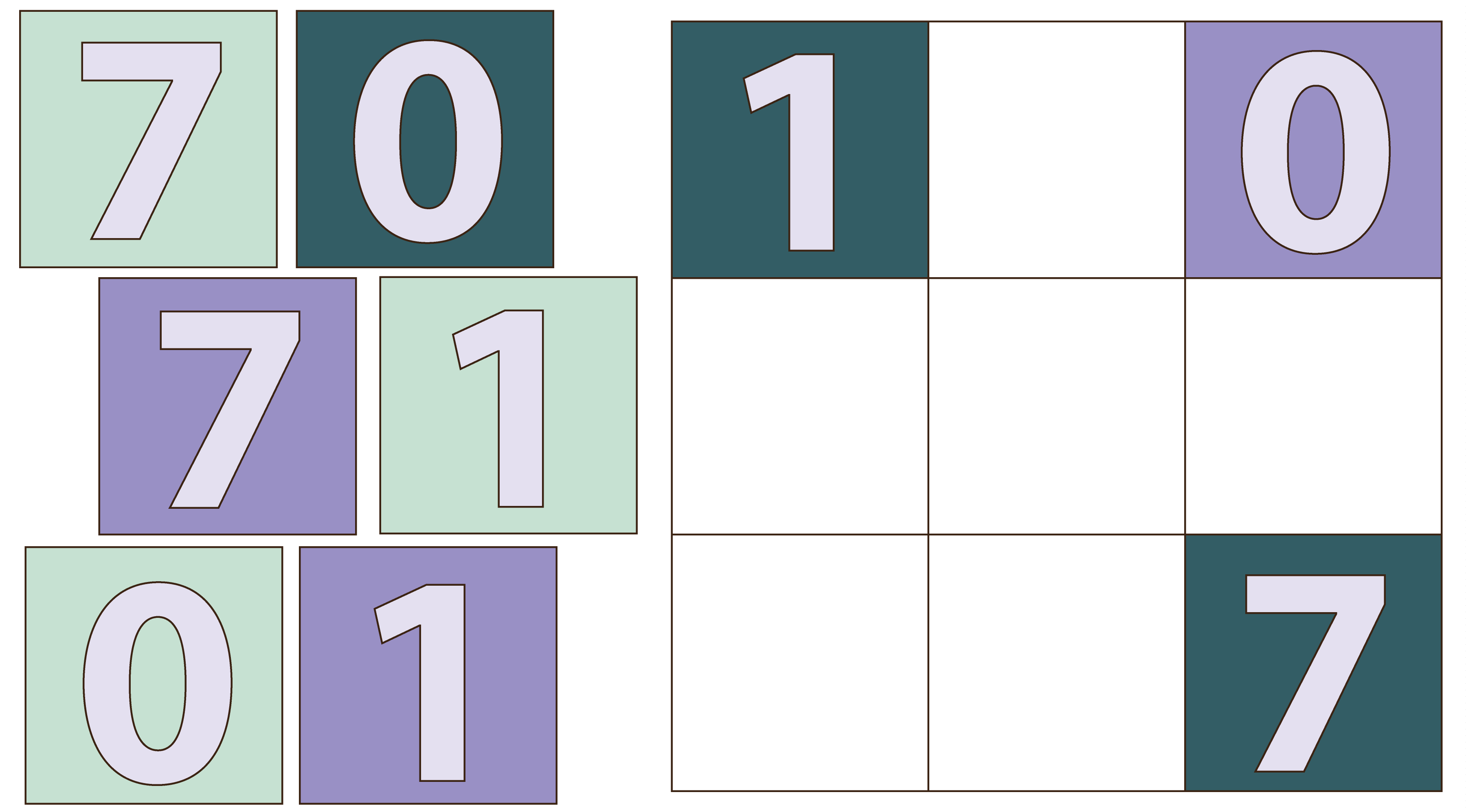
A Latin square is a grid filled with permutations: letters, numbers, or other symbols so that no row or column contains more than one of any character. You’ve probably seen the popular Latin-square puzzle called Sudoku. A Graeco-Latin square (also called an Euler square) is two independent Latin squares overlapping each other.
Can you complete this Euler square made by overlapping permutations of the digits of 170 with winter colors? Don’t repeat the same color OR the same number in any row or column.
Click the picture to get a larger image you can print.
What is a “living book”? English education reformer Charlotte Mason introduced this term for any book that brings the reader directly into contact with the major ideas that have fascinated humans across the ages.
We know that reading aloud helps build our children’s love for books. But did you know it works for math as well?
And that it can transform the parent’s attitude as well as the child’s?
A playful math book fleshes out the bones of abstract math, brings it alive, makes it human, relatable, interesting to readers of all ages, opening our eyes to the wonderful world of big ideas, where concepts meet and topics intertwine in a beautifully intricate dance of understanding.
We live in an age of abundance, with more new creative math books being published every year, so many that I can’t keep track of them all, not to mention the older classics, some out of print, that can still be found in public libraries.
Here are a few of my favorite books of playful, living math, both old and new:
“I think the most important thing that we need to change…we need to radically change what our idea is of what it means to learn math.
“Our biggest failure, both in the classroom and in homeschool settings, is that we’ve given our children a totally wrong idea of what math is all about.
Welcome to the 162nd edition of the Playful Math Education Blog Carnival — a smorgasbord of delectable tidbits of mathy fun. It’s like a free online magazine devoted to learning, teaching, and playing around with math from preschool to high school.
Bookmark this post, so you can take your time browsing.
There’s so much playful math to enjoy!
By tradition, we start the carnival with a puzzle/activity in honor of our 162nd edition. But if you’d rather jump straight to our featured blog posts, click here to see the Table of Contents.
Try This Puzzle/Activity
The number 162 is a palindromic product:
162 = 3 x 3 x 2 x 3 x 3
and 162 = 9 x 2 x 9
How would you define palindromic products?
What other numbers can you find that are palindromic products?
What do you notice about palindromic products?
What questions can you ask?
Make a conjecture about palindromic products. (A conjecture is a statement you think might be true.)
Make another conjecture. How many can you make? Can you think of a way to investigate whether your conjectures are true or false?
Welcome to the 160th edition of the Playful Math Education Blog Carnival — a smorgasbord of delectable tidbits of mathy fun. It’s like a free online magazine devoted to learning, teaching, and playing around with math from preschool to high school.
Bookmark this post, so you can take your time browsing.
There’s so much playful math to enjoy!
By tradition, we start the carnival with a puzzle/activity in honor of our 160th edition. But if you’d rather jump straight to our featured blog posts, click here to see the Table of Contents.
Try This Puzzle/Activity
Appropriately for an October carnival, 160 is an evil number.
A number is evil if it has an even number of ones in binary form. Can you find the binary version of 160? (Hint: Exploding Dots.)
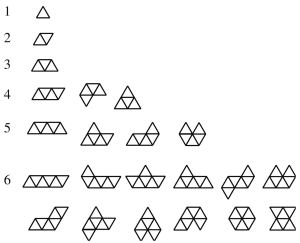
160 is also a polyiamond number. If you connect 9 equilateral triangles side-to-side, a complete set of 9-iamond shapes would have 160 pieces.
But sets that large can be overwhelming. Try playing with smaller sets of polyiamonds. Download some triangle-dot graph paper and see how many different polyiamond shapes you can make.
What do you notice? Does it make you wonder?
What designs can you create with your polyiamonds?