Mental Math: Early Division

Boy doing mental math calculation

Mental math is doing calculations with our minds, though we can use scratch paper or whiteboards to make notes as we work.

Doing mental math, children use the basic principles of arithmetic to simplify problems so they can think about number relationships, mastering the basic structures of how numbers work, the same structures that underlie algebraic reasoning.

As always, we rely on two key mental-math strategies.

  • Use friendly numbers.
  • Estimate, then adjust.

Division is the mirror image of multiplication, the inverse operation that undoes multiplication, which means we are scaling numbers down into smaller parts. Important friendly numbers include halves, thirds, and tenths, plus the square numbers and any multiplication facts the student happens to remember.

Continue reading Mental Math: Early Division

Mental Math: Early Multiplication

mother and daughter talking math together

Children learn best through interaction with others, and mental math prompts can lead to fascinating conversations, listening as our kids apply their creativity to the many ways numbers interact.

With mental math, students master the true 3R’s of math: to Recognize and Reason about the Relationships between numbers.

And these 3Rs are the foundation of algebra, which explains why flexibility and confidence in mental math is one of the best predictors of success in high school math and beyond.

Let’s Try an Example

Multiplication involves scaling one number by another, making it grow twice as big, or three times as much, or eightfold the size. Multiplication by a fraction scales the opposite direction, shrinking to half or a third or five-ninths the original amount.

The key friendly numbers for multiplication and division are the doubles and the square numbers. As with addition and subtraction, students can estimate the answer using any math facts they know and then adjust as needed.

How many ways might children think their way through the most-missed multiplication fact, 8 × 7?

Continue reading Mental Math: Early Multiplication

FAQ: How To Start a Homeschool Math Club

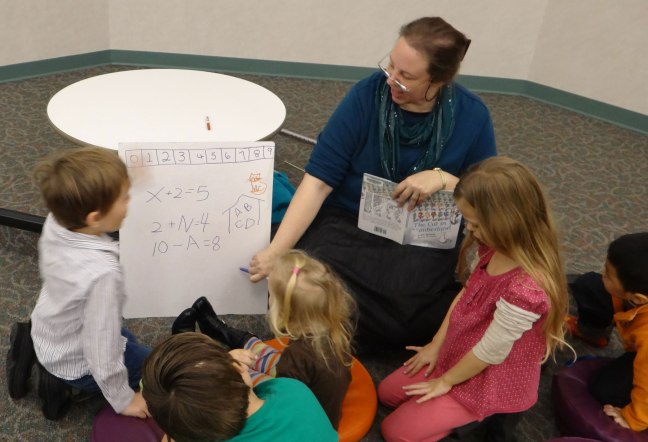
Denise Gaskins reading math with preschoolers

The question hits my inbox whenever parents start planning for a new school year:

“Hello! I am on the board of a homeschool co-op. We have had requests for a math club and wondered if you have any tips for starting one. We service children from K-10th and would need to try to meet the needs of as many ages as possible.”

There are several ways you might organize a homeschool math club, depending on the students you have and on your goals. I think you would have to split the students by age groups — it is very hard to keep that wide of a range of students interested. Then decide whether you want an activity-oriented club or a more academic focus.

When I started my first math club, I raided the math shelves in the children’s section at my library (510-519) for anything that interested me. I figured that if an activity didn’t interest me, I couldn’t make it fun for the kids. Over the years we have done a variety of games, puzzles, craft projects, and more — always looking for something that was NOT like whatever the kids would be doing in their textbooks at home.

Let’s look at the possibilities by grade level…

Continue reading FAQ: How To Start a Homeschool Math Club

Mental Math: Early Subtraction

mother and child doing math homework

By doing mental math, we help our children use the basic principles of arithmetic to simplify problems so they can think about number relationships, mastering the basic structures of how numbers work.

And the more our children practice these structures in mental math, the better prepared they will be to recognize the same principles in algebra.

The basic idea of subtraction is finding the difference between two quantities: comparing a larger amount to a smaller one, figuring out what’s left when you remove a part, or finding the distance between two measurements (or two points on the number line).

When you work with young children learning subtraction, remember our two key mental-math strategies.

  • Use friendly numbers.

For early subtraction with numbers less than 20, the most important friendly numbers are 5 and 10, the pairs of numbers that make 10, and the doubles.

  • Estimate, then adjust.

When children apply their creative minds to reasoning about math, they can use friendly numbers to get close to an answer, and then tweak the result as needed.

Continue reading Mental Math: Early Subtraction

New Membership Tiers: One-on-One Mentorship

Two women chatting over tea

Over the years, in my public writing and in personal correspondence, I’ve tried to help younger parents by sharing the things I wish someone would have told me forty years ago. Oftentimes, I will answer a question but never hear back what the person ended up doing or how their family got along.

It leaves me feeling as though I could have done more to encourage them along the way.

In the past few years, I’ve watched a professional writer I admire organize several more formal mentorships for younger indie authors to grow their writing and publishing careers. I think a similar program could be helpful for homeschooling families.

So now I’m offering two new Patreon membership tiers that give you a direct one-on-one connection with me through email or email-plus-video.

My goal is to help you think about math as a creative, playful investigation where you and your children explore concepts together using the math program or curriculum of your choice. This is not a tutoring arrangement. I will help you understand and teach math, but I will not do the teaching for you.

Here’s How It Works

(1) You email me every Sunday—or pick the day that works best for you, at least once every two weeks—to keep me up to date with what you are doing: good times, rough spots, progress or no progress, plans for the coming week. You can also ask any questions about math or education (or indie book publishing).

(2) I’ll write back with encouragement and tips, and I’ll answer questions to the best of my ability. Caveat: I’ve forgotten everything except the broad brushstrokes of calculus and beyond.

(3) If you signed up for a video mentorship, include in your first email a list of several dates and times when you would be available for our monthly one-on-one chat. I’ll compare that with my schedule to find a time we can meet.

Interested?

These new tiers are limited to a few members each—first paid, first in. Check out all the details on my Patreon home page.

Join me on Patreon

 
* * *

Thank you for reading!

“New Membership Tiers: One-on-One Mentorship” copyright © 2025 by Denise Gaskins. Image at the top of the post copyright © deagreez1 / Depositphotos.


Mental Math: Early Addition

child counting on fingers

From the very beginning of a child’s experience with math, we want to focus on reasoning, making sense of numbers, thinking about how they relate to each other and how we can use these relationships to solve problems.

The basic idea of addition is putting like things together: combining parts to make a whole thing, putting together sets to make a collection, or starting with an original amount and adding the increase as it grows. Connecting two numbers in relationship with a third number we call the sum.

When you work with young children learning addition, remember the two key mental-math strategies I mentioned in the previous post.

  • Use friendly numbers.

For early single-digit addition, the most important friendly numbers are 5 and 10, the pairs of numbers that make 10, and the doubles.

  • Estimate, then adjust.

When children apply their creative minds to reasoning about math, they can use friendly numbers to get close to an answer, and then tweak the result as needed.

Continue reading Mental Math: Early Addition

Tell Children Interesting Things

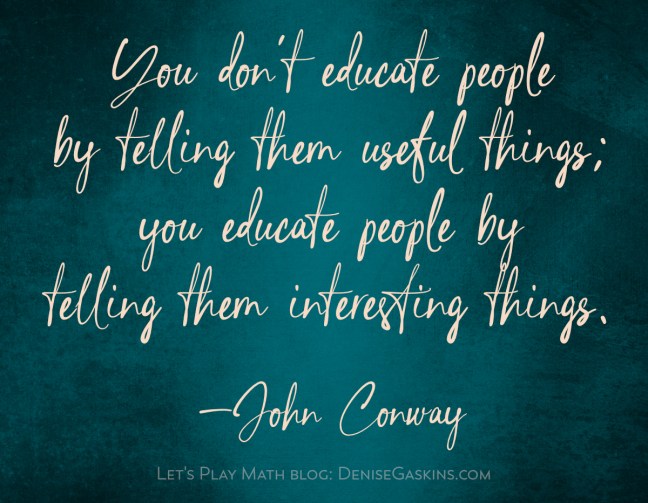
quote by John Conway

“You don’t educate people by telling them useful things; you educate people by telling them interesting things.”

— John Conway

If you want help educating your children with interesting things about math, check out Denise Gaskins’ Playful Math store.

We’re currently running a huge back-to-school sale on ALL of my playful math ebooks, problem-solving activities, math journaling task cards, and math art projects.

So many great ways to play with math!

The 20% discount will automatically apply when you check out. No discount code required.

Check it out:

Back to School Sale 2025

Morning Coffee: That Moment of Epiphany

Morning Coffee Lifelong Learning for Parents

One of the best ways we can help our children learn mathematics (or anything else) is to be lifelong learners ourselves.

Here are a few stories to read as you sip your morning brew. . .

Download your printable Morning Coffee journal

This week’s rabbit hole started with a thought-provoking article from Dan Meyer…

“It would have been quite easy, nothing at all really, to share the epiphany with students, to share the short-cut, to tell my kid that these are all the even numbers and here is where you’ll find them…”

—Dan Meyer

Read more about the value of taking the harder long-cut in this fifth installment of professional development for homeschooling parents.

 
* * *

Are you looking for more creative ways to play math with your kids? Check out all my books, printable activities, and cool mathy merch at Denise Gaskins’ Playful Math Store. Or join my email newsletter.

This blog is reader-supported. If you’d like to help fund the blog on an on-going basis, then please join me on Patreon for mathy inspiration, tips, and an ever-growing archive of printable activities.

“Morning Coffee: That Moment of Epiphany” copyright © 2025 by Denise Gaskins. Image at the top of post copyright © Kira auf der Heide / Unsplash.

Playing to Learn

quotation from Dan Finkel

“Play and rigor support each other.

    “When students are invited to play with math, they learn more deeply, more robustly, and remember more consistently.

      “Play is promoted as something that can engage kids and give them a more positive attitude about school, but it’s easy to assume that it’s not useful for learning, when in reality the opposite is true:

        “The student who is playing tends to be the student who is learning most deeply.”

        —Dan Finkel, Math for Love newsletter

        Mental Math: Three Basic Principles

        Doing mental math on the couch

        “We know that algorithms are amazing human achievements, but they are not good teaching tools because mimicking step-by-step procedures can actually trap students into using less sophisticated reasoning than the problems are intended to develop.”

        — Pam Harris, Math Is Figure-Out-Able Podcast

        Whether you work with a math curriculum or take a less-traditional route to learning, do not be satisfied with mere pencil-and-paper competence. Instead, work on building your children’s mental math skills, because mental calculation forces a child to understand arithmetic at a much deeper level than is required by traditional pencil-and-paper methods.

        Traditional algorithms (the math most of us learned in school) rely on memorizing and rigidly following the same set of rules for every problem, repeatedly applying the basic, single-digit math facts. Computers excel at this sort of step-by-step procedure, but children struggle with memory lapses and careless errors.

        Mental math, on the other hand, relies on a child’s own creative mind to consider how numbers interact with each other in many ways. It teaches students the true 3R’s of math: to Recognize and Reason about the Relationships between numbers.

        The techniques that let us work with numbers in our heads reflect the fundamental properties of arithmetic. These principles are also fundamental to algebra, which explains why flexibility and confidence in mental math is one of the best predictors of success in high school math and beyond.

        Your textbook may explain these properties in technical terms, but don’t be intimidated by the jargon. These are just common-sense rules for playing with numbers.

        Continue reading Mental Math: Three Basic Principles