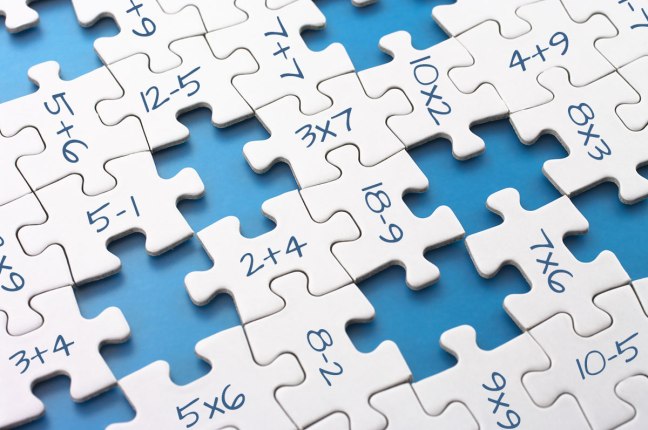
It came up again this week, one of the most frequently asked questions about homeschooling math:
“I believe it’s important for children to memorize the math facts, but my kids are struggling with mental math. How can I help them master these important number relationships?”
We all want our children to own the math facts, those basic relationships between small numbers that form the foundation of all arithmetic.
But I don’t think emphasizing memorization will develop the sort of fluency your children need.
The human brain remembers what it thinks about, so we want children using their brains and thinking as deeply as possible about number relationships from as many different perspectives as we can get, noticing patterns, finding connections, making sense of the math.
Tip 1: Tell Stories
Most people think in stories, not abstractions. So telling stories is a good way to get children thinking about math. Take turns making up number stories about favorite foods, pets, or toys. Encourage your children to make up stories for you to solve. Kids love trying to stump their parents!
This is a good way to fill little bits of time while driving, doing dishes, or sitting in a waiting room.
Tip 2: Play Games
Playing math games that rely on strategy (not speed) is a fun way to get kids thinking. I share a lot of these on my blog, and even more in my books.
Tip 3: Focus on Strategies
Mental math strategies help us reason logically about number relationships. They are more helpful than memorized facts because they give children something to fall back on when memory inevitably fails.
For several examples, see my blog post:
Pam Harris has a great podcast about helping children learn to think mathematically. Awhile back, they ran a series on mental math strategies for the basic operations and published a free 16-page handout to go along with it.
Check out the Math Is Figure-out-able archives:
- Ep 94: If Not Algorithms, Then What?
- Ep 95: If Not the Addition Algorithm, Then What?
- Ep 96: If Not the Subtraction Algorithm, Then What?
- Ep 97: If Not the Multiplication Algorithm, Then What?
- Ep 98: If Not the Division Algorithm, Then What?
- Ep 99: If Not Algorithms, Then What? Finale
- The Most Important Numeracy Strategies download
Tip 4: Then Memorize
Memorization is mop-up work, finishing things off, polishing the final bits. When your children have learned how to handle most of the math facts through play, with strategies firmly in place so they can figure out anything they forget, that’s when you can safely work on memory skills.
You may find Math for Love’s flashcard sets helpful. They use a variety of images to help children visualize number relationships.
Best wishes in the lifelong adventure of learning!
* * *
Most of us have at least one math fact that never sticks in memory. For me it’s 7×8. What’s yours?
This blog is reader-supported.
If you’d like to help fund the blog on an on-going basis, then please join me on Patreon for mathy inspiration, tips, and an ever-growing archive of printable activities.
If you liked this post, and want to show your one-time appreciation, the place to do that is PayPal: paypal.me/DeniseGaskinsMath. If you go that route, please include your email address in the notes section, so I can say thank you.
Which I am going to say right now. Thank you!
“FAQ: Memorizing the Math Facts” copyright © 2023 by Denise Gaskins. Image at the top of the post copyright © Tadamichi / Depositphotos.
 Denise Gaskins' Let's Play Math