Playful Math 178: Nicomachus’s Carnival

Playful Math Blog Carnival 178

Welcome to the 178th edition of the Playful Math Education Blog Carnival — a smorgasbord of delectable tidbits of mathy fun. It’s like a free online magazine devoted to learning, teaching, and playing around with math from preschool to high school.

Bookmark this post, so you can take your time browsing.

There’s so much playful math to enjoy!

By tradition, we start the carnival with a puzzle/activity in honor of our 178th edition. But if you’d rather jump straight to our featured blog posts, click here to see the Table of Contents.

Activity: Nicomachus’s Theorem

Welcome to 2025, a perfectly square year — and the only one this century!

2025 = (20 + 25)2

  • When is the next time we’ll have a perfect-square year?
  • Can you find the only perfect square less than 2025 that works by this pattern? When you split the number’s digits into two smaller numbers and square their sum, you get back to that number.

2025 = the sum of all the numbers in the multiplication table, from 1×1 to 9×9

2025 = the sum of the first 9 perfect cubes

  • When is the next time this will happen, that the year is the sum of the first n perfect cubes?

And by Nicomachus’s theorem:

2025 = 13 + 23 + 33 + 43 + 53 + 63 + 73 + 83 + 93
so it must also = (1 + 2 + 3 + 4 + 5 + 6 + 7 + 8 + 9)2

Try it for yourself with small numbers: Get some blocks, and build the first few perfect cubes. Then see if you can rearrange the block to form the sum of those numbers squared.

Can you show that…

  • 13 = 12
  • 13 + 23 = (1 + 2)2
  • 13 + 23 + 33 = (1 + 2 + 3)2
  • 13 + 23 + 33 + 43 = (1 + 2 + 3 + 4)2
  • 13 + 23 + 33 + 43 + 53 = (1 + 2 + 3 + 4 + 5)2

Nicomachus theorem 3D

Older Students: Can you see that the pattern would continue as long as you want? How might you prove that?

Here’s the formula for triangular numbers, to get you started:

(1 + 2 + 3 + … + n) = n(n + 1)/2

Click here for all the mathy goodness!

FAQ: Can I Use Your Books as a Math Curriculum?

Father helping girl with math homework

I recently listened to you on Cindy Rollins’ podcast, and I was captivated by your perspective on math. It was exciting, freeing, and wonder-filled. I would absolutely love to be able to teach in the ways you described.

    We use early-elementary Saxon Math right now, which is thorough, but has SO MUCH to do that I’ve always struggled to do it all. Then I feel like I’m missing things, and I never know quite what is important. And yet, the actual lessons move so slowly that my kids get bored with the repetition.

      I use a published curriculum because I have no idea of an appropriate scope and sequence, or similar flow of learning. With your playful approach to math, how do I know where to start, and what to do each day?

        Do you have a suggested order to approach your books to have a full math approach? A sort of curriculum, per se, using your books.

        [For those who missed my chat with Cindy Rollins about a Charlotte Mason approach to math, you can listen to it here.]

        Continue reading FAQ: Can I Use Your Books as a Math Curriculum?

        FAQ: Real Math for Early Learners

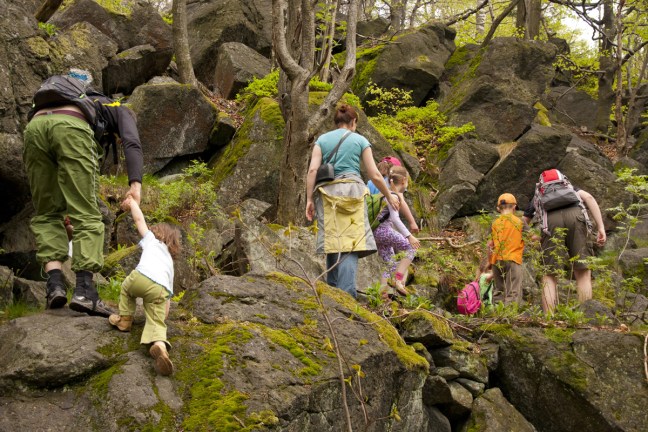
        photo of family hiking a rocky trail

        “I love your image of math as a nature walk. My children are ready to start their homeschooling journey, and I want to put them on the right track from the beginning. How can I help them think about math and problem-solving without using a textbook?”

        The most difficult part of teaching our children real math is to change our own way of thinking about the subject you’ve already taken that step, so it looks like your family’s learning journey is off to a great start.

        [For readers who are wondering what I mean by math as a nature walk, check out this post. You may also enjoy my article on natural learning: Math with Young Children.]

        Continue reading FAQ: Real Math for Early Learners

        Memories: The Oral Story Problem Game

        photo of sheep in a field

        Homeschool Memories…

        Perhaps you’ve heard me mention the oral story problem game. It was one of my favorite ways to get my children thinking about math, back in our early days of homeschooling. We played in the car on the way to soccer practice, or while we washed dishes, or sitting in the lobby waiting for a doctor’s appointment.

        The rules are simple: I’ll make up a math problem for you to solve. And then you make up one for me.

        The kids always loved trying to stump me.

        This problem from Henry Ernest Dudeney’s Amusements in Mathematics reminded me of those days. This is exactly the way my eldest loved to torture me…

        Continue reading Memories: The Oral Story Problem Game

        Start the New Year Right: Playful Math Carnival 177 via Math Hombre

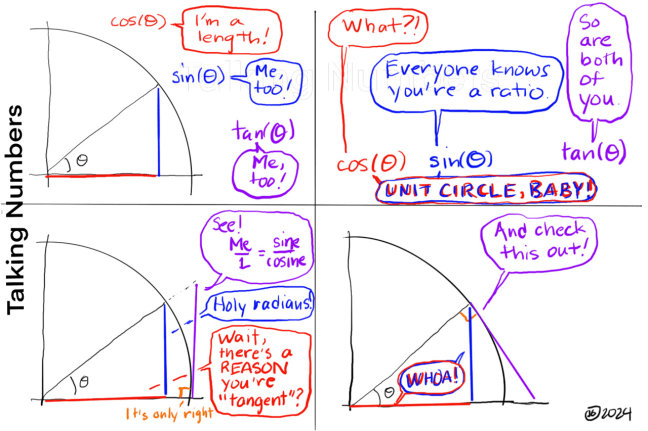
        Talking Numbers from Playful Math Carnival 177

        If you’re looking for an entertaining way to weather the coming storm — or just curious about how learning math could possibly be fun — you’ll definitely want to check out the latest edition of the Playful Math Carnival.

        It’s a collection of awesome blog posts curated by John Golden and published on the Math Hombre website:

        The whole point of the carnival is to show that math doesn’t have to be tedious or repetitive. Through a bunch of fun and engaging posts, we celebrate math that’s playful, creative, and totally relevant to everyday life.

        Because what could be more relevant than having fun while we learn?

        Continue reading Start the New Year Right: Playful Math Carnival 177 via Math Hombre