
Childhood Memories
When I was in school, math was something each person did on their own for homework, quizzes or tests.
Even when the teacher sent us to work on the chalkboard, each person did their own problem. We would never think to collaborate on math.
To look at someone else’s answer was considered cheating.
Math in the Real World
But in the real world, mathematicians collaborate all the time. They work together, bounce ideas around, compare their thoughts to what others have done, brainstorm what to try next.
And even when they are working on a solo project, they are still part of the Great Conversation through reading each other’s work in journals and going to conferences. In the real world, you get to look at each other’s answers all the time.
Math is a social game, where each player builds on everyone else’s work.
Practical Ideas
How can we bring this collaboration, this sense of community, into our children’s experience of math?
(1) Avoid routine, repetitive practice problems. If your children need to practice something repetitive, try making it into a game.
- Try some of my favorite math games.
(2) Use Notice-and-Wonder to turn math problems into a cooperative investigation. Brainstorm together. How many observations can you make? How many questions can you ask? Do any of those noticings or wonderings stand out and make you curious enough to pursue them?
- For specific examples, check out my If Not Methods blog post series.
(3) If you use a textbook or workbook program, do it as Buddy Math. It’s like Charlotte Mason-style narration that you can do with any math program.
- Get all the details in my blog post: Buddy Math.
(4) Bring a bunch of kids together for a math club or math circle. Invite friends over for a math play date. Be sure to have snacks, because mental work requires energy. Also, that makes it more like a party.
- Need activity ideas? Check out these puzzles from the Julia Robinson Mathematics Festival.
Play with Conjectures
Make a conjecture. A conjecture is a statement that you think might be true.
For example, you might make a conjecture that “All odd numbers are…” How would you finish that sentence?
Make another conjecture. And another. Does thinking about your conjectures make you wonder about math?
Can you think of any way to test your conjectures, to discover if they will always be true?
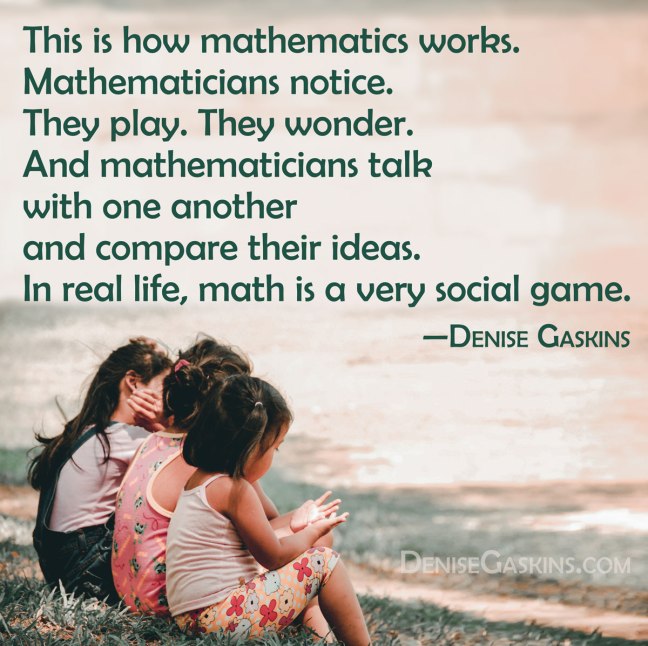
This is how mathematics works. Mathematicians notice something interesting about certain numbers, shapes, or ideas. They play around and explore how those relate to other ideas. After collecting a set of interesting things, they think about ways to organize them. They wonder about patterns and connections. They make conjectures and try to imagine ways to test them.
And mathematicians talk with one another and compare their ideas. In real life, math is a very social game.
* * *
Are you looking for more creative ways to play math with your kids? Check out all my books, printable activities, and cool mathy merch at Denise Gaskins’ Playful Math Store. Or join my email newsletter.
This blog is reader-supported. If you’d like to help fund the blog on an on-going basis, then please join me on Patreon for mathy inspiration, tips, and an ever-growing archive of printable activities.
“Musings: Math Is a Social Game” copyright © 2025 by Denise Gaskins. “Make a Conjecture” section is an excerpt from my book Prealgebra & Geometry: Math Games for Middle School. Image at the top of the blog copyright © Charlein Gracia on Unsplash.
 Denise Gaskins' Let's Play Math
Terrific post, Denise! Your take on math as a social game is spot-on and inspiring. Highlighting how collaboration and even missteps drive mathematical play makes it so approachable. It’s a brilliant way to ignite curiosity and show math’s lively, human side. Love this fresh perspective!
And when we involve our students in discussions, we can draw out their understanding of the topics rather than just trying to funnel our ideas into their heads.