Conversion Factors: How Old Are You in Nanoseconds?
birthday cupcake with sparkler

Homeschool Memories

[Based on a problem I made up for my co-op students, once upon a time…]

Conversion factors are special fractions that contain problem-solving information. Why are they called conversion factors?

  • “Conversion” means change, and conversion factors help you change the numbers and units in your problem.
  • “Factors” are things you multiply with. So to use a conversion factor, you will multiply it by something.

For instance, if I am driving an average of 60 mph on the highway, I can use that rate as a conversion factor. I may use the fraction:

Or I may flip it over to make:

It all depends on what problem I want to solve.

After driving two hours, how far have I gone?

But if I am planning to go 240 more miles, how much longer will it take?

Any rate can be used as a conversion factor. You can recognize them by their form: this per that. Miles per hour, dollars per gallon, cm per meter, and many, many more.

Of course, you will need to use the rate that is relevant to the problem you are trying to solve. If I were trying to figure out how far a tank of gas would take me, it wouldn’t be any help to know that an M1A1 Abrams tank would get about 1/3 mile per gallon. I won’t be driving one of those.

Continue reading Conversion Factors: How Old Are You in Nanoseconds?

Podcast: Charlotte Mason’s Living Math

family doing math together

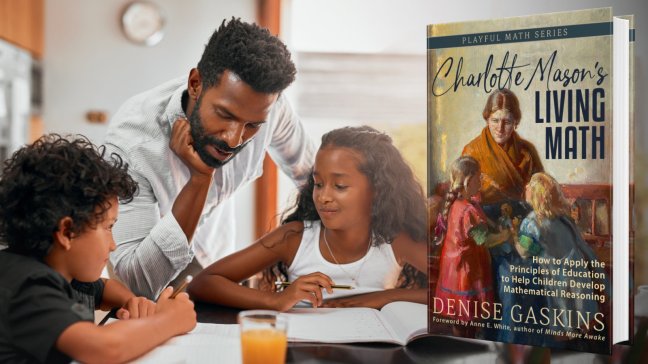
Cindy Rollins, Dawn Duran, and I had a delightful chat about my new book, Charlotte Mason’s Living Math, which is now available in ebook (print editions coming soon!) at my Playful Math Store.

We talked about how math is a whole world full of big, living ideas that we can explore with our children. What it means to have a living education in math, opening our children’s minds to big ideas about the relationships of numbers, shapes, and patterns. And how to tell if our kids really understand what they are doing, or if they’re just parroting back the steps we taught them.

And lots more — listen for yourself:

“Math doesn’t have to be a drudgery, a chore that we finish so we can check it off of our list. Math can be a delight when we give children things to think about, ideas to wonder about. When we explore the world of numbers and shapes together, math can be a playful delight for the whole family.”

—Denise Gaskins

For full show notes, see Season 11, Episode 144: Charlotte Mason’s Living Math with Denise Gaskins.

 
* * *

Are you looking for more creative ways to play math with your kids? Check out all my books, printable activities, and cool mathy merch at Denise Gaskins’ Playful Math Store. Or join my free email newsletter on Substack.

This blog is reader-supported. If you’d like to help fund the blog on an ongoing basis, then please join me on Patreon (or choose the paid level on Substack) for mathy inspiration, tips, and an ever-growing archive of printable activities.

Column Jumping: An Investigation

man jumping on rock columns

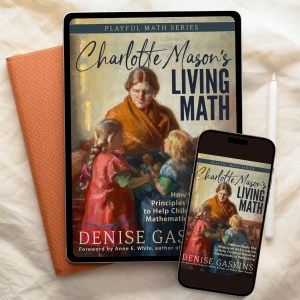
Charlotte Mason's Living Math ebook editionIn my new book, Charlotte Mason’s Living Math, I encourage families to explore the world of math by asking big, open-ended questions.

[Now available exclusively in my Playful Math Store! Ebook only at the moment, but print editions are coming soon.]

Here’s an example of such a question, an excerpt from my earlier book, 70+ Things To Do with a Hundred Chart: Number, Shape, and Logic Activities from Preschool to Middle School.

Have fun exploring math with your kids!

Continue reading Column Jumping: An Investigation