
“The value of a problem is not so much coming up with the answer as in the ideas and attempted ideas it forces on the would-be solver.”
—I. N. Herstein
Whenever I give a problem or puzzle in an Alexandria Jones story, I’ll try to post the answer soon afterward.
But don’t peek!
In the old days of my snail mail newsletters, the answers always came in the next issue, so students had two months to let the puzzle ruminate without temptation.
After all, if you only read the answer I give, you miss out on the fun of solving the puzzle. Follow the Math Adventurer’s Rule:
- Figure it out for yourself!
Give the problem a good workout on your own. See what you can notice about the puzzle. Wonder about how it connects to the larger world of mathematics.
Play with the ideas and find out where they may lead.
Then check the answer just to prove you got it right, and maybe to see whether we did it the same way. There’s always more than one way to approach any math problem, and each method offers its own insights.
Surveying the Egyptian Farm
Did you try to find the area of the Egyptian farm?
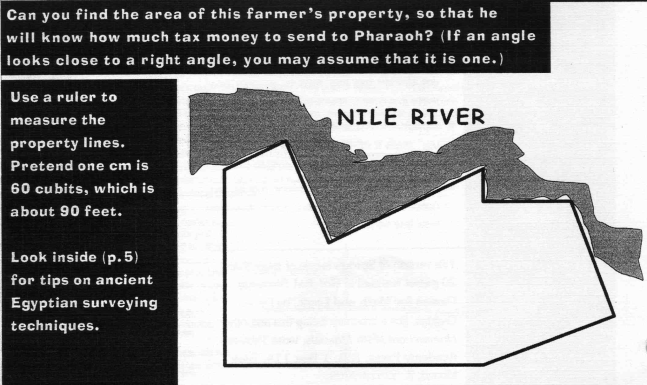
Divide the property into rectangles and right triangles, calculate the area of each piece, and then add the areas all together to find the total area of the farm. Your answer will depend on what size the map came out when you printed it, because each printer has its own idiosyncrasies.
Also, there will be round-off error and slight differences in the way people measure—did you read the inside of the dark line, or the outside, or try to estimate the center?—so don’t expect your answer to match mine exactly. But the order of magnitude should be the same.
My map had the long line at the bottom almost exactly 7 cm long. I was able to divide the farm into one large rectangle and five smaller right triangles, and I calculated the entire area as about 45 square cm.
Since one cm stands for 60 cubits, each square cm represents 60 × 60 = 3600 square cubits.
So the total area of the farm on my print-out was approximately 162,000 square cubits.
Proportional Reasoning
But your map might have come out a very different size, depending on your printer settings. Then how can we compare answers?
You have to understand ratios and proportions.
A ratio is a fraction that compares one number to another.

A direct proportion says one ratio is equal to another ratio.
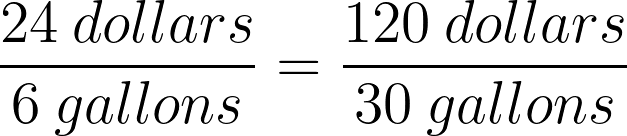
The key in a proportion is to make sure that the numbers match each other in type. For example, it would be nonsense to compare dollars/gallon to cups/quart.
But if you are buying gas, the dollars/gallon should be equal whether you buy a lot or a little. So we could set up a proportion like this:
Proportional Measurements
In the case of our farm puzzle, we want to compare the ratio of our measurements:

But what measurements shall we compare?
Area is directly proportional to length squared. That means that for any similar shapes—like your map and mine—we can make a ratio comparing the overall area to the square of one side’s length measurement. As long as we both measure the same side, your ratio should be equal to mine.
And the coolest thing about proportions is that the units don’t matter, as long as we are consistent. We can compare cm to cubits, as long as we do the same thing in each ratio.
In the case of the farm plot, the following proportion should be true despite our different printer settings:

So to check whether our answers agree:
- Measure (in cm) the long line at the bottom of your map. Call that length your baseline, b.
- Multiply that number times itself to find b^2.
- Calculate your answer (in square cubits) for the area of the farm. Call it A.
- Calculate your ratio: A ÷ b^2.
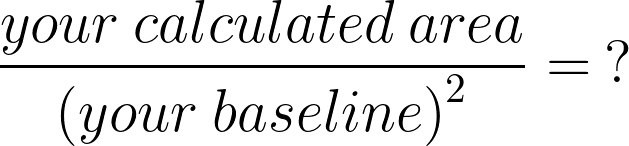
That should be the same as my ratio, within a reasonable margin for differences in measurement or rounding off numbers.

A Research Project
Would you like to know how big the Egyptian farm is in “real life”?
There is enough information given in the problem. You will need to use conversion factors to switch between a hodgepodge of units: cm, cubits, feet, and square kilometers or acres (your choice).
If you don’t remember how conversion factors work, check out my blog post “How Old Are You in Nanoseconds?”
I will give you this hint: Our hypothetical Egyptian farmer was not a wealthy man.
Playing with Ratios
If you’d like to have some more fun with ratio math, try this puzzle from my Let’s Play Math blog:
(Rates are just ratios where the two numbers are different types, like dollars/gallon or for my voracious daughter, books/day.)
* * *
“Ratios and Proportional Reasoning” copyright © 2026 by Denise Gaskins. Image at the top of the blog copyright © Flying Carpet / Unsplash.
Are you looking for more creative ways to play math with your kids? Check out all my books, printable activities, and cool mathy merch at Denise Gaskins’ Playful Math Store. Or join my email newsletter.
This blog is reader-supported. If you’d like to help fund the blog on an ongoing basis, then please join me on Patreon (or choose the paid level on Substack) for mathy inspiration, tips, and an ever-growing archive of printable activities.

