Let’s Play Math in Korean

Ooo, look at my shiny new book! Let’s Play Math is now out in Korean. How cool is that?

You can find the book at these two major bookstores:

And probably in other places where Korean education or parenting books are sold.

I’m sorry to say I can’t read Korean — but I did play math there a couple years back. My daughter teaches English through EPIK, and I had a wonderful visit with her in Jeju. If you’re interested, you can see a few of my photos here, and my fraction-math sidewalk puzzle here.

And if you know a Korean-speaking family who wants to play math with their kids, I’d be honored if you share my book.

10 Ways to Play Math with Play-Doh

Today we have a guest post from Lucy Ravitch, author of the new Kickstarter picture book Trouble with Monkeys: A math concept story of place value. She’s sharing a few ideas from her Math Activity Thursday (M.a.Th.) video series. Enjoy!


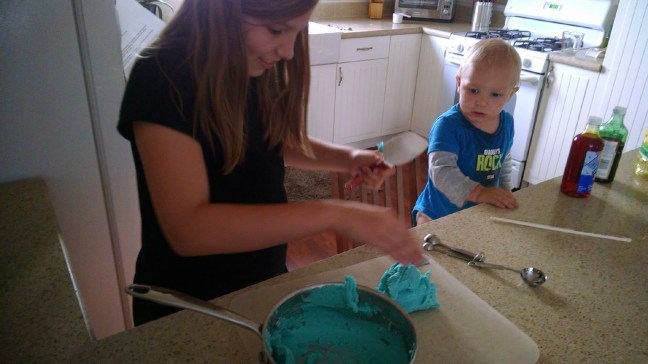
Hello, math fans and enthusiasts! Each week I try to give you and your family a fun math activity to try. Two months ago I posted this video with ten ways to turn play dough into an engaging activity for lower and upper elementary math.

If you want to make your own dough from scratch here are a few simple recipes. I encourage you to let your children play freely at first, before trying these activities.

Below I have identified some of the math concepts that your kids will experience as they play.

1. Toss It

Practice counting. With older children, record your results and make a graph of the data.

  • How many times can you catch it in a row? What’s your average number of tosses?
  • Talk about attributes. Does the size or color of the play dough balls make a difference?
  • How high are you tossing it? Talk about measuring systems. Do you use feet and inches, or meters and centimeters?
  • If you know how to juggle, time how long you can keep the balls going.

2. Smash It

Make several small balls or pieces. Then play as you smash them.

  • Play a NIM game: Make 10-15 small play dough balls. Take turns. On your turn, you can smash one ball or two. Whoever smashes the last ball wins the game.
  • Or smash your math facts: Choose several equations for your children to practice. Write each answer on a 3×5 card. Lay out each card next to a play dough piece. As you call out the equations, kids smash the play dough next to the correct card.

3. Shape It

Have fun molding your play dough. Roll it out to cut shapes.

  • Try making 3D shapes while practicing your math vocabulary. MathisFun.com has a great section about solid geometry. Can you find three math terms that are new for you?
  • Roll out the dough and cut 2D shapes. Discuss their attributes. Can you cut your shape in half to be symmetrical?

4. Hide Things in It

Find small objects around the house and enclose them inside play dough.

  • Take turns hiding small objects in play dough. Optional: Give a one-minute time limit to guess before opening it. This gives you and your kids a chance to talk about size, shape, or other attributes.
  • Have challenges to use the least amount of dough to hide identical objects. Two players have two minutes to hide an object in as little play dough as possible. The object must be completely concealed within the dough. What methods will you use?

5. Make Imprints on It

Show off your design skills and observe textures.

  • You can practice counting as you poke and press your fingers or objects into the dough. Older children can discuss the distance between impressions and/or the pressure applied.
  • As you and your kids make designs, talk about what you notice: Is your design symmetrical? What tools did you use (toothpicks, pencils, marbles, fingers, toy cars)? Which objects make interesting textures?

6. Cut It

Use a butter knife or the edge of a ruler to cut your play dough. Discuss findings as you play and explore.

  • In the video, I posed the question: how many sections do you get if you make only three cuts? Try it and see.
  • Does the number of pieces change if you use a shape other than a flat circle?
  • Discuss making straight cuts that will intersect or be parallel. Bring in more geometry terms.
  • Experiment with a different number of cuts.

7. Weigh It

Pull out a kitchen scale or balancing scales to use with dough.

  • Older children can make conversions between ounces to grams. They can make calculations about doubling or multiplying the measured weight. With younger kids, try using balancing scales. Compare the weights between pieces.
  • Try making two pieces that weigh exactly the same. This is harder than it sounds! For small children, this gives them the opportunity to see that the mass (weight) of an object can come in different shapes.

8. Measure It

Use a ruler or measuring tape while you play. There are several ways you can measure your dough — height, width, and length.

  • How long can you extend one ounce of dough? Pick your own size/weight of play dough and see who can get the longest. What fraction of a yard or meter is it?
  • Discuss height and what it takes to make dough stand vertically. How tall can you get three ounces to stand? Can anything help make it taller?

9. Roll It

Make sure you have plenty of room for this activity. Playing outside or on smooth floors works best.

  • With one push how far does your play dough roll? Is there an ideal size for a piece? Is there an ideal weight for rolling?
  • Is the ground sloped? What effects does the rolling surface have?
  • Why do some shapes roll easily while others don’t? Can you create a not-round shape that will roll?

10. Compare It

Compare similarities and differences between dough colors and types. Consider comparing the previously listed activities

  • If you made your own dough, compare consistency between batches. Is homemade dough denser or lighter than store-bought dough?
  • What are differences between the dough you played with and the dough that has not been touched?
  • Which of these activities do you think will take the shortest amount of time? The longest? Or put the activities in order based on how much dough you will need — least to greatest.

May you and your students have fun as you play with dough!


About the Author

Lucy blogs at kidsmathteacher.com and is the author/creator of Kids Menu Books. The first book in that series is The Pancake Menu, an interactive book that lets kids practice math as they play restaurant.

And be sure to visit Lucy’s Kickstarter project! She’s teamed up with artist Trav Hanson to create the delightful picture book Trouble with Monkeys: A math concept story of place value.

Math Humor and Copywork

Homeschool Memories…

The more years we spent homeschooling, the more I appreciated Charlotte Mason’s work and tried to incorporate her ideas into our laid-back, eclectic, not-quite-unschooling program.

We never fit the typical Charlotte Mason mold. Mosquitos and natural laziness limited our nature walks, and our version of narration was much too informal.

But those are just techniques, methods.

What really interests me in Mason’s writing is the philosophy behind the methods. Two points resonated: That we must respect our children as persons in their own right. And that we must provide a generous, wide-ranging feast to their minds.

Striving to live out those principles had a profound influence on our day-to-day homeschooling.

Continue reading Math Humor and Copywork

New Book: Word Problems from Literature

The posts on my Let’s Play Math blog are, for the most part, first-draft material. Of course, I’ve proofread each post — many times! because I’m a perfectionist that way, and yet I still miss typos :-/ — but these articles haven’t gotten the sort of feedback that polishes a book manuscript.

Well, now I’m taking some of the best of my old blog posts, expanding them with a few new games or activities, and giving them that book-quality polish. Let me introduce my newest series, the Playful Math Singles.

Under Construction …
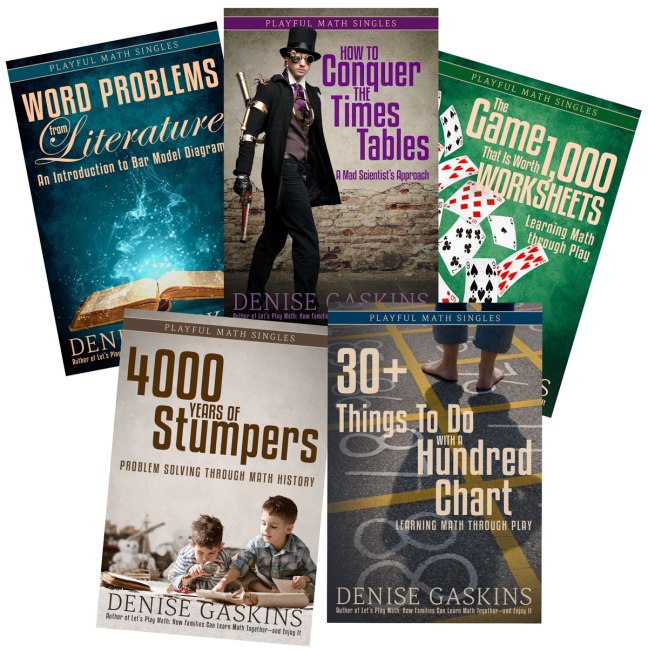
The Playful Math Singles from Tabletop Academy Press will be short, topical books featuring clear explanations and ready-to-play activities.

I’m hoping to finish up two or three of these this year. Watch for them at your favorite online bookstore.

The first one is done …

Word Problems from Literature: An Introduction to Bar Model Diagrams
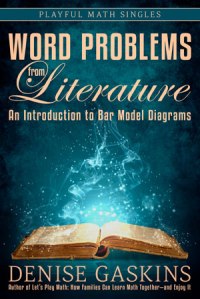
You can help prevent math anxiety by giving your children the mental tools they need to conquer the toughest story problems.

Young children expect to look at a word problem and instantly see the answer. But as they get older, their textbook math problems also grow in difficulty, so this solution-by-intuitive-leap becomes impossible.

Too often the frustrated child concludes, “I’m just not good at math.”

But with guided practice, any student can learn to master word problems.

Word Problems from Literature features math puzzles for elementary and middle school students from classic books such as Mr. Popper’s Penguins and The Hobbit.

For each puzzle, I demonstrate step by step how to use the problem-solving tool of bar model diagrams, a type of pictorial algebra. For children who are used to playing with Legos or other blocks — or with computer games like Minecraft — this approach reveals the underlying structure of a math word problem. Students can make sense of how each quantity in the story relates to the others and see a path to the solution.

And when you finish the puzzles in this book, I’ll show you how to create your own word problems from literature, based in your children’s favorite story worlds.

Buy now at your favorite online bookstore.

If you’re using these word problems with your children, consider buying them the paperback companion Word Problems from Literature Student Workbook.

… and People Like It!

A screen shot from this past weekend:

“I found this method really clarified for me what was going on visually and conceptually. Particularly when it came to more complex questions, for which I would normally write out an equation, I felt that thinking about what was going on with the bars actually made more sense … This is a wonderful book for those who want to support their children in finding better ways to work on word problems.”

—Miranda Jubb, Amazon customer reviewer
Playful Math on Kickstarter

Have you noticed that we live in a wonderful era of mathematical innovation? Not only at the “it’s all over my head” level — which is growing faster than anyone can keep up with — but also at the Cool Math For Kids level.

For instance, our children can enjoy Patterns of the Universe, and Prime Climb, and This is Not a Maths Book, and Which One Doesn’t Belong?, and Tiny Polka Dot, and Math & Magic in Wonderland, and Spiraling Pentagons, and …

So many things! I’m sure I forgot one (or several) of your favorite modern-classic math books or toys. I’d love to hear about them in the comments.

And here are a few bits of new playful math. Click, support, and share!

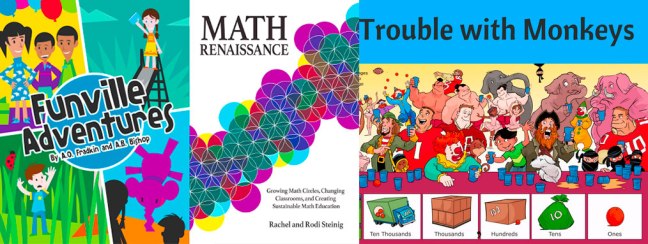
Math Renaissance

In alternating chapters, Rodi Steinig tells stories about her math circle and exactly what happens there, while her daughter Rachel discusses why so many kids hate math, documents the ways math is taught in the classroom — and ways that can be improved.

I first discovered Rodi’s work through her chapter in Sue VanHattum’s wonderful collection Playing with Math: Stories from Math Circles, Homeschoolers, and Passionate Teachers. I’ve been a fan of Rodi’s math circle blog for years, and I can’t wait to get my hands on her new book.

Funville Adventures

When 9-year-old Emmy and her 5-year-old brother Leo go down an abandoned dilapidated slide, they are magically transported into Funville — a land inhabited by ordinary-looking beings, each with a unique power to transform objects.

I had the fun of previewing this book. It’s a cute little fairy tale that should help launch family conversations about math.

Trouble with Monkeys

A boy wants to surprise his dad, but meddlesome monkeys keep getting in the way. The boy is interviewed by the local news, and the story escalates to involve pirates, ballerinas, ninjas — and the magic of our place value number system.

Lucy Ravitch, math blogger and author of The Pancake Menu, teams up with artist Travis Hanson (one of my favorite comic bloggers) to create a story that will build number sense.

This story reminds me of the Cookie Factory Model for long division. Place Value is a key to understanding many things in math.

GregTangMath Home Kit

I haven’t seen these games in person, but they sure look like fun.

And Others?

If you know a project we should all check out, please share in the Comments section below.

Playful Math Education Carnival 108 at Math Hombre

Check out the new Math Teachers at Play blog carnival at Math Hombre blog. You’re sure to enjoy this month’s collection of playful math for all ages.

The carnival features numberless problems, math circles, bookmaking, talking with kids, infinite series, division, number routines, calculus, inspiring tips for teachers, and much more.

Click here to go read the carnival blog!

Do You Want More Ways to Play with Math?

Past carnivals are still full of mathy treasure. See them all on Pinterest:

Even a Math Workbook Can Be a Game

Homeschool Memories…

My youngest daughter wanted to do Singapore math. Miquon Red was her main math text at the time, but we added a bit of Singapore Primary Math 1B whenever she was in the mood.

We turned to the lesson on subtracting with numbers in the 30-somethings.

Continue reading Even a Math Workbook Can Be a Game

Playful Math Education Carnival 107 at Give Me a Sine

Check out the new carnival of playful math for all ages at Give Me a Sine blog. Each month’s carnival brings you a great new collection of puzzles, math conversations, crafts, teaching tips, and all sorts of mathy fun.

This month’s post features symmetry, origami, and an ant hotel. Percents, fractions, decimals, and the bathroom sink. Algebra, geometry, and trig. And much more!

Click Here to Read the Carnival Blog

Hey, Blogger, Can You Spare a Time?

Do you write an education or family blog? Classroom teacher, math coach, homeschooler, parent, college professor, unschooler — anyone interested in helping kids play around with math? Please consider volunteering to host the MTaP blog carnival for one month.

We still need volunteer hosts for fall semester 2017. Or plan ahead: 2018 is wide open.

You choose the month that fits your schedule and decide how much effort you want to put in. Writing the carnival can take a couple of hours for a simple post — or you can spend several days searching out and polishing playful math gems to share.

If you want more information, read the MTaP Math Education Blog Carnival home page. Then let me know which month you want.

CREDITS: Carnival fireworks photo by Andrew Lane via Flickr (CC BY 2.0) edited to add carnival number.

Rabbit Trails and Fibonacci Poetry

Homeschool Memories…

Well, I hadn’t planned on spending my day that way. But one of the great things about homeschooling is the freedom to follow rabbit trails.

While browsing the Carnival of Homeschooling, I found a link to Farm School blog’s article Fib Foolery, which sent me to Gotta Book for his articles The Fib and More Fibbery (read the comments on both threads, but be warned that some are crude) and several other posts, all of which set me off on a morning of poetic fun.

A “Fib” is a Fibonacci poem. It’s based on syllable count, like a haiku, but the lines follow the Fibonacci counting series: 1, 1, 2, 3, 5, 8… Each number is the sum of the previous two numbers.

I knew what I was going to share at our Tuesday Teatime and Poetry Reading that afternoon.

Continue reading Rabbit Trails and Fibonacci Poetry

There Ain’t No Free Candy

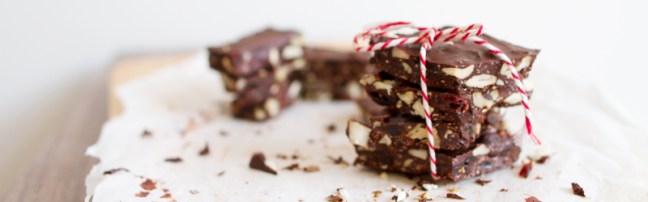
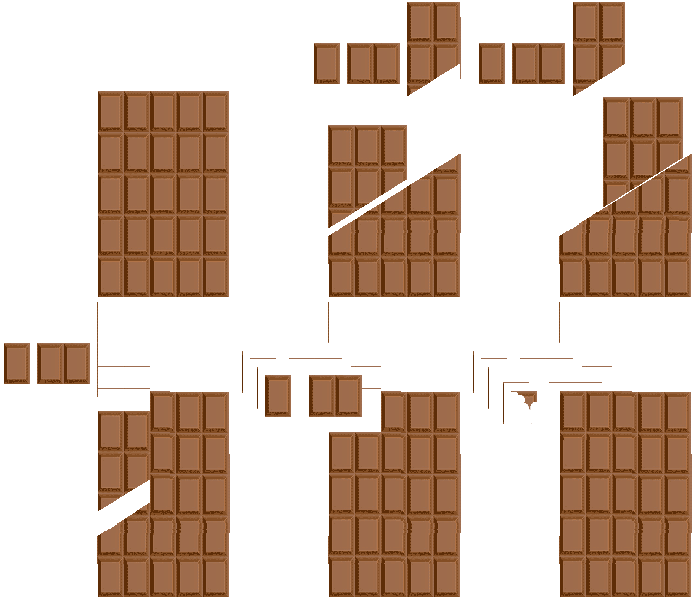
Ah, the infinite chocolate bar. If only it could work in real life! But can your children find the mistake? Where does the extra chocolate come from?

Here’s a hint: It’s related to this classic brainteaser. And here’s a video from Christopher Danielson (talkingmathwithkids.com), showing how the chocolate bar dissection really works.

Happy munchings!

CREDITS: Feature photo (top) by Yoori Koo via Unsplash. “Hershey Bar Math” video by Christopher Danielson via YouTube. The infinite chocolate gif went viral long ago, and I have no idea who was the original artist.