Did You Get Your Playful Math Snacks?

Circumferències de FordMy April “Let’s Play Math” newsletter went out early this morning to everyone who signed up for Tabletop Academy Press math updates. This month’s issue celebrated the 200th anniversary of the Farey Sequence.

The Farey Sequence was described in 1816 by English geologist John Farey, who was disparaged by the famous mathematical snob* G.H. Hardy as “at the best an indifferent mathematician.”

“I rather like the idea that the Farey Sequences are named after someone who noticed a pattern and asked a question — and not even the first person to notice the pattern, ask the question, or provide the answer. As math teachers, we teach plenty of indifferent mathematicians who wake up when they experience the joy of discovering something that is new to them, not necessarily new to the whole world.”

— Debra K. Borkovitz,
Farey Fraction Visual Patterns

If you’re a subscriber but didn’t see your newsletter, check your Updates or Promotions tab (in Gmail) or your Spam folder. And to make sure you get all the future newsletters, add “Denise at Tabletop Academy Press” [denise.gaskins @ tabletop academy press .com, without spaces] to your contacts or address book.

If you missed this month’s edition, no worries—‌there will be more playful math snacks coming soon. Click the link below to sign up today!

And remember: Newsletter subscribers are always the first to hear about new books, revisions, and sales or other promotions.


* See A Mathematician’s Apology Revisited by W.W. Sawyer.

Playful Math Carnival 96 via The Usual Mayhem

Check out the new playful math education carnival at The Usual Mayhem. Puzzles, primes, patterns, and more playful mathy fun:

MTAP96

I am delighted to be hosting March’s MTaP Carnival! It’s late because I had the flu for 10 days – sorry for the delay, I know that we all look forward to reading the contributors’ posts each month. Without further delay, then, here are the great reads you won’t want to miss….

Click here to go read the carnival post.

Memorizing the Math Facts

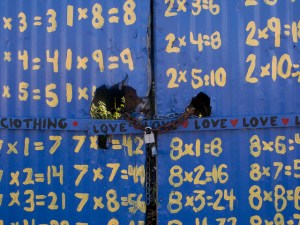
Central City Times Tables[Photo by dsb nola via flickr. (CC BY 2.0)]

The most effective and powerful way I’ve found to commit math facts to memory is to try to understand why they’re true in as many ways as possible. It’s a very slow process, but the fact becomes permanently lodged, and I usually learn a lot of surrounding information as well that helps me use it more effectively.

Actually, a close friend of mine describes this same experience: he couldn’t learn his times tables in elementary school and used to think he was dumb. Meanwhile, he was forced to rely on actually thinking about number relationships and properties of operations in order to do his schoolwork. (E.g. I can’t remember 9×5, but I know 8×5 is half of 8×10, which is 80, so 8×5 must be 40, and 9×5 is one more 5, so 45. This is how he got through school.) Later, he figured out that all this hard work had actually given him a leg up because he understood numbers better than other folks. He majored in math in college and is now a cancer researcher who deals with a lot of statistics.

Ben Blum-Smith
Comment on Math Mama’s post What must be memorized?

The entire discussion (article and comments) is well worth reading:

You may also enjoy:

Quotable: On Teaching

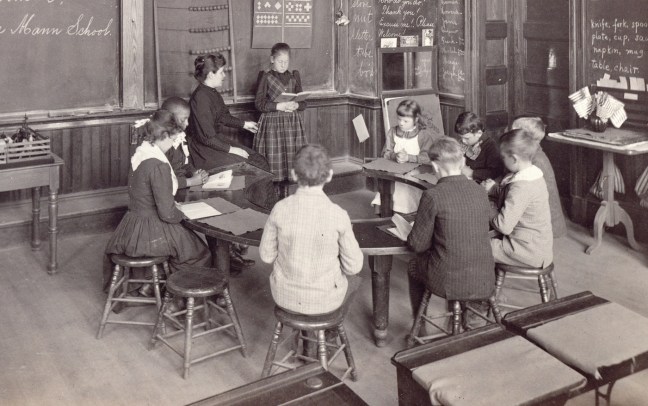
classroom scene

[Photo by City of Boston Archives via Flickr (CC BY 2.0).]

I’ve started collecting quotes about teaching math for the chapter pages in my next Math You Can Play book. Here are a couple snippets that don’t fit the theme of “Multiplication & Fractions,” but they struck my fancy anyway:

If teachers would only encourage guessing. I remember so many of my math teachers telling me that if you guess, it shows that you don’t know. But in fact there is no way to really proceed in mathematics without guessing. You have to guess! You have to have intuitive judgment as to the way it might go. But then you must be willing to check your guess. You have to know that simply thinking it may be right doesn’t make it right.

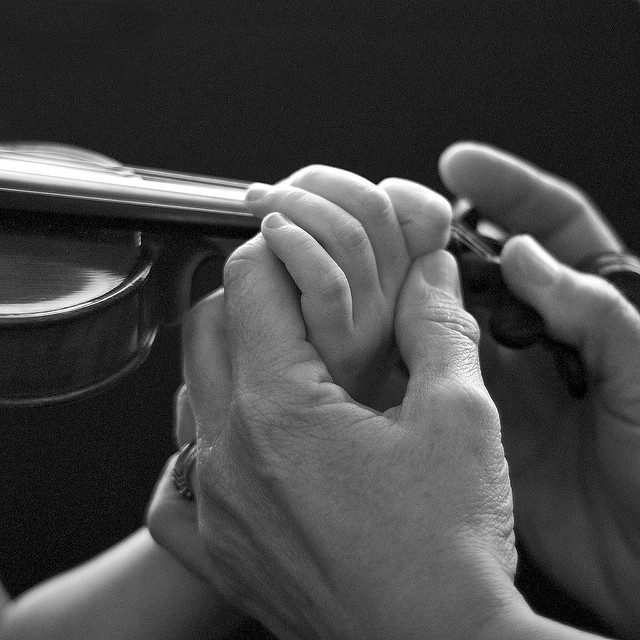
teaching

[Photo by Nathan Russell via Flickr (CC BY 2.0).]

One of the big misapprehensions about mathematics that we perpetrate in our classrooms is that the teacher always seems to know the answer to any problem that is discussed. This gives students the idea that there is a book somewhere with all the right answers to all of the interesting questions, and that teachers know those answers. And if one could get hold of the book, one would have everything settled. That’s so unlike the true nature of mathematics.

Leon Henkin
from “Round and Round at the Round Table”
Teaching Teachers, Teaching Students: Reflections on Mathematical Education

What Are Your Favorite Quotes?

Do you have some favorite quotes on math and teaching? I’d love to hear them! Please share in the Comments section below.

Did You Get Your Playful Math Snacks?

NumberPuzzles-300My March “Let’s Play Math” newsletter went out early this morning to everyone who signed up for Tabletop Academy Press math updates. This month’s issue focused on math history stories and puzzles, and it also included links to my newly expanded Math with Living Books pages:
  • Picture Books and Early Readers
    From counting books to math history, picture books offer a gentle introduction to a variety of topics. Elementary and middle school students will also enjoy many of these.
  • Elementary and Middle School
    Patterns, puzzles, games, and activities — here are plenty of ideas to get your children playing around with math.
  • Problem Solving and Math Circles
    From the elementary puzzles to Olympiad-level stumpers, the problems in these books will intrigue and challenge your students.
  • High School and Beyond
    These histories, biographies, and explanations of mathematical concepts are written for an adult general audience, so most of them assume no mathematical knowledge beyond a vague memory of high school.

If you’re a subscriber but didn’t see your newsletter, check your Updates or Promotions tab (in Gmail) or your Spam folder. And to make sure you get all the future newsletters, add “Denise at Tabletop Academy Press” [Tabletop Academy Press @ gmail.com, without spaces] to your contacts or address book.

If you missed this month’s edition, no worries—‌there will be more playful math snacks coming soon. Click the link below to sign up today!

And remember: Newsletter subscribers are always the first to hear about new books, revisions, and sales or other promotions.

New Picture Book: Tessalation!

When I run a math circle or co-op class, I love starting with a picture book. This new beauty from Emily Grosvenor will be perfect.

You could say that Tessalation is a book about tessellations (repeating tiled patterns), but it is really a children’s picture book about discovering order in a chaotic world.

— Emily Grosvenor

Seeing Math in the World

In taking a playful approach to mathematics, I hope to open children’s eyes to math in their world. Schooly math lessons have led many of my math group kids to think a “pattern” has to be a strictly repeating (and rather boring) series of shapes or colors.

But in the real world, patterns are so important that American mathematician Lynn Arthur Steen defined mathematics as the science of patterns.

“As biology is the science of life and physics the science of energy and matter, so mathematics is the science of patterns,” Steen wrote. “We live in an environment steeped in patterns — patterns of numbers and space, of science and art, of computation and imagination. Patterns permeate the learning of mathematics, beginning when children learn the rhythm of counting and continuing through times tables all the way to fractals and binomial coefficients.”

Tessa Truman-Ling’s delight in patterns is contagious. And it will provide a wonderful jumping-off point for a variety of math activities.

Visit Grosvenor’s Kickstarter page to find out more about her lovely book:

Further Exploration

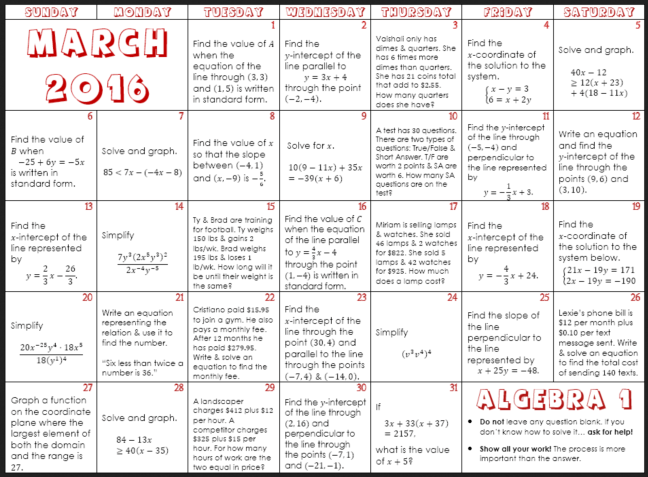
March 2016 Math Calendars

Once again, a few of my favorite bloggers have come through with math calendars for our students to puzzle over. Check them out:

algebra calendar

Things to Do with a Math Calendar

At home:
Post the calendar on your refrigerator. Use each math puzzle as a daily review “mini-quiz” for your children (or yourself).

In the classroom:
Post today’s calculation on the board as a warm-up puzzle. Encourage your students to make up “Today is…” puzzles of their own.

As a puzzle:
Cut the calendar squares apart and trim off the dates. Then challenge your students to arrange them in ascending (or descending) order.

Make up problems to fill a new calendar for next month.
And if you do, please share!

Playful Math Carnival #95 via Life Through A Mathematician’s Eyes

MTAP95

Check out the new playful math education carnival at Life Through A Mathematician’s Eyes. Parabolas, fractions, numbers square puzzles, edible math manipulatives, and all sorts of mathy fun:

Excitement!! The MTaP Math Educational Blog Carnival is at its 95 issue and I am extremely excited to host it. Moreover, February is one of my favorite months so I am extra excited for the opportunity.
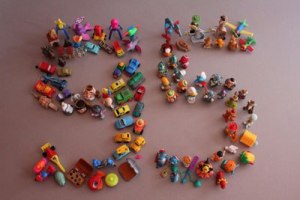
First thing, let us think a little about the interesting properties of the number 95…

Click here to go read the carnival post.