Blog

Look Beneath the Surface

So, I decided to try my hand at rewriting the Standards for Mathematical Practice into student-friendly language.

Here’s the fourth installment…

Math Tip # 4: Look Beneath the Surface.

  • Notice the math behind everyday life.
  • Examine a complex situation. Ignore the parts that aren’t relevant.
  • Pay attention to the big picture, but don’t lose track of the details.
  • Make assumptions that simplify the problem.
  • Express the essential truth using numbers, shapes, or equations.
  • Test how well your model reflects the real world.
  • Draw conclusions. Explain how your solution relates to the original situation.

Continue reading Look Beneath the Surface

The Value of Puzzles

I love puzzles. Don’t you?

Here are several examples of river-crossing puzzles you and your kids can try. They date back at least to the time of Alcuin, the famous scholar from the court of Charlemagne.

I wish someone would write a whole math curriculum devoted entirely to puzzles.

W.W. Sawyer on the Value of Puzzles

Master teacher W.W. Sawyer didn’t write a curriculum, but he often used puzzles in the classroom.

“It is quite possible to use simultaneous equations as an introduction to algebra. Within a single lesson, pupils who previously did not know what x meant can come not merely to see what simultaneous equtions are, but to have some competence in solving them.

“No rules need to be learnt; the work proceeds on a basis of common sense.

“The problems the pupils solve in such a first lesson will not be of any practical value. They will be in the nature of puzzles.

“Fortunately, nature has so arranged things that until the age of twelve years or so, children are more interested in puzzles than in realistic problems.”

—W. W. Sawyer, Vision in Elementary Mathematics

Then he gives this example:

“A man has two sons. The sons are twins; they are the same height. If we add the man’s height to the height of one son, we get 10 feet. The total height of the man and the two sons is 14 feet. What are the heights of the man and his sons?”

Try This at Home

Not only can children solve puzzles like this, but even better — they can make up story puzzles of their own. You could spend a whole week or more making up silly height puzzles for each other to solve. By the time you were done, your kids would have a great introduction to algebra!

Maybe I never grew up. Because I still prefer puzzles over “real world” math problems.

What are your favorite kinds of puzzles? Please share in the comments section.

CREDITS: “Boat puzzles” comic from xkcd.com.
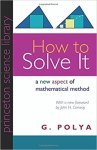
[THE FINE PRINT: I am an Amazon affiliate. If you follow the book link and buy something, I’ll earn a small commission (at no cost to you). But this book is a well-known classic, so you should be able to order it through your local library.]

Know How to Argue

You may remember, I decided to try my hand at rewriting the Standards for Mathematical Practice into student-friendly language.

My kids loved to argue. Do yours?

Math Tip # 3: Know How to Argue.

  • Argue respectfully.
  • Analyze situations.
  • Recognize your own assumptions.
  • Be careful with definitions.
  • Make a guess, then test to see if it’s true.
  • Explain your thoughts. Give evidence for your conclusions.
  • Listen to other people. Ask questions to understand their point of view.
  • Celebrate when someone points out your mistakes. That’s when you learn!

Continue reading Know How to Argue

More Dover Samples

“Without mathematics you can’t do anything! Everything around you is mathematics. Everything around you is numbers.”

—Anna Claybourne, I Can Be a Math Magician


Dover Publications sent out a new email today with fun coloring and craft samples. And several puzzles from I Can Be a Math Magician: Fun STEM Activities for Kids by Anna Claybourne.

Enjoy!

If you’d like to receive future Dover Sampler emails, you can sign up here.

THE FINE PRINT: I am an Amazon affiliate. If you follow the book link above and buy something, I’ll earn a small commission (at no cost to you).

W.W. Sawyer’s Rules of Mathematics

“In the beginnings of arithmetic and algebra, the main purpose is not to get the pupil making calculations. The main purpose is to get him into the habit of thinking, and to show him that he can think the problems out for himself.

“Pupils ask ‘Am I allowed to do this?’ as if we were playing a game with certain rules.

“A pupil is allowed to write anything that is true, and not allowed to write anything untrue!

“These are the only rules of mathematics.”

—W. W. Sawyer, Vision in Elementary Mathematics

[THE FINE PRINT: I am an Amazon affiliate. If you follow the link and buy something, I’ll earn a small commission (at no cost to you). But this book is a well-known classic, so you should be able to order it through your local library.]

Inspired by Sawyer’s Two Rules

I love this quote so much, I turned it into a printable math activity guide. I hope it helps inspire your students to deeper mathematical thinking.

Here’s the product description…

Join the Math Rebellion: Creative Problem-Solving Tips for Adventurous Students

Take your stand against boring, routine homework.

Fight for truth, justice, and the unexpected answer.

Join the Math Rebellion will show you how to turn any math worksheet into a celebration of intellectual freedom and creative problem-solving.

Help your students practice thinking for themselves as they follow the Two Rules of the Math Rebellion: “A pupil is allowed to write anything that is true, and not allowed to write anything untrue! These are the only rules of mathematics.”

Find Out More

Free Number Sense Resources from Steve Wyborney

If you teach children in the primary grades, you’ll enjoy this new series from the wonderful Steve Wyborney. Every day for the rest of the school year, Steve will post a new estimation or number sense resource for grades K–8 (or any age!) at his blog:

“This is my way of providing support and encouragement – as well as bringing math joy to your classroom… I’m going to stick with you all year long.”

—Steve Wyborney

Click to visit Steve’s blog

Did You Get Your Books?

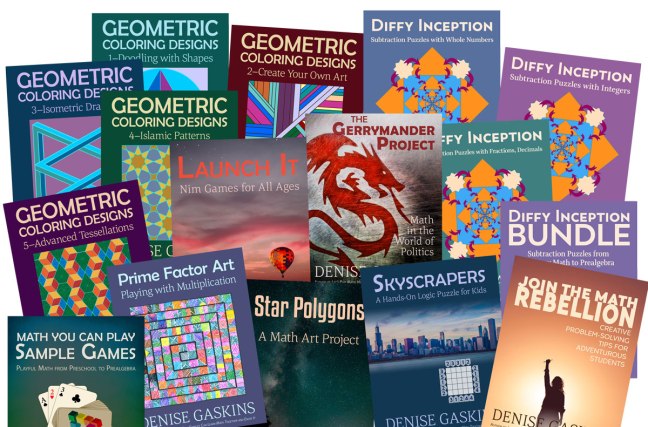
Math You Can Play series by Denise Gaskins

One more time, because I’m still finding people who didn’t get their Kickstarter rewards…

To Everyone Who Supported the Math You Can Play Kickstarter

Thank you so much! I’m amazed and awed by how many people from all around the world showed interest in my books. You’re the greatest!

ALL the pledge rewards have now been sent, both digital and physical books.

Everyone should have received two emails:

  • Stretch Goals, four printable pdf math activity books.
  • Your digital (ebook) rewards and printable gameboard files.

Even if you ordered paperbacks, you should have gotten the digital book email.

But we’ve had trouble with things getting lost in the tangles of the internet. If you don’t see these emails, check your Spam folder — or if you use Gmail, look in the Promotions or Updates tab.

If you did NOT receive the emails mentioned above, please let me know!!

You can contact me through Kickstarter or use the About/Contact page on this blog to send me a message.

P.S.: There are still two people who ordered (and paid for) paperbacks but haven’t filled out the Kickstarter survey. I can’t mail out your book package until I get an address. If you can’t find the survey email, feel free to message me directly.

Don’t Panic

As I mentioned last Saturday, I decided to try my hand at rewriting the Standards for Mathematical Practice into student-friendly language.

Here’s the second installment…

Math Tip # 2: Don’t Panic.

  • Don’t let abstraction scare you.
  • Don’t freeze up when you see complex numbers or symbols.
  • Break them down into simpler parts.
  • Take each problem one step at a time.
  • Know the meaning of the math, how it relates to the “real world.”
  • But if it gets in your way, ignore the “real world” situation. Revel in the abstract fantasy.

Continue reading Don’t Panic

Magical Mathematics

In fact, mathematics is the closest that we humans get to true magic. How else to describe the patterns in our heads that — by some mysterious agency — capture patterns of the universe around us?

Ian Stewart
The Magical Maze

CREDITS: Photo by Greg Rakozy via Unsplash.com. I am an Amazon affiliate. If you follow the book link and buy something, I’ll earn a small commission (at no cost to you).