With a big election on the horizon, now is a great time to talk about the math of politics.
Does “One person, one vote” make a fair democracy?
Or does it give the majority license to trample a minority?
How can planners arrange voting districts to give everyone the best representation? And is that really what politicians would do, if they had the choice?
Try the Gerrymander Project with your students to investigate these questions and spark real-world mathematical discussion.
First, Create a Map
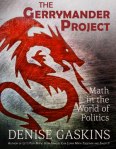 [Or buy a copy of my printable activity guide, The Gerrymander Project: Math in the World of Politics, which includes a prepared city map with more detailed instructions, answers, and journaling prompts. My publisher has extended the 10% discount code TBLTOP10 through to Election Day, 3 November 2020.]
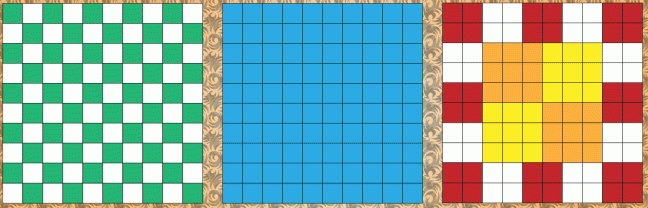
- Print a blank hundred chart or outline a 10×10 square on grid paper. This represents your city. Give it a name.
- Pull out your colored pencils. Choose one color for your city’s Majority Party and another for the Minority Party.
- Color 10 squares in a neutral color for non-voting areas. These might be malls or parks or the downtown business district — your choice.
- Color the remaining 90 blocks in a random distribution so that 60% are the Majority color and 40% the Minority. How will you choose which squares to make which colors? Can you think of a way to use dice or playing cards to make your choices random, yet still get the right proportion?
Slip your finished map into a clear page protector, so you can mark on it with dry-erase markers. Or make several copies, so you can write on them without destroying the original.
Then Gerrymander Your City
“Gerrymandering” is the American political tradition of adjusting the voting district boundaries to favor one’s own party at the expense of one’s opponents.
The city has hired you to mark out 10 new voting districts of 9 squares each (not counting the neutral squares, which can go in any district). The squares in each district must touch side-to-side, not just meet at a corner.
So now you get to play “political hack.”
First, see how fair you can make the map:
- What happens if you ignore the party colors and make your districts as compact as possible, so the people living nearest to each other vote together? Will the Majority Party always win?
- Can you give all your voters a proportional representation? Both parties should win the number of districts that most closely matches their percentage of the voting population.
Next, try your hand at gerrymandering, but make sure all the squares in each district stay connected. Can you create ten voting districts that will guarantee:
- A come-from-behind triumph for the Minority Party? They need to carry at least six districts to wrest control of the City Council from their opponents.
- The greatest possible margin of victory for the Majority Party? Can you keep the Minority from winning any districts at all?
Share Your Thoughts
I’d love to hear your students’ reaction to this project. Please share in the comments section below.
For myself, the more I play with this project, the more I admire the work done by the framers of the U.S. Constitution. Our Electoral College divides the country into “districts” based on state boundaries, giving each a vote roughly proportional to its population — but in a way that slightly strengthens the Minority Party. The system may not be perfect, but it’s done an amazing job through the centuries of maintaining a balance of power, making sure that neither major political party can destroy the other.
Which is NOT to say that our country always protects the rights of true minorities. Clearly, that’s an ongoing struggle.
But overall, the political parties stay relatively balanced, making for a stable government. After more than two centuries, we still have, as Ben Franklin said, “a republic, if you can keep it.”
This blog is reader-supported.
If you’d like to help fund the blog on an on-going basis, then please head to my Patreon page.
If you liked this post, and want to show your one-time appreciation, the place to do that is PayPal: paypal.me/DeniseGaskinsMath. If you go that route, please include your email address in the notes section, so I can say thank you.
Which I am going to say right now. Thank you!
“The Gerrymander Math Project” copyright © 2020 by Denise Gaskins.
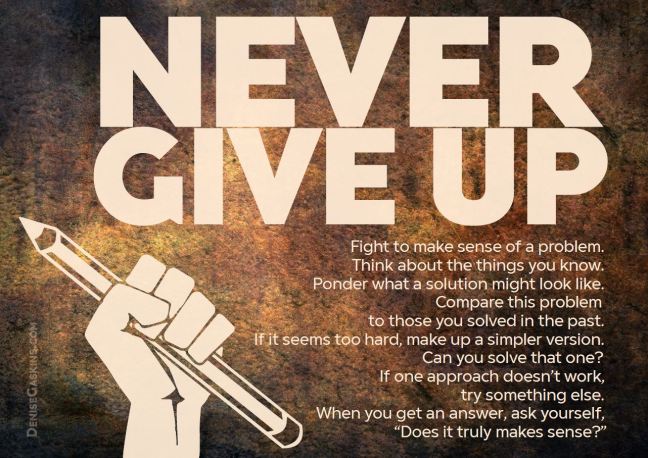
 I had so much fun making these posters that I decided to put them into a printable activity guide. It includes the full-color poster shown above and a text-only version, with both also in black-and-white if you need to conserve printer ink.

 Children can model planar graphs with three-dimensional constructions using small balls of playdough (vertices) connected by toothpicks (edges).
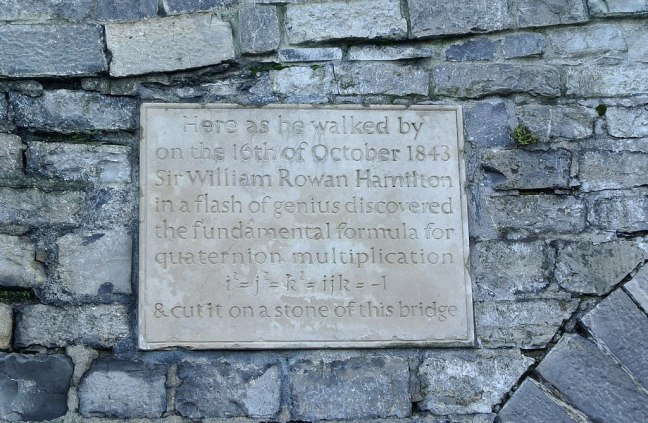
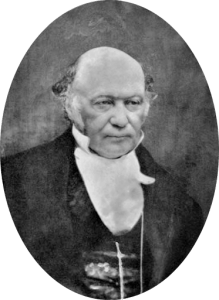 Irish mathematician William R. Hamilton was struggling with a tough math problem in October, 1843. It had him stumped. Then on the 16th, as he walked along Dublin’s Royal Canal with his wife, inspiration struck.



_regarding_the_discovery_of_Quaternions_multiplication_by_Sir_William_Rowan_Hamilton.jpg)

