Blog

New Book: Word Problems from Literature

The posts on my Let’s Play Math blog are, for the most part, first-draft material. Of course, I’ve proofread each post — many times! because I’m a perfectionist that way, and yet I still miss typos :-/ — but these articles haven’t gotten the sort of feedback that polishes a book manuscript.

Well, now I’m taking some of the best of my old blog posts, expanding them with a few new games or activities, and giving them that book-quality polish. Let me introduce my newest series, the Playful Math Singles.

Under Construction …
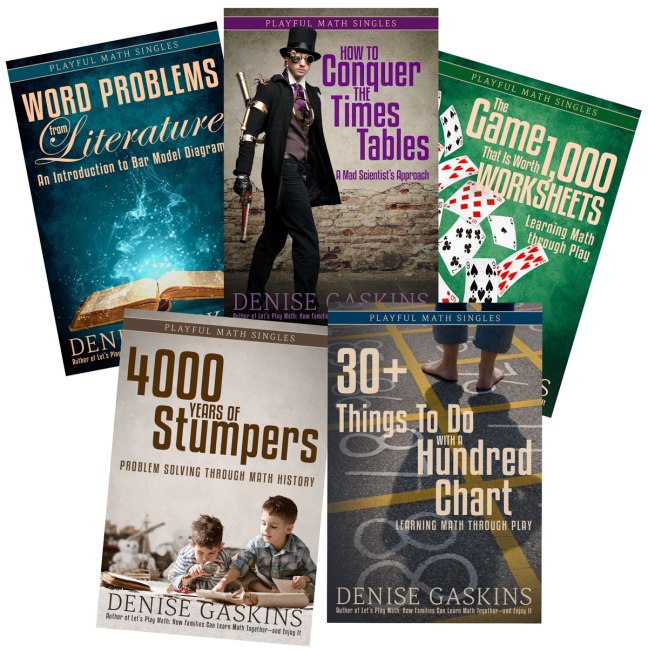
The Playful Math Singles from Tabletop Academy Press will be short, topical books featuring clear explanations and ready-to-play activities.

I’m hoping to finish up two or three of these this year. Watch for them at your favorite online bookstore.

The first one is done …

Word Problems from Literature: An Introduction to Bar Model Diagrams
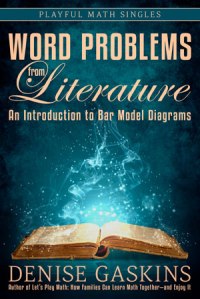
You can help prevent math anxiety by giving your children the mental tools they need to conquer the toughest story problems.

Young children expect to look at a word problem and instantly see the answer. But as they get older, their textbook math problems also grow in difficulty, so this solution-by-intuitive-leap becomes impossible.

Too often the frustrated child concludes, “I’m just not good at math.”

But with guided practice, any student can learn to master word problems.

Word Problems from Literature features math puzzles for elementary and middle school students from classic books such as Mr. Popper’s Penguins and The Hobbit.

For each puzzle, I demonstrate step by step how to use the problem-solving tool of bar model diagrams, a type of pictorial algebra. For children who are used to playing with Legos or other blocks — or with computer games like Minecraft — this approach reveals the underlying structure of a math word problem. Students can make sense of how each quantity in the story relates to the others and see a path to the solution.

And when you finish the puzzles in this book, I’ll show you how to create your own word problems from literature, based in your children’s favorite story worlds.

Buy now at your favorite online bookstore.

If you’re using these word problems with your children, consider buying them the paperback companion Word Problems from Literature Student Workbook.

… and People Like It!

A screen shot from this past weekend:

“I found this method really clarified for me what was going on visually and conceptually. Particularly when it came to more complex questions, for which I would normally write out an equation, I felt that thinking about what was going on with the bars actually made more sense … This is a wonderful book for those who want to support their children in finding better ways to work on word problems.”

—Miranda Jubb, Amazon customer reviewer
Playful Math on Kickstarter

Have you noticed that we live in a wonderful era of mathematical innovation? Not only at the “it’s all over my head” level — which is growing faster than anyone can keep up with — but also at the Cool Math For Kids level.

For instance, our children can enjoy Patterns of the Universe, and Prime Climb, and This is Not a Maths Book, and Which One Doesn’t Belong?, and Tiny Polka Dot, and Math & Magic in Wonderland, and Spiraling Pentagons, and …

So many things! I’m sure I forgot one (or several) of your favorite modern-classic math books or toys. I’d love to hear about them in the comments.

And here are a few bits of new playful math. Click, support, and share!

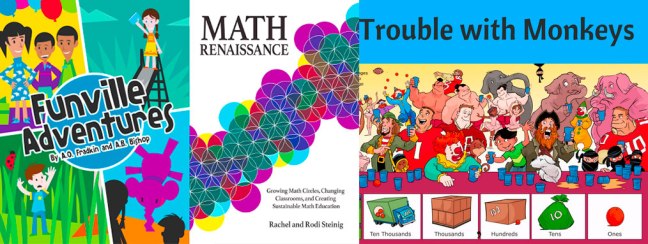
Math Renaissance

In alternating chapters, Rodi Steinig tells stories about her math circle and exactly what happens there, while her daughter Rachel discusses why so many kids hate math, documents the ways math is taught in the classroom — and ways that can be improved.

I first discovered Rodi’s work through her chapter in Sue VanHattum’s wonderful collection Playing with Math: Stories from Math Circles, Homeschoolers, and Passionate Teachers. I’ve been a fan of Rodi’s math circle blog for years, and I can’t wait to get my hands on her new book.

Funville Adventures

When 9-year-old Emmy and her 5-year-old brother Leo go down an abandoned dilapidated slide, they are magically transported into Funville — a land inhabited by ordinary-looking beings, each with a unique power to transform objects.

I had the fun of previewing this book. It’s a cute little fairy tale that should help launch family conversations about math.

Trouble with Monkeys

A boy wants to surprise his dad, but meddlesome monkeys keep getting in the way. The boy is interviewed by the local news, and the story escalates to involve pirates, ballerinas, ninjas — and the magic of our place value number system.

Lucy Ravitch, math blogger and author of The Pancake Menu, teams up with artist Travis Hanson (one of my favorite comic bloggers) to create a story that will build number sense.

This story reminds me of the Cookie Factory Model for long division. Place Value is a key to understanding many things in math.

GregTangMath Home Kit

I haven’t seen these games in person, but they sure look like fun.

And Others?

If you know a project we should all check out, please share in the Comments section below.

Playful Math Education Carnival 108 at Math Hombre

Check out the new Math Teachers at Play blog carnival at Math Hombre blog. You’re sure to enjoy this month’s collection of playful math for all ages.

The carnival features numberless problems, math circles, bookmaking, talking with kids, infinite series, division, number routines, calculus, inspiring tips for teachers, and much more.

Click here to go read the carnival blog!

Do You Want More Ways to Play with Math?

Past carnivals are still full of mathy treasure. See them all on Pinterest:

Even a Math Workbook Can Be a Game

Homeschool Memories…

My youngest daughter wanted to do Singapore math. Miquon Red was her main math text at the time, but we added a bit of Singapore Primary Math 1B whenever she was in the mood.

We turned to the lesson on subtracting with numbers in the 30-somethings.

Continue reading Even a Math Workbook Can Be a Game

Playful Math Education Carnival 107 at Give Me a Sine

Check out the new carnival of playful math for all ages at Give Me a Sine blog. Each month’s carnival brings you a great new collection of puzzles, math conversations, crafts, teaching tips, and all sorts of mathy fun.

This month’s post features symmetry, origami, and an ant hotel. Percents, fractions, decimals, and the bathroom sink. Algebra, geometry, and trig. And much more!

Click Here to Read the Carnival Blog

Hey, Blogger, Can You Spare a Time?

Do you write an education or family blog? Classroom teacher, math coach, homeschooler, parent, college professor, unschooler — anyone interested in helping kids play around with math? Please consider volunteering to host the MTaP blog carnival for one month.

We still need volunteer hosts for fall semester 2017. Or plan ahead: 2018 is wide open.

You choose the month that fits your schedule and decide how much effort you want to put in. Writing the carnival can take a couple of hours for a simple post — or you can spend several days searching out and polishing playful math gems to share.

If you want more information, read the MTaP Math Education Blog Carnival home page. Then let me know which month you want.

CREDITS: Carnival fireworks photo by Andrew Lane via Flickr (CC BY 2.0) edited to add carnival number.

Rabbit Trails and Fibonacci Poetry

Homeschool Memories…

Well, I hadn’t planned on spending my day that way. But one of the great things about homeschooling is the freedom to follow rabbit trails.

While browsing the Carnival of Homeschooling, I found a link to Farm School blog’s article Fib Foolery, which sent me to Gotta Book for his articles The Fib and More Fibbery (read the comments on both threads, but be warned that some are crude) and several other posts, all of which set me off on a morning of poetic fun.

A “Fib” is a Fibonacci poem. It’s based on syllable count, like a haiku, but the lines follow the Fibonacci counting series: 1, 1, 2, 3, 5, 8… Each number is the sum of the previous two numbers.

I knew what I was going to share at our Tuesday Teatime and Poetry Reading that afternoon.

Continue reading Rabbit Trails and Fibonacci Poetry

There Ain’t No Free Candy

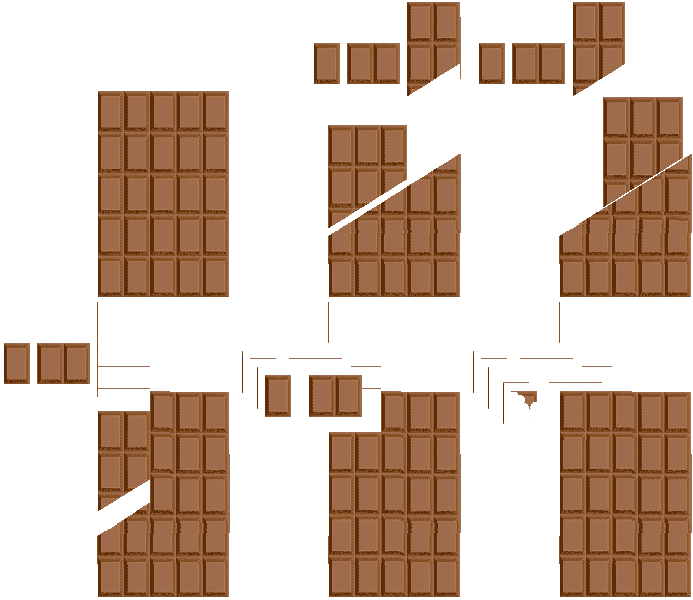
Ah, the infinite chocolate bar. If only it could work in real life! But can your children find the mistake? Where does the extra chocolate come from?

Here’s a hint: It’s related to this classic brainteaser. And here’s a video from Christopher Danielson (talkingmathwithkids.com), showing how the chocolate bar dissection really works.

Happy munchings!

CREDITS: Feature photo (top) by Yoori Koo via Unsplash. “Hershey Bar Math” video by Christopher Danielson via YouTube. The infinite chocolate gif went viral long ago, and I have no idea who was the original artist.

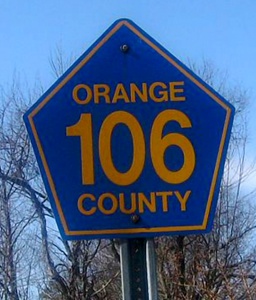
Playful Math Education Carnival 106 with Math Art

Do you enjoy math? I hope so! If not, browsing this post just may change your mind.
Welcome to the 106th edition of the Math Teachers At Play math education blog carnival — a smorgasbord of links to bloggers all around the internet who have great ideas for learning, teaching, and playing around with math from preschool to pre-college. Let the mathematical fun begin!

By tradition, we start the carnival with a puzzle in honor of our 106th edition. But if you would like to jump straight to our featured blog posts, click here to see the Table of Contents.

Try This Puzzle

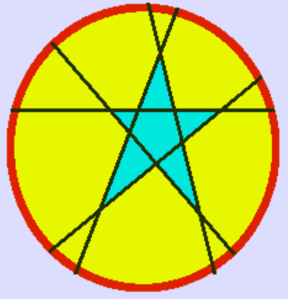
If you slice a pizza with a lightsaber, you’ll make straight cuts all the way across. Slice it once, and you get two pieces.

If you slice it five times, you’ll get a maximum of sixteen pieces. (And if you’re lucky you might get a star!)

  • How many times would you have to slice the pizza to get 106 pieces?

Click here for all the mathy goodness!

How To Break In Your New Math Journal

I love my new paperback math journal series. The books are sturdy, inexpensive, and fit nicely in my purse.

But as with any paperback book, these have one problem. How do I use them without cracking the spine?

When we exercise, we need to warm up our bodies with a bit of stretching to prevent injury. In the same way, we need to warm up a new book to protect it. The process is called “breaking it in.”

It only takes a few minutes to break in a paperback book:

Step by Step

Never force the book but help it limber up gradually, and it will serve you well.

Because my journals are working books, I take the breaking-in process a bit further than shown in the video:

(1) Set the book on its back and follow the process above. Press down each cover, but not completely flat — let it bend at the fold line, about 1 cm from the actual spine. Then press a couple pages at a time, alternating front and back, down flat on each cover.

(2) Flip through the pages of the book forward and backward to limber them up.

(3) Repeat the steps of the video. This time, gently lean the main part of the book away from the part you are pressing down. Aim for a 130–140 degree angle.

(4) Flip through the pages again. For paperbacks, you can even roll the whole book back and forth a bit — gently curving the cover and pages almost as if you’re trying to fold the book in half — to encourage flexibility.

(5) Optional: Repeat the breaking-in process one more time. This time, fold each section back as close to 180 degrees as it will go.

And you’re done!

The pages will still curve in at the fold line, where they connect to the spine of the book. You want that because it makes the book strong. But now they’ll also open up to provide a nice, wide area for writing or math doodling.

Dot Grid Doodling

What can you DO with a page full of dots?

Yesterday, I mentioned my new series of paperback dot grid notebooks, and I promised to share a few ideas for mathematical doodling.

But first, let me share my new dot-grid journals for kids. Aren’t they pretty?

Click Here for More Information

Doodling gives our minds a chance to relax, wander, and come back to our work refreshed. And though it goes against intuition, doodling can help us remember more of what we learn.

Math doodles let us experiment with geometric shapes and symmetries. We can feel our way into math ideas gradually, through informal play. Through doodles, our students will explore a wide range of mathematical structures and relationships.

Our own school experiences can make it hard for us to teach. What we never learned in school was the concept of playing around with math, allowing ideas to “percolate,” so to speak, before mastery occurs, and that process may take time.

—Julie Brennan

I like to doodle on dotty grid paper, like the pages in my math journals, but there’s No Purchase Necessary! You can design your own printable dot page at Incompetech’s PDF generator.

Patterns in Shape and Angle

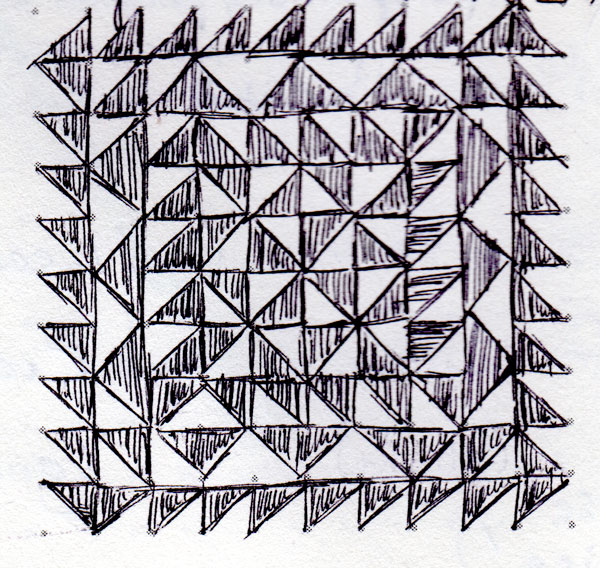
To make a faceted mathematical gemstone, start with any shape you like. Then build other shapes around it. What do you notice? Does your pattern grow outward from its center? Or flow around the corner of your page? How is each layer similar, and how is it different?

Arbitrary constraints can lead to mathematically interesting doodles. For instance, create a design out of 45-45-90 triangles by coloring exactly half of every grid square. How many variations can you find?

Symmetry Challenge

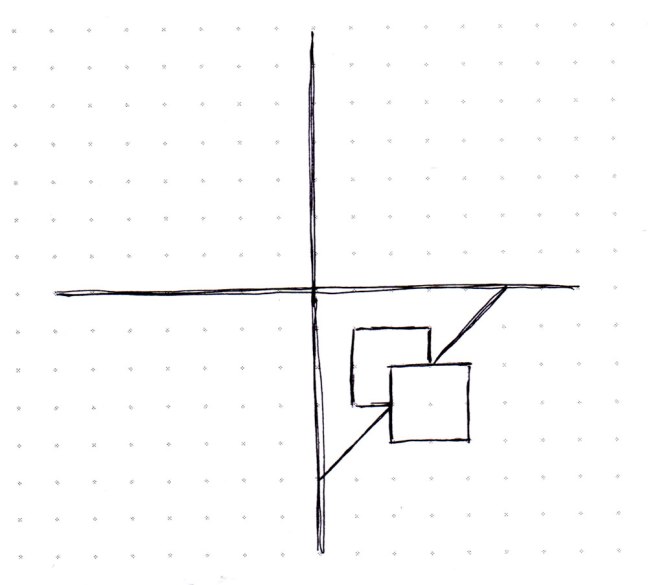
Play a symmetry puzzle game. Draw a line of symmetry and fill in part of the design. Then trade with a partner to finish each other’s doodles.

Make more complex symmetry puzzles with additional reflection lines.

Math Doodle Links

  • Who can talk about mathematical doodling without mentioning Vi Hart? If you’ve never seen her “Doodling in Math Class” video series, you’re in for a treat!
  • See if you can draw a rotational-symmetry design, like Don’s “Order 4” graphs.
  • Or experiment with the more flexible rules in John’s “Knot Fun” lesson.
  • And my latest obsession: the “ultimate” tutorial series on Celtic Knotwork, which explores the link between knots and their underlying graphs.
My favorite knot doodle so far.
Inspirations: A Recreational Mathematics Journal
Reflections: A Math Teacher’s Journal
Explorations: A Math Student’s Journal
Contemplations: A Homeschooler’s Journal

Before you start doodling: How to Break In Your New Math Journal.

Feature photo (top): Sommermorgen (Alte Holzbrücke in Pretzfeld) by Curt Herrmann, via Wikimedia Commons. [Public domain]