Blog

April 2015 Math Calendar

AprilMathCalendar

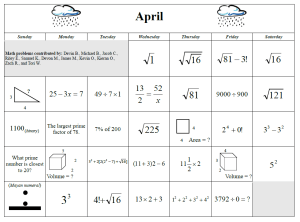
Six years ago, my homeschool co-op classes had fun creating this April calendar to hand out at our end-of-semester party. Looking at my regular calendar today, I noticed that April this year starts on Wednesday, just like it did back then. I wonder when’s the next time that will happen?

A math calendar is not as easy to read as a traditional calendar — it is more like a puzzle. The expression in each square simplifies to that day’s date, so your family can treat each day like a mini-review quiz: “Do you remember how to calculate this?”

The calendar my students made is appropriate for middle school and beyond, but you can make a math calendar with puzzles for any age or skill level. Better yet, encourage the kids to make puzzles of their own.

How to Use the Math Calendar

At home:
Post the calendar on your refrigerator. Use each math puzzle as a daily review “mini-quiz” for your children (or yourself).

In the classroom:
Post today’s calculation on the board as a warm-up puzzle. Encourage your students to make up “Today is…” puzzles of their own.

As a puzzle:
Cut the calendar squares apart, then challenge your students to arrange them in ascending (or descending) order.

Help Us Make the Next Math Calendar

If you like, you may use the following worksheet:

Submission details here: Kids’ Project — More Math Calendars?
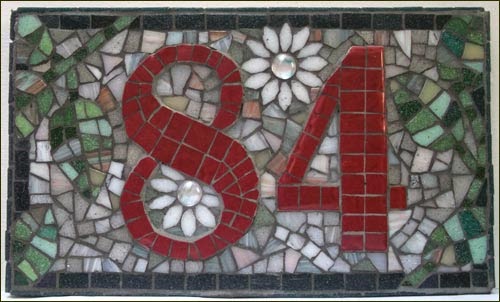
Math Teachers at Play #84 via Math Hombre

Rectangles, fractions, prime factorization, dancing, puzzles, great books, and so much more — check out all the fun at the March Math education blog carnival:

But Before You Go…

I’m running out of carnival hosts! Would you like to volunteer? It’s a bit of work, but great fun, too. Leave a comment here, or send me an email.

Excerpt:

Welcome to the 84th Math Teachers at Play Blog Carnival!
MTaP84

84 is a portentous number. It’s the sum of twin primes (What’s the previous sum of twin primes? Next?). It’s thrice perfect, twice everything. It’s positively Orwellian. It’s even a town in Pennsylvania.

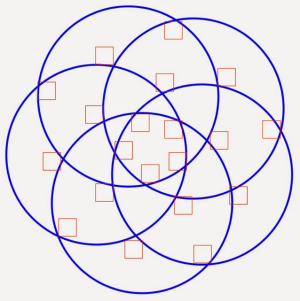
84 puzzler 1:
Number the intersections of these five circles with the integers 1 to 20 so that the points on each circle sum to the same.

It was a good month for math reading related posts …

Click here to go read the math blog carnival.

Happy Birthday, General Relativity

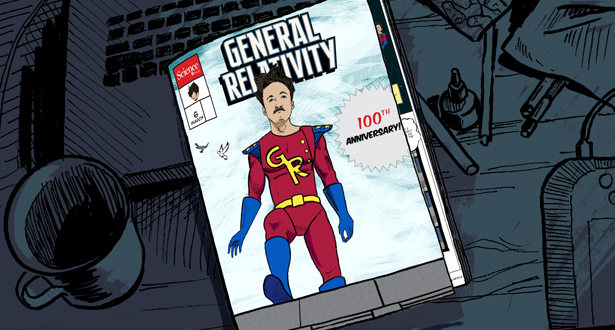
Don’t forget that Pi Day is also Albert Einstein’s birthday! And this year marks the 100th anniversary of his Theory of General Relativity. So Science Magazine has a special Einstein issue online, featuring this interactive comic:

comic-image

You may also enjoy:

Pi: Who Needs That Many Digits?

From Numberphile: Pi is famously calculated to trillions of digits – but Dr. James Grime says 39 is enough.

How you round it off makes a difference:

An extra note from Dr. Grime: “Since pi39 ends in 0, you may think we could use pi38 instead, which has even fewer digits. Unfortunately, the rounding errors of pi38 are ten times larger than the rounding errors of pi39 — more than a hydrogen atom. So that extra decimal place makes a difference, even if it’s 0.”

Pi and Buffon’s Matches

From Numberphile: Dr Tony Padilla’s unique (and low budget) twist on the Buffon’s Needle experiment to learn the true value of Pi.

For a kid-friendly version of this experiment, try throwing food:

Do you have a favorite family activity for celebrating Pi Day? I’d love to hear it!

Unending Digits… Why Not Keep It Simple?

Unending-digits

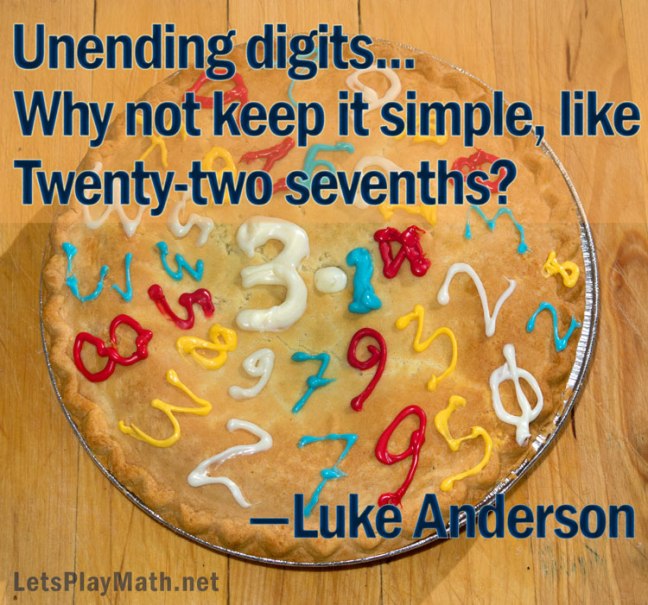
Unending digits …
Why not keep it simple, like
Twenty-two sevenths?

—Luke Anderson

Math Poetry Activity

Encourage your students to make their own Pi Day haiku with these tips from Mr. L’s Math:

And remember, Pi Day is also Albert Einstein’s birthday! Check out this series of short videos about his life and work: Happy Birthday, Einstein.

CREDITS: Today’s quote is from Luke Anderson, via TeachPi.org. Background photo courtesy of Robert Couse-Baker via Flickr, text added (CC BY 2.0).

Pi Makes a River Bend

From Numberphile: “Sinuosity is a measure of how ‘bendy’ a river is. It is the length of the river divided by the direct route. Featuring Dr. James Grime.”

Update

After posting this video, Dr. Grimes and Lawrence Roberts began collecting and analyzing data about real-world rivers. It turns out the pi theory of sinuosity is too simple. Read about their results: