Giveaway: Hexa-Trex Puzzle Book

Bogusia Gierus, host of this month’s Math Teachers at Play blog carnival, is offering to give away her First Book of Hexa-Trex Puzzles for just the cost of shipping. How generous!

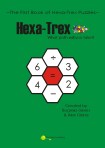
My math club had fun with several of these puzzles a few years ago, and the “Easy” ones (like the sample shown here) were just right for my 4th-5th grade students. One girl enjoyed them enough that she took home extra copies to share with her father.

It’s a thin book, just the right size for a stocking-stuffer. To see the full range of difficulty levels, look over the puzzles on Bogusia’s Daily Hexa-Trex page. To get your own copy of the book, read the giveaway instructions on Bogusia’s blog.

Object of the Puzzle

The object of the puzzle is to find the equation pathway that leads through ALL the tiles.

Forming Equations

  • Two or three (or four or five etc.) digit numbers are made up of the individual tiles in the particular order as the equation is read. For example 5 x 5 = 2 5 is correct, but read backwards 5 2 = 5 x 5 is incorrect.
  • The equation must be continuous (no jumping over tiles or empty spaces).
  • Each tile can be used ONLY ONCE.
  • Order of operations is followed. Multiplication and division comes before addition and subtraction.
  • The tile “-” can be used as both a subtraction operation or a negative sign in front of a digit, making it a negative number.

What to Do with a Hundred Chart #27

[Photo by geishaboy500.]

It began with a humble list of 7 things to do with a hundred chart in one of my out-of-print books about teaching home school math. Over the years I added a few new ideas, and online friends contributed still more, so the list grew to its current length of 26. Recently, thanks to several fans at pinterest, it has become the most popular post on my blog:

Now I am working several hours a day revising my old math books, in preparation for publishing new, much-expanded editions. And as I typed in all the new things to do with a hundred chart, I thought of one more to add to the list:

(27) How many numbers are there from 11 to 25? Are you sure? What does it mean to count from one number to another? When you count, do you include the first number, or the last one, or both, or neither? Talk about inclusive and exclusive counting, and then make up counting puzzles for each other.

Share Your Ideas

Can you think of anything else we might do with a hundred chart? Add your ideas in the Comments section below, and I’ll add the best ones to our master list.

More Than One Way to Solve It, Again

photo by Annie Pilon via flickr

We continue with our counting lessons — and once again, Kitten proves that she doesn’t think the same way I do. In fact, her solution is so elegant that I think she could have a future as a mathematician. After all, every aspiring novelist needs a day job, right?

If only I could get her to give up the idea that she hates math…

Permutations with Complications

How many of the possible distinct arrangements of 1-6 have 1 to the left of 2?

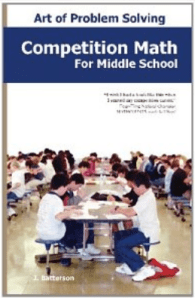
Competition Math for Middle School, by J. Batterson

Continue reading More Than One Way to Solve It, Again

More Than One Way to Solve It

More-Than-One-Way

Photo by Eirik Newth via flickr.

In a lazy, I-don’t-want-to-do-school mood, Princess Kitten was ready to stop after three math problems. We had gotten two of them correct, but the last one was counting the ways to paint a cube in black and white, and we forgot to count the solid-color options.

For my perfectionist daughter, one mistake was excuse enough to quit. She leaned her head against me as we sat together on the couch and said, “We’re done. Done, done, done.” If she could, she would have started purring — one of the most manipulative noises known to humankind. I’m a soft touch. Who can work on math when there’s a kitten to cuddle?

by tanjila ahmed via flickr

Still, I managed to squeeze in one more puzzle. I picked up my whiteboard marker and started writing:

DONE
DOEN
DNOE
DENO
DNEO
ONED
ODNE

Continue reading More Than One Way to Solve It

The (Mathematical) Trouble with Pizza

Photo by George Parrilla via flickr.

Kitten complained that some math programs keep repeating the same kind of problems over and over, with bigger numbers: “They don’t get any harder, they just get longer. It’s boring!”

So we pulled out the Counting lessons in Competition Math for Middle School. [Highly recommended book!] Kitten doesn’t like to compete, but she enjoys learning new ideas, and Batterson’s book gives her plenty of those, well organized and clearly explained.

Today’s topic was the Fundamental Counting Principle. It was review, easy-peasy. The problems were too simple, until…

Pizzas at Mario’s come in three sizes, and you have your choice of 10 toppings to add to the pizza. You may order a pizza with any number of toppings (up to 10), including zero. How many choices of pizza are there at Mario’s?

[The book said 9 toppings, but I was skimming/paraphrasing aloud and misread.]

  • Can you figure out the answer?

Continue reading The (Mathematical) Trouble with Pizza

2011 Mathematics Game

[Photo from Wikipedia.]

Two of the most popular New Year’s Resolutions are to spend more time with family and friends, and to get more exercise. The 2011 Mathematics Game is a chance to do both at once.

So grab a partner, slip into your workout clothes, and pump up those mental muscles!

Here are the rules:

Use the digits in the year 2011 to write mathematical expressions for the counting numbers 1 through 100.

  • All four digits must be used in each expression. You may not use any other numbers except 2, 0, 1, and 1.
  • You may use the arithmetic operations +, -, x, ÷, sqrt (square root), ^ (raise to a power), and ! (factorial). You may also use parentheses, brackets, or other grouping symbols.
  • You may use a decimal point to create numbers such as .1, .02, etc.
  • Multi-digit numbers such as 20 or 102 may be used, but preference is given to solutions that avoid them.

Bonus Rules
You may use the overhead-bar (vinculum), dots, or brackets to mark a repeating decimal.

You may use multifactorials:

  • (n!)! = a factorial of a factorial, which is not the same as a multifactorial
  • n!! = a double factorial = the product of all integers from 1 to n that have the same parity (odd or even) as n
  • n!!! = a triple factorial = the product of all integers from 1 to n that are equal to n mod 3

[Note to teachers: The bonus rules are not part of the Math Forum guidelines. They make a significant difference in the number of possible solutions, however, and they should not be too difficult for high school students or advanced middle schoolers.]

Continue reading 2011 Mathematics Game

A Football Puzzle

[Photo by rdesai.]

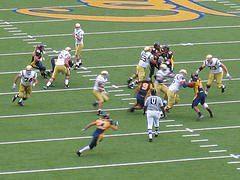
The MIT Mathmen got the ball on their own 20-yard line for the last drive of the game. They were down by 2 points, so they needed at least a field goal to win the game.

If quarterback Zeno and his offense advanced the ball halfway to the opposing team’s end zone on each play…

Continue reading A Football Puzzle

Logic Games at Blogging 2 Learn

http://www.wpclipart.com/money/. Per the licen...
Image via Wikipedia

For the rest of NaBloPoMo (National Blog Posting Month), my other blog is featuring a logic game or puzzle every day. So far, I’ve shared three of my online favorites:

And there’s plenty more fun to come. Drop in every day until December to see a new puzzle or game:

A Couple of Chess Puzzles

Checkmate2
Image via Wikipedia

Chess is a favorite game for recreational mathematicians — not to play it, but to play around with it. Many puzzles and challenges are based on the moves of chess pieces.

Stretch your brain with these puzzles:

  • Can you go on a Knight’s Tour? Start your knight on any square, and try to hop around to all the rest.
  • Or, how many queens can you place on the board so that no queen can capture another?

Continue reading A Couple of Chess Puzzles