Renée’s Platonic Mobile

Alexandria Jones struggled to think of a Christmas gift that a one-month-old baby could enjoy, but finally she got an idea.

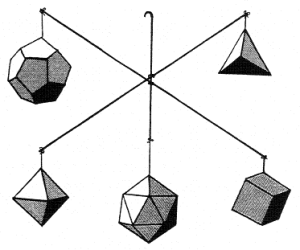
She cut empty cereal boxes to make regular polygons: 6 squares, 12 regular pentagons, and 32 equilateral triangles. Using small pieces of masking tape, she carefully formed the five Platonic solids. Then she mixed flour and water into a runny paste. She tore an old newspaper into small strips and soaked them in the paste. She covered each solid with a thin layer of paper.

Continue reading Renée’s Platonic Mobile

A Football Puzzle

[Photo by rdesai.]

The MIT Mathmen got the ball on their own 20-yard line for the last drive of the game. They were down by 2 points, so they needed at least a field goal to win the game.

If quarterback Zeno and his offense advanced the ball halfway to the opposing team’s end zone on each play…

Continue reading A Football Puzzle

And the Baby Is . . .

[Photo by gabi menashe.] This story is continued from Alexandria Jones and the Eighty-Yard Drive

There was a time-out on the field, and the Jones family sat down for a brief rest. Sam asked, “How do babies decide when it’s time to be born?”

“Well, son, it has to do with numbers. You see,” Uncle Will explained, “the baby spends his first month thinking about the number one.”

“That’s not much to think about,” Sam said. “But I suppose he can’t handle much at that age.”

Continue reading And the Baby Is . . .

Alexandria Jones and the Eighty-Yard Drive


[Photo by West Point Public Affairs.]

Alexandria Jones pulled the last sheet of chocolate chip cookies from the oven and inhaled deeply. Mmm! Perfect. And just in time — Mom was calling her to the car. She slid the cookies into a plastic bowl but left the lid off so the steam could escape. The Jones family was going to meet Uncle Will and Alex’s cousin Sam for a tail-gate picnic before the big football game.

Continue reading Alexandria Jones and the Eighty-Yard Drive

Lewis Carroll’s Logic Challenges

Workplace stress caused by an unsuitable work ...
Image via Wikipedia

Symbolic Logic Part I was published in 1896. When Lewis Carroll (Charles Lutwidge Dodgson) died two years later, Part II was lost. Because they couldn’t find the manuscript, many people doubted that he ever wrote Part II. But almost eighty years after his death, portions of Part II were recovered and finally published. The following puzzles are from the combined volume, Lewis Carroll’s Symbolic Logic, edited by William Warren Bartley, III.

These puzzles are called soriteses or polysyllogisms. Carroll began with a series of “if this, then that” statements. He rewrote them to make them more confusing, and then he mixed up the order to create a challenging puzzle.

Given each set of premises, what conclusion can you reach?

Continue reading Lewis Carroll’s Logic Challenges

Alex Deals Out Equations

Miscellaneous Playing Cards
Image by incurable_hippie via Flickr

Looking around the room, Alex saw kids and parents moving from one table to another. Everyone seemed to be enjoying the Homeschool Math Carnival. She had six junior-high and high school students at her table, waiting while she shuffled her deck of cards.

“Okay,” she said. “These are Math Cards. I took out the face cards, so we just have numbers.”

Continue reading Alex Deals Out Equations

Cousin Sam’s 15 Challenge

Uncle Will drove in from the tree farm to drop off Alex’s cousin, Sam, so he could go to the Homeschool Math Carnival.

“Hey, Sam,” Alex said. “What’s in the sack?”

Sam smiled. “A secret puzzle.”

“Aw, c’mon,” Leon whined. “We’ll be busy with our own games at the carnival. Can’t you show us now?”

Continue reading Cousin Sam’s 15 Challenge

Alexandria Jones and the Mathematical Carnival

Alexandria JonesMaria Jones hung up the phone and collapsed at the kitchen table. She buried her head in her hands and groaned. Alex looked up from her game of Solitaire.

“Let me guess,” she said. “Can’t-Say-No Syndrome, again?”

Mrs. Jones nodded. “This time I volunteered to plan an activity for next month’s homeschool group meeting.”

Leon wandered in and pulled an apple from the fruit bowl. “Ha!” he said. “She means she volunteered us to plan an activity, right?”

Mrs. Jones smiled. “That’s my motto: When in doubt, delegate!”

Continue reading Alexandria Jones and the Mathematical Carnival

Probability Issue: Hints and Answers

Remember the Math Adventurer’s Rule: Figure it out for yourself! Whenever I give a problem in an Alexandria Jones story, I will try to post the answer soon afterward. But don’t peek! If I tell you the answer, you miss out on the fun of solving the puzzle. So if you haven’t worked these problems yet, go back to the original posts. If you’re stuck, read the hints. Then go back and try again. Figure them out for yourself — and then check the answers just to prove that you got them right.

This post offers hints and answers to puzzles from these blog posts:

Continue reading Probability Issue: Hints and Answers

Probability and Baby Blues


[Photo by audi_insperation.]

[In The Birthday Surprise, Alex discovered her family was expecting a new member…]

What will the baby look like, Alex wondered. “Dad, is there any way to tell whether the baby will have blue eyes like I do, or brown like the rest of the family?”

Dr. Jones shuffled the papers on his desk and found a blank page. “Over 100 years ago, the Austrian monk Gregor Mendel studied genetics, or how various traits are passed down from one generation to another.” He began to draw a diagram as he talked.

Continue reading Probability and Baby Blues