This post has been revised to incorporate all the suggestions in the comments below, plus many more activities. Please update your bookmarks:
Or continue reading the original article…
This post has been revised to incorporate all the suggestions in the comments below, plus many more activities. Please update your bookmarks:
Or continue reading the original article…
Here are a few challenging word problems from Singapore:
I did fine on the 3rd-grade problems, but I stumbled a bit on the 4/5th-grade “How much sugar…” problem. The toy cars were tricky, but manageable. I misread the problem with the chocolate and sweets at first — I think of chocolates as a sub-category of sweets, but in this problem they are totally different. (Perhaps “sweets” are what I would call “hard candy”?) Finally, I had to resort to algebra for the last two Grade 6 questions.
How many can you solve?
Math concepts: addition, number bonds for 10, visual memory
Number of players: any number, mixed ages
Equipment: math cards, one deck
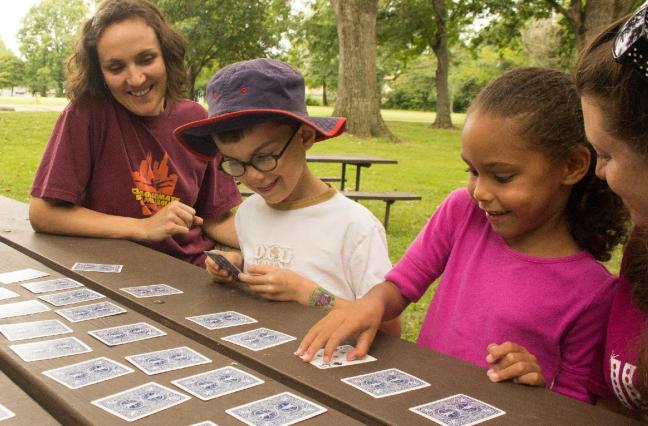
Each player draws a card, and whoever choses the highest number will go first. Then shuffle the cards and lay them all face down on the table, spread out so no card covers any other card. There are 40 cards in a deck, so you can make a neat array with five rows of eight cards each, or you may scatter them at random.
For anyone who can’t make it to Peoria this weekend but is still interested in my math workshops — and just in case we run out of handouts at said workshop — I am posting my math handouts here. These are pdf files, so if you have a sluggish dial-up connection like ours (ah, the joys of rural life!), you can right-click and save each file as a download.
These puzzles look like a lot of fun for whole number and integer arithmetic review. I think they would make a great warm-up at the beginning of a class or math club meeting.
Hat tip: MathPuzzle.com
Feature photo (above) by Jimmie via flickr. Photo (right) by Old Shoe Woman via Flickr.
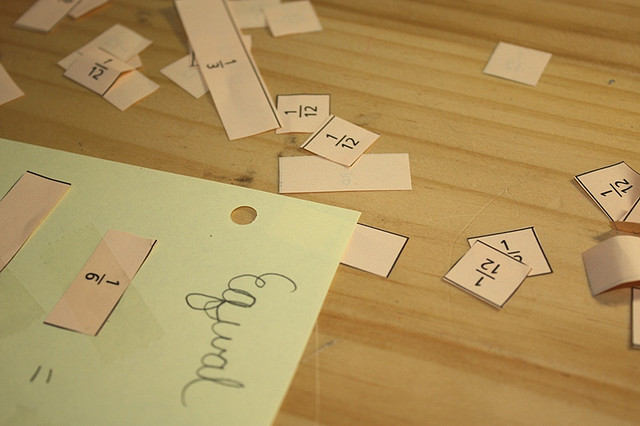
Nearing the end of Miquon Blue today, my youngest daughter encountered fractions greater than one. She collapsed on the floor of my bedroom in tears.
The worksheet started innocently enough:
[Rescued from my old blog.]
I love Miquon math, but the program does feel odd to many homeschoolers, especially at first. It is so different from the math most of us grew up with that it takes time for the teacher to adjust. DJ asked for Miquon advice at a forum I frequent, but I thought enough people might find these tips useful to justify an expanded repost. If you have more advice on teaching Miquon, please chime in!
Well, I didn’t get any takers with the last story problem challenge. But school is in full session now, and we’re doing story problems in Math Club this Friday, so I thought I’d try again.
Here’s the challenge: Can you and your students make up some original math problems?
In Math Club, we always start by reading part of the book Math by Kids for inspiration. I can’t print those stories here, however, because of copyright rules, so I’ll share some of the stories my past students have made, arranged in roughly increasing order of difficulty. After you solve a couple of these problems with your children, encourage them to try making some of their own.
And please, share their gems with us!
The problems below are now available as a printable handout: Story Problem Challenge.
[Rescued from my old blog.]
Would you like to introduce your students to negative numbers before they study them in pre-algebra? With a whimsical number line, negative numbers are easy for children to understand.
Get a sheet of poster board, and paint a tree with roots — or a boat on the ocean, with water and fish below and bright sky above. Use big brushes and thick poster paint, so you are not tempted to put in too much detail. A thick, permanent marker works well to draw in your number line, with zero at ground (or sea) level and the negative numbers down below.
Have you and your children been struggling to learn the math facts? The game of Math Card War is worth more than a thousand math drill worksheets, letting you build your children’s calculating speed in a no-stress, no-test way.
Math concepts: greater-than/less-than, addition, subtraction, multiplication, division, fractions, negative numbers, absolute value, and multi-step problem solving.