Hidden Figures Teaching Resources

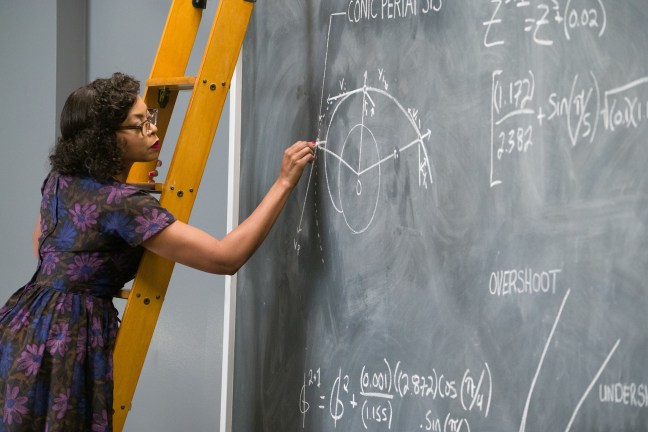
Are you taking your kids to see the movie Hidden Figures? Check out Raymond Johnson’s blog post for references and teaching ideas:

If you know of any other resources, please share in the comments below. And as I find new goodies, I’ll add them to the list below.

Teachers and Students in Action

Lesson Plan Resources

Background Information

Before computers were machines, computers were people who computed things. This complicated task often fell to women because it was considered basically clerical. That’s right: computing triple integrals all day long qualified as clerical.

— Samantha Schumacher
Hidden Figures Movie Review

2017 Mathematics Game

Two of the most popular New Year’s Resolutions are to spend more time with family and friends, and to get more exercise. The 2017 Mathematics Game is a prime opportunity to do both at once.

So grab a partner, slip into your workout clothes, and pump up those mental muscles!

For many years mathematicians, scientists, engineers and others interested in mathematics have played “year games” via e-mail and in newsgroups. We don’t always know whether it is possible to write expressions for all the numbers from 1 to 100 using only the digits in the current year, but it is fun to try to see how many you can find. This year may prove to be a challenge.

Math Forum Year Game Site

Rules of the Game

Use the digits in the year 2017 to write mathematical expressions for the counting numbers 1 through 100. The goal is adjustable: Young children can start with looking for 1-10, middle grades with 1-25.

  • You must use all four digits. You may not use any other numbers.
  • Solutions that keep the year digits in 2-0-1-7 order are preferred, but not required.
  • You may use +, -, x, ÷, sqrt (square root), ^ (raise to a power), ! (factorial), and parentheses, brackets, or other grouping symbols.
  • You may use a decimal point to create numbers such as .2, .02, etc., but you cannot write 0.02 because we only have one zero in this year’s number.
  • You may create multi-digit numbers such as 10 or 201 or .01, but we prefer solutions that avoid them.

My Special Variations on the Rules

  • You MAY use the overhead-bar (vinculum), dots, or brackets to mark a repeating decimal. But students and teachers beware: you can’t submit answers with repeating decimals to Math Forum.
  • You MAY use a double factorial, n!! = the product of all integers from 1 to n that have the same parity (odd or even) as n. I’m including these because Math Forum allows them, but I personally try to avoid the beasts. I feel much more creative when I can wrangle a solution without invoking them.

Click here to continue reading.

New Hundred Chart Game: Jigsaw Gomoku

100chart

Counting all the fractional variations, my massive blog post 30+ Things to Do with a Hundred Chart now offers nearly forty ideas for playing around with numbers from preschool to prealgebra.

Here is the newest entry:

(34) The Number Puzzle Game: Rachel created this fun cross between the hundred-chart jigsaw puzzle (#7) and Gomoku (#23). You can download the free 120-board version here or buy the complete set at Teachers Pay Teachers.

 
* * *

This blog is reader-supported.

If you’d like to help fund the blog on an on-going basis, then please join me on Patreon for mathy inspiration, tips, and an ever-growing archive of printable activities.

If you liked this post, and want to show your one-time appreciation, the place to do that is PayPal: paypal.me/DeniseGaskinsMath. If you go that route, please include your email address in the notes section, so I can say thank you.

Which I am going to say right now. Thank you!

“New Hundred Chart Game: Jigsaw Gomoku” copyright © 2016 by Denise Gaskins. Image at the top of the post copyright © geishaboy500 (CC BY 2.0).

A New Graph-It Puzzle

Since I’ve been posting new Alexandria Jones stories this week (beginning here), I’ve gone back and re-read the old Christmas posts. I noticed that the original Graph-It Game included a religious design, but nothing for those who don’t celebrate Christmas.

So I updated the post with a new, non-religious puzzle. Here it is, if you want to play…

Graph-It Game Design

For this design, you will need graph paper with coordinates from −8 to +8 on both the x- and y-axis. Connect the points in each line. Stop at the periods, and then start a new line at the next point.

(-8,8) – (-8,0) – (0,8) – (-8,8) – (-4,4) – (0,4) – (0,8) – (8,8) – (4,4) – (0,8).

(8,8) – (8,0) – (4,0) – (4,-4) – (8,0) – (8,-8) – (0,-8) – (4,-4) – (0,-4) – (0,-8) – (-8,0) – (-8, -8) – (0,-8).

(-8,-8) – (4,4) – (0,4) – (4,0) – (4,4) – (8,0).

(8,-8) – (-4,4) – (-4,-4) – (0,-4) – (-4,0) – (-8,0).

(0,-2) – (0,-4) – (4,0) – (2,0) – (2,-2) – (-2,-2) – (-2,2) – (2,2) – (2,0) – (1,1) – (1,0) – (2,0) – (0,-2) – (-2,0) – (0,2) – (1,1) – (-1,1) – (-1,-1) – (1,-1) – (1,0) – (-4,0) – (0,4) – (0,-1) – (-1,0) – (0,1) – (1,0) – (0,-1) – (0,-2).

Color in your design and hang it up for the whole family to enjoy!

Now Make Your Own

Of course, the fun of the Graph-It Game is to make up your own graphing puzzle. Can you create a coordinate design for your friends to draw?

Want More?

You can see all the Alexandria Jones Christmas posts at a glance here:

CREDITS: “Love Christmas Lights” photo by Kristen Brasil via Flickr (CC BY 2.0).

A Polyhedra Construction Kit

To make a Christmas gift for her brother Leon, Alex asked all her friends to save empty cereal boxes. She collected about a dozen boxes.

She cut the boxes open, which gave her several big sheets of thin cardboard.

Then she carefully traced the templates for a regular triangle, square, pentagon, and hexagon, as shown below.

polyhedra-construction-kit

Click here to download the polygon templates

She drew the dark outline of each polygon with a ballpoint pen, pressing hard to score the cardboard so the tabs would bend easily.

She cut out shapes until her fingers felt bruised: 20 each of the pentagon and hexagon, 40 each of the triangle and square.

Alex bought a bag of small rubber bands for holding the tabs together. Each rubber band can hold two tabs, forming an edge of the polyhedron. So, for instance, it takes six squares and twelve rubber bands to make a cube.

Finally, she stuffed the whole kit in a plastic zipper bag, along with the following instructions.

Polyhedra Have “Many Faces”

Poly means many, and hedron means face, so a polyhedron is a 3-D shape with many faces.

The plural of polyhedron is polyhedra, thanks to the ancient Greeks, who didn’t know that the proper way to make a plural was to use the letter s.

Each corner of a polyhedron is called a vertex, and to make it more confusing, the plural of vertex is vertices.

Regular Polyhedra

Regular polyhedra have exactly the same faces and corners all around. If one side is a square, then all the sides will be squares. And if three squares meet to make one vertex, then all the other vertices will be made of three squares, just like that first one.

There are only five possible regular polyhedra. Can you figure out why?

Here are the five regular polyhedra, also called the Platonic solids. Try to build each of them with your construction kit.

Tetrahedron: three equilateral triangles meeting at each vertex.

Hexahedron: three squares meeting at each vertex. Do you know its common name?

Octahedron: four triangles at each vertex.

Icosahedron: five triangles at each vertex.

Dodecahedron: three pentagons per vertex.

You can find pictures of these online, but it’s more challenging to build them without peeking at the finished product. Just repeat the vertex pattern at every corner until the polygons connect together to make a complete 3-D shape.

Semi-Regular Polyhedra

Semi-regular polyhedra have each face a regular polygon, although not all the same. Each corner is still the same all around. These are often called the Archimedean polyhedra.

For example, on the cuboctahedron, every vertex consists of a square-triangle-square-triangle combination.

Here are a few semi-regular polyhedra you might try to build, described by the faces in the order they meet at each corner:

Icosidodecahedron: triangle, pentagon, triangle, pentagon.

Truncated octahedron: square, hexagon, hexagon.

Truncated icosahedron: pentagon, hexagon, hexagon. Where have you seen this?

Rhombicuboctahedron: triangle, square, square, square.

Rhombicosidodecahedron: triangle, square, pentagon, square.

Now, make up some original polyhedra of your own. What will you name them?

To Be Continued…

Read all the posts from the December 2000/January 2001 issue of my Mathematical Adventures of Alexandria Jones newsletter.

CREDITS: “50/52 Weeks of Teddy – Merry Christmas” photo by Austin Kirk via Flickr (CC BY 2.0).

How to Make a Flexagon Christmas Card

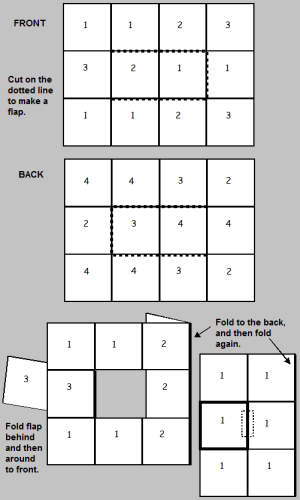
tetra-tetraflexagonHere’s how Alex created tetra-tetraflexagon Christmas cards to send to her friends:

1. Buy a pack of heavy paper at the office supply store. Regular construction paper tears too easily.

2. Measure and divide the paper into fourths one direction and thirds the other way. Fold each line backward and forward a few times.

3. Number the front and back of the paper in pencil, lightly, as shown. Then carefully cut a center flap along the dotted lines.

4. Fold the paper along the dark lines as shown, so the center flap sticks out from underneath and the right-hand column shows all 2’s.

5. Fold the flap the rest of the way around to the front and fold the right-hand column under again. (Shown as dark lines on the diagram.) This makes the front of the flexagon show 1’s in every square.

6. Carefully, tape the flap to its neighbor on the folded column. Don’t let the tape stick to any but these two squares.

7. Gently erase your pencil marks.

Find All the Faces

A tetra-tetraflexagon has four faces: front, back, and two hidden. It is shaped like a tetragon — better known as a rectangle.

Here’s how to flex your tetra-tetraflexagon card:

  • Face 1 is easy to find. It’s on top when you make the card.
  • Turn the card over to find Face 2.
  • Face 3 is hidden behind Face 2. Fold your flexagon card in half (vertically) so that Face 1 disappears. Unfold Face 2 at the middle, like opening a book. Face 3 should appear like magic.
  • Face 4 is hidden behind Face 3. Fold the card (vertically) to hide Face 2, then open the middle of Face 3. Face 2 vanishes, and Face 4 is finally revealed.

When Faces 2 and 3 are folded to the back, you will notice that any pictures you drew on them will look scrambled. What happened?

Add Your Designs

Alex wrote a holiday greeting on Face 1. Then she drew Christmas pictures on the other three faces of her card.

To Be Continued…

Read all the posts from the December 2000/January 2001 issue of my Mathematical Adventures of Alexandria Jones newsletter.

CREDITS: “Happy Holidays” photo by Mike Brand via Flickr (CC BY 2.0). Video by Shaireen Selamat of DynamicEducator.com.

Puzzle: Exploding Dots

I’m planning ahead for my fall semester homeschool co-op math class. Definitely going to try this with the kids…

Encourage your children to have some fun this week with this Exploding Dots math puzzle from The Global Math Project. What do they notice? Does it make them wonder?

More Explosive Math

You may recognize the connection between Exploding Dots and binary numbers. Or not — the puzzle is accessible to people at almost any age and level of mathematical sophistication.

But what I find amazing is that this puzzle can help us understand all sorts of topics in elementary arithmetic and algebra. So cool!

If you’d like to investigate Exploding Dots in depth, check out James Tanton’s free G’Day Math online course.

FAQ: Trouble Finding the Right Math Program

“I can’t find a home school math program my son likes. We’ve tried Singapore Math, Right Start, Saxon, and Math Mammoth. We subscribed to a month of IXL Math to keep him in practice, but he hates that, too. I know I shouldn’t have changed so many times, but this was our first year of homeschooling, and I was trying to please him. But I’m running out of things to try. Do you think Life of Fred might work?”

Rock-Surfing

You’ve tried all those math programs in one year? Many people recommend that new homeschoolers take a few months off to “detox” from the classroom setting, to relax and enjoy the freedom of making their own choices. But your son might want a few months to detox from his homeschool experience.

I suggest you set aside all those books and focus on games and informal math. Try to avoid schoolish lessons until your son starts to enjoy learning for its own sake.

Continue reading FAQ: Trouble Finding the Right Math Program

Review: Math & Magic in Wonderland

Are you looking for a fun book to read over the summer? I just finished Lilac Mohr’s delightful Math & Magic in Wonderland, and I loved it.

Highly recommended, for kids or adults!

About the Book

Math-Magic-WonderlandA Jubjub bird disguised as a lark,
Borogroves concealing a snark,
When you’re in Tulgey Wood, you must
Be careful whom it is you trust…

With the discovery of Mrs. Magpie’s Manual of Magic for Mathematical Minds, Lulu and Elizabeth embark on an exciting journey to a realm inspired by Lewis Carroll’s poetry. The twins must use ingenuity and sagacity to solve classic logic puzzles that promise to uncover the book’s secrets and earn them The Vorpal Blade. In this interactive novel, the reader is invited to play along with the two heroines on their grand mathematical adventure.

Do you have the smarts to help Lulu and Elizabeth outwit the frumious Bandersnatch?

It’s time to enter Wonderland and find out!

–from the back cover of Math & Magic in Wonderland by Lilac Mohr

What I Liked

Puns, poetry, and plenty of puzzles. Tangrams, tessellations, truth-tellers and liars. History tidbits and many classics of recreational mathematics.

The sisters Lulu and Elizabeth seem real — though perhaps more widely read than most of us. They are different from each other. They make mistakes and have disagreements. But they never deteriorate into the cliché of sibling rivalry that passes for characterization in too many children’s books.

In each chapter, the girls must solve a language, math, or logic puzzle to proceed along their journey. Then a “Play Along” section offers related puzzles for the reader to try.

No matter how challenging the topic, the book never talks down to the reader.

What I Didn’t Like

… Um … Honestly, I can’t think of anything.

Since it’s traditional to criticize the editing of self-published books, I will say this: There was at least one place where the wording seemed a bit awkward. I would have phrased the sentence differently. But don’t ask me to identify the page — I was too caught up in the story to bother jotting down such a quibble. And I tried flipping through the book as I wrote this post, but I can’t find it again.

Buy, or Don’t Buy?

Buy. Definitely buy.

Unless you hate logic puzzles and despise Lewis Carroll’s poetry.

But for everyone else, this book is truly a gem. If you like The Cat in Numberland or The Man Who Counted, then I’m sure you’ll enjoy Math & Magic in Wonderland.

Useful Links

Disclaimer: Like almost all book links on my blog, the links in this post take you to Amazon.com, where you can read descriptions and reviews. I make a few cent’s worth of affiliate commission if you make a purchase — but nowhere near enough to influence my opinion about the book.

And Now for the Giveaway

Math-Magic-WonderlandLilac offered a paperback copy of Math & Magic in Wonderland for one lucky reader of Let’s Play Math blog.

The giveaway is done. Congratulations, Keshua!

But the comments section below remains open, and I’d still love to hear your answers:

  • Tell us about your favorite language, math, or logic puzzle book! Or share a book you’ve been wanting to read.

10 Ways to Celebrate World Tessellation Day

Guest post by Emily Grosvenor.

June 17 marks World Tessellation Day, a holiday I created to bring awareness to the fun of finding and making tessellations.

Will you celebrate with us?

Here are 10 great ways to play with tessellations, learn about them, and introduce your children to a math concept that opens a variety of creative learning opportunities.

1) Learn about tessellations with your kids.

A tessellation is a tiled mosaic pattern of the same shape laid out over and over again, repeating into infinity. Tessellations can be found in nature, or they can be created by people. Learn more at these websites:

1WorldTessellationDayExcept where otherwise noted, graphics and photos copyright ©2016 Emily Grosvenor. All rights reserved.

Continue reading 10 Ways to Celebrate World Tessellation Day