A-Hunting They Will Go

Alexandria Jones and her family piled into the car for a drive in the country. This year, they were determined to find an absolutely perfect Christmas tree at Uncle William Jones’s tree farm.

“I want the tallest tree in Uncle Will’s field,” Alex said.

“Hold it,” said her mother. “I refuse to cut a hole in the roof.”

“But, Mom!” Leon whined. “The Peterkin Papers…”

“Too bad. Our ceiling will stay a comfortable 8 feet high.”

Continue reading A-Hunting They Will Go

Fraction Models, and a Card Game

Fraction cards

Models give us a way to form and manipulate a mental image of an abstract concept, such as a fraction. There are three basic ways we can imagine a fraction: as partially-filled area or volume, as linear measurement, or as some part of a given set. Teach all three to give your students a well-rounded understanding.

When teaching young students, we use physical models — actual food or cut-up pieces of construction paper. Older students and adults can firm up the foundation of their understanding by drawing many, many pictures. As we move into abstract, numbers-only work, these pictures remain in our minds, an always-ready tool to help us think our way through fraction problems.

Continue reading Fraction Models, and a Card Game

In the News: Teaching Math

Here are a couple of interesting articles about teaching math:

Good Stories, Good Math

Math Trek (Nov. 10, 2007) — Spinning a good yarn may seem to have little to do with mathematics, but a new study suggests otherwise. Preschoolers who tell stories that include many different perspectives do better in math two years later than those who stick to one simple perspective. The researchers believe that the study may highlight a deep connection between mathematical ability and narrative skills… [Hat tip: Wild About Math!]

Gesturing Helps Grade School Children Solve Math Problems

ScienceDaily (Nov. 5, 2007) — Are math problems bugging your kids? Tell them to talk back — using their hands. Psychologists at the University of Chicago report that gesturing can help kids add new and correct problem-solving strategies to their mathematical repertoires. What’s more, when given later instruction, kids who are told to gesture are more likely to succeed on math problems…

Continue reading In the News: Teaching Math

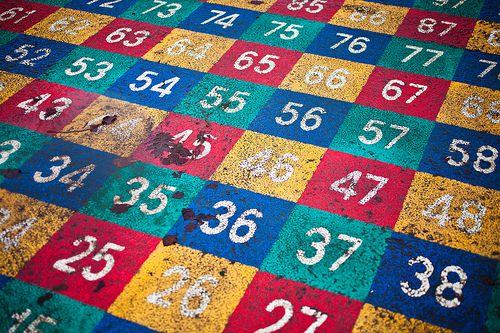
Game: Hundred Chart Nim

Photo by Håkan Dahlström via flickr.

Math concepts: addition and subtraction within 100, logical strategy
Number of players: 2 or 3
Equipment: printed hundred chart (also called a hundred board) and beans, pennies, or other tokens with which to mark numbers — or use this online hundred chart

Set Up

Place the hundred chart and a small pile of tokens where both players can reach them.

Continue reading Game: Hundred Chart Nim

Solving Complex Story Problems II

[Oops! I found one more post from my old blog. It apparently slipped off the back of my metaphorical desk and has been sitting with the dust bunnies.]

Here is a math problem in honor of one of our family’s favorite movies

Han Solo was doing some needed maintenance on the Millennium Falcon. He spent 3/5 of his money upgrading the hyperspace motivator. He spent 3/4 of the remainder to install a new blaster cannon. If he spent 450 credits altogether, how much money did he have left?

[Modified from a word problem in Singapore Primary Math 5B. Stop and think about how you would solve it before reading further.]

Continue reading Solving Complex Story Problems II

How Shall We Teach Fractions?

How did you fare on the Frustrating Fractions Quiz? With so many apparent inconsistencies, we can all see why children (and their teachers) get confused. And yet, fractions are vital to our children’s test scores — and scores are important to college admissions officers. What is a teacher to do? Must we tell our children, “Do it this way, and don’t ask questions”?

Parents and teachers are tempted to wonder if the struggle is worth it. After all, how often do you divide by a fraction in your adult life? If only we could skip the hard stuff…

Continue reading How Shall We Teach Fractions?

More Fun with Hexa-Trex

Hexa-trex turtle logo

My elementary Math Club students had fun practicing their math facts and “out of the box” thinking with Hexa-Trex puzzles. The object of Hexa-Trex is to find a path through all the number and operation tiles to make a true equation. The “Easy” puzzles are just the right level for my 4th-5th grade students, although they get stumped whenever the equations require Order of Operations. One girl enjoyed the puzzles enough to take our extra pages home for her dad.

Hexa-Trex puzzles were featured in the October issue of Games magazine, and now you can enjoy Hexa-Trex away from the computer with Bogusia Gierus‘s new book, The First Book of Hexa-Trex Puzzles. If you are thinking ahead to Christmas (can it be that time already?!), and if you have a puzzle lover in the family, this little book would make a fun stocking-stuffer.

Quiz: Those Frustrating Fractions

[Photo by jimmiehomeschoolmom.]

Fractions confuse almost everybody. In fact, fractions probably cause more math phobia among children (and their parents) than any other topic before algebra. Middle school textbooks devote a tremendous number of pages to teaching fractions, and still many students find fractions impossible to understand. Standardized tests are stacked with fraction questions.

Fractions are a filter, separating the math haves from the luckless have nots. One major source of difficulty with fractions is that the rules do not seem to make sense. Can you explain these to your children?

Start with an easy one…

Question #1

If you need a common denominator to add or subtract fractions…

  • Why don’t you need a common denominator when you multiply?

Continue reading Quiz: Those Frustrating Fractions

What Do We Mean by “Assume”?

Almost all math problems call for the student to assume one thing or another. Without assumptions — definitions, postulates, axioms, common notions, or whatever you want to call them — mathematics of any kind is impossible. Tony at Pencils Down (who plans to be a math teacher when he grows up) reminds us that, necessary though it may be, we are stepping on dangerous ground when we assume:

Random Samples: Making an Ass of You and Me

Continue reading What Do We Mean by “Assume”?