Hundred Chart Idea #28: Hang It on the Wall

Math is beautiful when it communicates an abstract idea clearly and provides new insight. Yelena’s hundred chart poster does just that:

[From the Moebius Noodles blog]

Check out my newest home decor item, a hundred chart. The amount of work I put into it, I consider getting it framed to be proudly displayed in the living room. The thing is monumental in several ways:

1. It is monumentally different from my usual approach to choosing math aids. My rule is if it takes me more than 5 minutes to prepare a math manipulative, I skip it and find another way.

2. It is monumentally time-consuming to create from scratch all by yourself.

3. It is monumentally fun to show to a child.

— Yelena McManaman
Moebius Noodles

Now she’s provided a fantastic set of free hundred chart printables:

Thanks, Yelena!

Share Your Ideas

It began with a humble list of seven things in the first (now out of print) edition of my book about teaching home school math. Over the years I added new ideas, and online friends contributed, too, so the list grew to become one of the most popular posts on my blog:

Can you think of anything else we might do with a hundred chart? Add your ideas in the Comments section below, and I’ll add the best ones to our master list.

Build Mathematical Skills by Delaying Arithmetic, Part 2

To my fellow homeschoolers,

Most young children are not developmentally ready to master abstract, pencil-and-paper rules for manipulating numbers. But they are eager to learn about and explore the world of ideas. Numbers, patterns, and shapes are part of life all around us. As parent-teachers, we have many ways to feed our children’s voracious mental appetites without resorting to workbooks.

To delay formal arithmetic does not mean that we avoid mathematical topics — only that we delay math fact drill and the memorization of procedures. Notice the wide variety of mathematics Benezet’s children explored through books and through their own life experiences:

Grade I

There is no formal instruction in arithmetic. In connection with the use of readers, and as the need for it arises, the children are taught to recognize and read numbers up to 100. This instruction is not concentrated into any particular period or time but comes in incidentally in connection with assignments of the reading lesson or with reference to certain pages of the text.

Meanwhile, the children are given a basic idea of comparison and estimate thru [sic] the understanding of such contrasting words as: more, less; many. few; higher, lower; taller, shorter; earlier, later; narrower, wider; smaller, larger; etc.

As soon as it is practicable the children are taught to keep count of the date upon the calendar. Holidays and birthdays, both of members of the class and their friends and relatives, are noted.

— L. P. Benezet
The Teaching of Arithmetic II: The Story of an experiment

Continue reading Build Mathematical Skills by Delaying Arithmetic, Part 2

Build Mathematical Skills by Delaying Arithmetic, Part 1

To my fellow homeschoolers,

It’s counter-intuitive, but true: Our children will do better in math if we delay teaching them formal arithmetic skills. In the early years, we need to focus on conversation and reasoning — talking to them about numbers, bugs, patterns, cooking, shapes, dinosaurs, logic, science, gardening, knights, princesses, and whatever else they are interested in.

In the fall of 1929 I made up my mind to try the experiment of abandoning all formal instruction in arithmetic below the seventh grade and concentrating on teaching the children to read, to reason, and to recite — my new Three R’s. And by reciting I did not mean giving back, verbatim, the words of the teacher or of the textbook. I meant speaking the English language.

— L. P. Benezet
The Teaching of Arithmetic I: The Story of an experiment

Continue reading Build Mathematical Skills by Delaying Arithmetic, Part 1

How Crazy Can You Make It?

And here is yet more fun from Education Unboxed. This type of page was always one of my my favorites in Miquon Math.

Update:

Handmade “How Crazy…?” worksheets are wonderful, but if you want something a tad more polished, I created a printable. The first page has a sample number, and the second is blank so that you can fill in any target:

Add an extra degree of freedom: students can fill in the blanks with equivalent and non-equivalent expressions. Draw lines anchoring the ones that are equivalent to the target number, but leave the non-answers floating in space.

Or don’t draw lines. Let the kids create a worksheet for you to solve. After they finish their expressions, can you figure out which ones connect to the target number?

How CRAZY Can You Make It

PUFM 1.4 Subtraction

Photo by Martin Thomas via flickr. In this Homeschooling Math with Profound Understanding (PUFM) Series, we are studying Elementary Mathematics for Teachers and applying its lessons to home education.

When adding, we combine two addends to get a sum. For subtraction we are given the sum and one addend and must find the “missing addend”.

— Thomas H. Parker & Scott J. Baldridge
Elementary Mathematics for Teachers

Notice that subtraction is not defined independently of addition. It must be taught along with addition, as an inverse (or mirror-image) operation. The basic question of subtraction is, “What would I have to add to this number, to get that number?”

Inverse operations are a very fundamental idea in mathematics. The inverse of any math operation is whatever will get you back to where you started. In order to fully understand a math operation, you must understand its inverse.

Continue reading PUFM 1.4 Subtraction

PUFM 1.3 Addition

Photo by Luis Argerich via flickr. In this Homeschooling Math with Profound Understanding (PUFM) Series, we are studying Elementary Mathematics for Teachers and applying its lessons to home education.

The basic idea of addition is that we are combining similar things. Once again, we meet the counting models from lesson 1.1: sets, measurement, and the numberline. As homeschooling parents, we need to keep our eyes open for a chance to use all of these models — to point them out in the “real world” or to weave them into oral story problems — so our children gain a well-rounded understanding of math.

Addition arises in the set model when we combine two sets, and in the measurement model when we combine objects and measure their total length, weight, etc.

One can also model addition as “steps on the number line”. In this number line model the two summands play different roles: the first specifies our starting point and the second specifies how many steps to take.

— Thomas H. Parker & Scott J. Baldridge
Elementary Mathematics for Teachers

Continue reading PUFM 1.3 Addition

Tell Me a (Math) Story

[Feature photo above by Keoni Cabral via Flickr (CC BY 2.0).]

My favorite playful math lessons rely on adult/child conversation — a proven method for increasing a child’s reasoning skills. What better way could there be to do math than snuggled up on a couch with your little one, or side by side at the sink while your middle-school student helps you wash the dishes, or passing the time on a car ride into town?

As soon as your little ones can count past five, start giving them simple, oral story problems to solve: “If you have a cookie and I give you two more cookies, how many cookies will you have then?”

The fastest way to a young child’s mind is through the taste buds. Children can easily visualize their favorite foods, so we use mainly edible stories at first. Then we expand our range, adding stories about other familiar things: toys, pets, trains.

Continue reading Tell Me a (Math) Story

Do You Teach Math to Young Children?

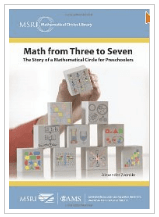
Sue VanHattum is trying to convince the publishers that this excellent book would reach a wider audience if they made it available at a lower price. What do you think?

As anyone who has taught or raised young children knows, mathematical education for little kids is a real mystery. What are they capable of? What should they learn first? How hard should they work? Should they even “work” at all? Should we push them, or just let them be?

There are no correct answers to these questions, and Zvonkin deals with them in classic math-circle style: He doesn’t ask and then answer a question, but shows us a problem — be it mathematical or pedagogical — and describes to us what happened. His book is a narrative about what he did, what he tried, what worked, what failed, but most important, what the kids experienced.

This book is not a guidebook. It does not purport to show you how to create precocious high achievers. It is just one person’s story about things he tried with a half-dozen young children. On the other hand, if you are interested in running a math circle, or homeschooling children, you will find this book to be an invaluable, inspiring resource. It’s not a “how to” manual as much as a “this happened” journal. … Just about every page contains a really clever teaching idea, a cool math problem, and an inspiring and funny story.

— Paul Zeitz
Introduction to Math from Three to Seven

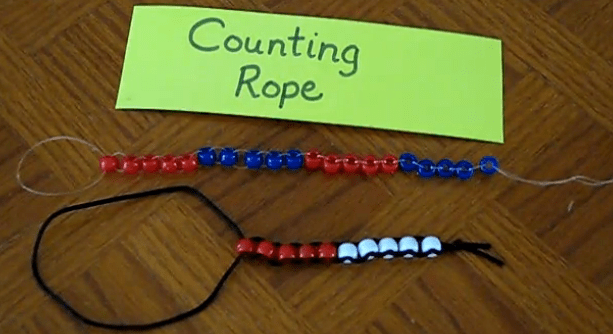
Easy-to-Make Counting Rope

This is wonderful! I am definitely not a crafts-person, but I can’t wait to make some of these. If I can just find my daughter’s pony beads….

From Cindy at love2learn2day, who got the idea from a math conference workshop by Kim Sutton.

Krista at the LivingMathForum wrote, “We’ve used these for several years. My son even made a bunch of them a few years ago and sold them at a homeschool resource fair. We always have one in most of our board games to help younger children add up their die rolls. I find them relaxing for some reason, just moving the beads along the cord, and my son will sometimes sit and listen to me reading, etc., and just manipulate the beads.”

Playful Math Lessons

You can use these math activities to play with your counting rope: