Click to read the earlier posts in this series: Understanding Math, Part 1: A Cultural Problem; Understanding Math, Part 2: What Is Your Worldview?; Understanding Math, Part 3: Is There Really a Difference?; Understanding Math, Part 4: Area of a Rectangle; Understanding Math, Part 5: Multiplying Fractions; and Understanding Math, Part 6: Algebraic Multiplication.
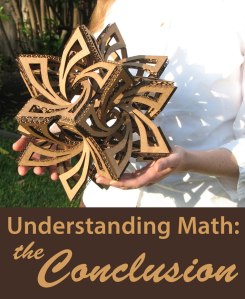
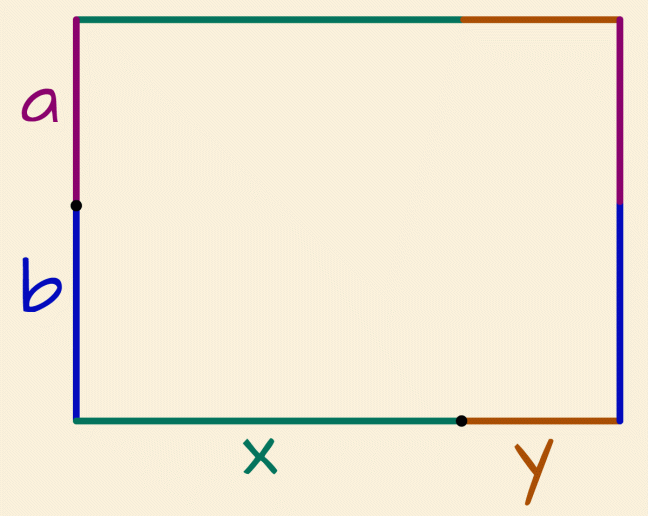
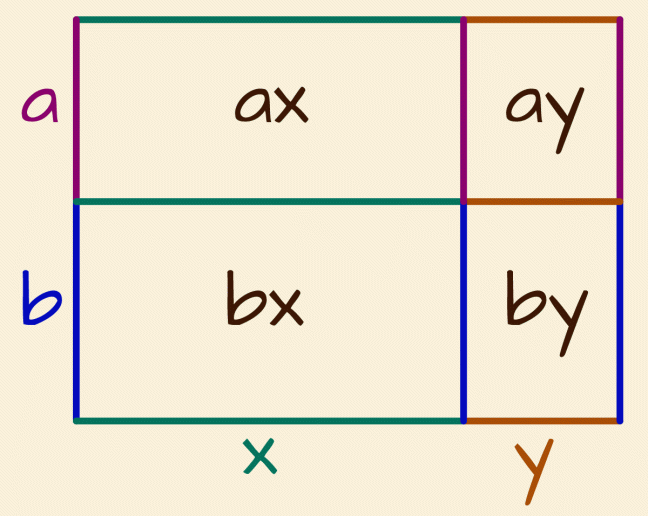
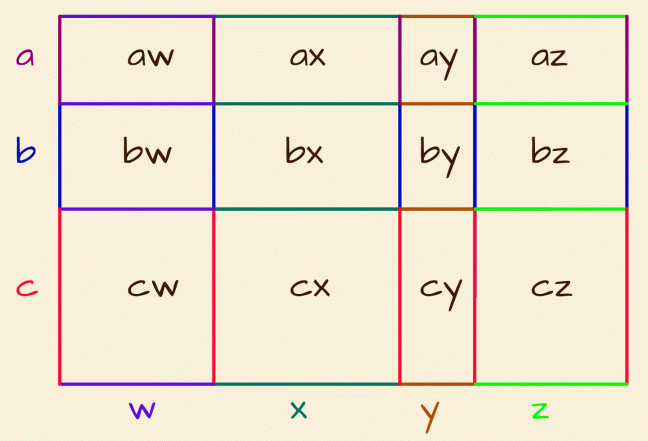
Earlier in this blog post series, I gave you three middle-school math rules. But by exploring the concept of rectangular area as a model of multiplication, we discovered that in a way they were all the same.
The rules are not arbitrary, handed down from a mathematical Mount Olympus. They are three expressions of a single basic question: what does it mean to measure area?
There was only one rule, one foundational pattern that tied all these topics together in a mathematical web.
What Is Your Worldview?
Many children want to learn math instrumentally, as a tool for getting answers. They prefer the simplicity of memorizing rules to the more difficult task of making sense of new ideas. Being young, they are by nature short-term thinkers. They beg, “Just tell me what to do.”
But if we want our children to truly understand mathematics, we need to resist such shortcuts. We must take time to explore mathematics as a world of ideas that connect and relate to each other in many ways. And we need to show children how to reason about these interconnected concepts, so they can use them to think their way through an ever-expanding variety of problems.
Our kids can only see the short term. If we adults hope to help them learn math, our primary challenge is to guard against viewing the mastery of facts and procedures as an end in itself. We must never fall into thinking that the point of studying something is just to get the right answers.
We understand this in other school subjects. Nobody imagines that the point of reading is to answer comprehension questions.  We know that there is more to learning history than winning a game of Trivial Pursuit. But when it comes to math, too many parents (and far too many politicians) act as though the goal of our children’s education is to produce high scores on a standardized test.
What If I Don’t Understand Math?
If you grew up (as I did) thinking of math as a tool, the instrumental approach may feel natural to you. The idea of math as a cohesive system may feel intimidating. How can we parents help our children learn math, if we never understood it this way ourselves?
Don’t panic. Changing our worldview is never easy, yet even parents who suffer from math anxiety can learn to enjoy math with their children. All it takes is a bit of self-discipline and the willingness to try.
You don’t have to know all the answers. In fact, many people have found the same thing that Christopher Danielson described in his blog post “Let the children play” — the more we adults tell about a topic, the less our children learn. With the best of intentions we provide information, but we unwittingly kill their curiosity.
- If you’re afraid of math, be careful to never let a discouraging word pass your lips. Try calling upon your acting skills to pretend that math is the most exciting topic in the world.
- Encourage your children to notice the math all around them.
- Search out opportunities to discuss numbers, shapes, symmetry, and patterns with your kids.
- Investigate, experiment, estimate, explore, measure — and talk about it all.
The Science of Patterns
Patterns are so important that American mathematician Lynn Arthur Steen defined mathematics as the science of patterns.
As biology is the science of life and physics the science of energy and matter, so mathematics is the science of patterns. We live in an environment steeped in patterns — patterns of numbers and space, of science and art, of computation and imagination. Patterns permeate the learning of mathematics, beginning when children learn the rhythm of counting and continuing through times tables all the way to fractals and binomial coefficients.
— Lynn Arthur Steen, 1998
Reflections on Mathematical Patterns, Relationships, and Functions
If you are intimidated by numbers, you can look for patterns of shape and color. Pay attention to how they grow, and talk about what your children notice. For example, some patterns repeat exactly, while other patterns change as they go (small, smaller, smallest, or loud, louder, loudest).
Nature often forms fractal-like patterns: the puffy round-upon-roundness of cumulus clouds or broccoli, or the branch-upon-branchiness of a shrub or river delta. Children can learn to recognize these, not as a homework exercise but because they are interesting.
Math the Mathematician’s Way
Here is the secret solution to the crisis of math education: we adults need to learn how to think like mathematicians.
For more on what it means to think about math the mathematician’s way, check out my Homeschooling with Math Anxiety blog post series:
- Mathematicians avoid busywork as if it were an infectious disease.
- Mathematicians always ask questions.
- And most of all, mathematicians love to play.
As we cultivate these characteristics, we will help our children to recognize and learn true mathematics.
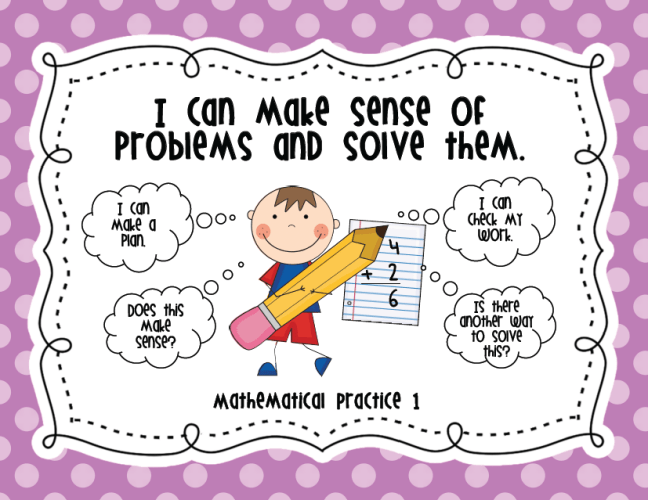
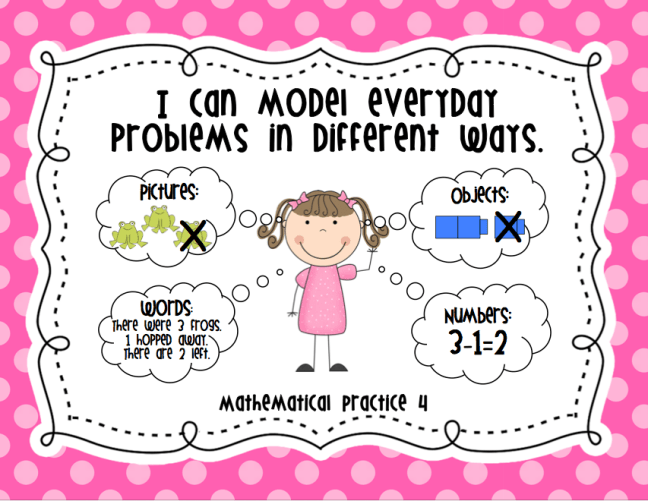
CREDITS: “Frabjous 01” photo (top, text added) by Windell Oskay and “Back to School” photo (middle) by Phil Roeder via Flicker (CC BY 2.0). “I Can Solve Problems” poster by Nicole Ricca via Teachers Pay Teachers.  This is the final post in my Understanding Math series, adapted from my book Let’s Play Math: How Families Can Learn Math Together—and Enjoy It, available at your favorite online book dealer.
 We’ve examined how our vision of mathematical success shapes our children’s learning. Do we think math is primarily a tool for solving problems? Or do we see math as a web of interrelated concepts?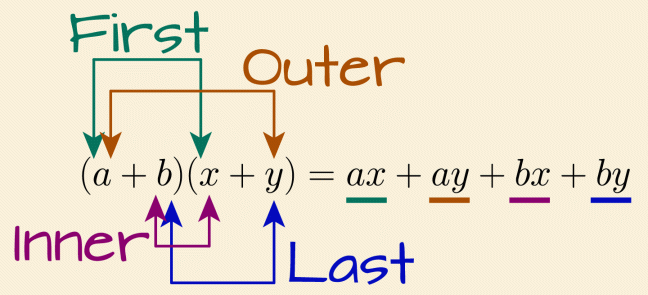
 .
.
 .
.
 .
.

 Fractions confuse almost everybody. In fact, fractions probably cause more math phobia among children (and adults) than any other topic before algebra.
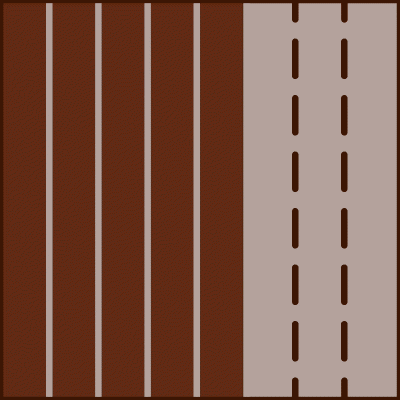
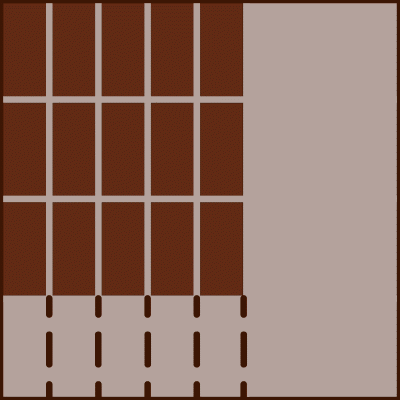
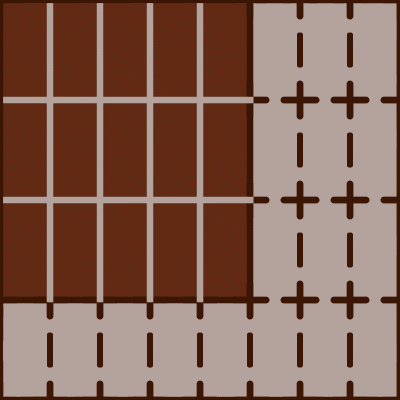

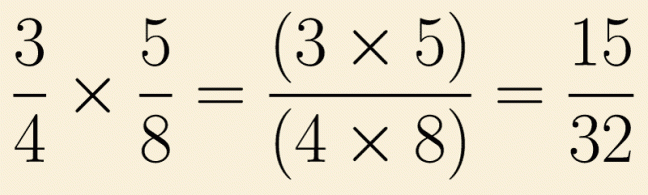

 Every mathematical procedure we learn is an instrument or tool for solving a certain kind of problem. To understand math means to know which tool we are supposed to use for each type of problem and how to use that tool — how to categorize the problem, remember the formula, plug in the numbers, and do the calculation. To be fluent in math means we can produce correct answers with minimal effort.


 Denise Gaskins' Let's Play Math