PUFM 1.4 Subtraction

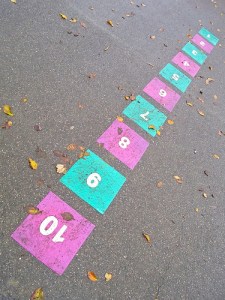
Photo by Martin Thomas via flickr. In this Homeschooling Math with Profound Understanding (PUFM) Series, we are studying Elementary Mathematics for Teachers and applying its lessons to home education.

When adding, we combine two addends to get a sum. For subtraction we are given the sum and one addend and must find the “missing addend”.

— Thomas H. Parker & Scott J. Baldridge
Elementary Mathematics for Teachers

Notice that subtraction is not defined independently of addition. It must be taught along with addition, as an inverse (or mirror-image) operation. The basic question of subtraction is, “What would I have to add to this number, to get that number?”

Inverse operations are a very fundamental idea in mathematics. The inverse of any math operation is whatever will get you back to where you started. In order to fully understand a math operation, you must understand its inverse.

Continue reading PUFM 1.4 Subtraction

PUFM 1.3 Addition

Photo by Luis Argerich via flickr. In this Homeschooling Math with Profound Understanding (PUFM) Series, we are studying Elementary Mathematics for Teachers and applying its lessons to home education.

The basic idea of addition is that we are combining similar things. Once again, we meet the counting models from lesson 1.1: sets, measurement, and the numberline. As homeschooling parents, we need to keep our eyes open for a chance to use all of these models — to point them out in the “real world” or to weave them into oral story problems — so our children gain a well-rounded understanding of math.

Addition arises in the set model when we combine two sets, and in the measurement model when we combine objects and measure their total length, weight, etc.

One can also model addition as “steps on the number line”. In this number line model the two summands play different roles: the first specifies our starting point and the second specifies how many steps to take.

— Thomas H. Parker & Scott J. Baldridge
Elementary Mathematics for Teachers

Continue reading PUFM 1.3 Addition

Tell Me a (Math) Story

[Feature photo above by Keoni Cabral via Flickr (CC BY 2.0).]

My favorite playful math lessons rely on adult/child conversation — a proven method for increasing a child’s reasoning skills. What better way could there be to do math than snuggled up on a couch with your little one, or side by side at the sink while your middle-school student helps you wash the dishes, or passing the time on a car ride into town?

As soon as your little ones can count past five, start giving them simple, oral story problems to solve: “If you have a cookie and I give you two more cookies, how many cookies will you have then?”

The fastest way to a young child’s mind is through the taste buds. Children can easily visualize their favorite foods, so we use mainly edible stories at first. Then we expand our range, adding stories about other familiar things: toys, pets, trains.

Continue reading Tell Me a (Math) Story

Quotable: The Art of Teaching

Most remarks made by children consist of correct ideas very badly expressed. A good teacher will be very wary of saying ‘No, that’s wrong.’ Rather, he will try to discover the correct idea behind the inadequate expression. This is one of the most important principles in the whole of the art of teaching.

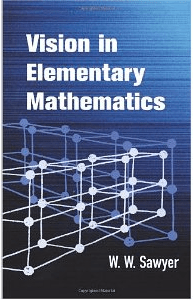
W. W. Sawyer
Vision in Elementary Mathematics

Thinking (and Teaching) like a Mathematician

photos by fdecomite via flickr

Most people think that mathematics means working with numbers and that being “good at math” means being able to do (only slower) what any $10 calculator can do. But then, most people think all sorts of silly things, right? That’s what makes “man on the street” interviews so funny.

Numbers are definitely part of math — but only part, and not even the biggest part. And being “good at math” means much more than being able to work with numbers. It means making connections, thinking creatively, seeing familiar things in new ways, asking “Why?” and “What if?” and “Are you sure?”

It means trying something and being willing to fail, then going back and trying something else. Even if your first try succeeded — or maybe, especially if your first try succeeded. Just knowing one way to do something is not, for a mathematician, the same as understanding that something. But the more different ways you know to figure it out, the closer you are to understanding it.

Mathematics is not just memorizing and following rules. If we want to teach real mathematics, we teachers need to learn to think like mathematicians. We need to see math as a mental game, playing with ideas. James Tanton explains:

Continue reading Thinking (and Teaching) like a Mathematician

PUFM 1.2 Place Value

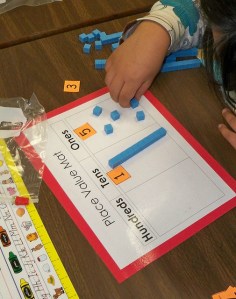
Photo by Chrissy Johnson1 via flickr. In this Homeschooling Math with Profound Understanding (PUFM) Series, we are studying Elementary Mathematics for Teachers and applying its lessons to home education.

Our decimal system of recording numbers is ingenious. Once learned, it is a simple, versatile, and efficient way of writing numbers. … But the system is not obvious nor easily learned. The use of place value is subtle, and mastering it is the single most challenging aspect of elementary school mathematics.

Ironically, these challenges are largely invisible to untrained parents and teachers — place value is so ingrained in adults’ minds that it is difficult to appreciate how important it is and how hard it is to learn.

— Thomas H. Parker & Scott J. Baldridge
Elementary Mathematics for Teachers

In other words, we take place value for granted. I know this was true of me when I started teaching my kids. Every year, their textbooks would start with the obligatory chapters on place value, which seemed to me just busywork. I began to appreciate the vital importance of place value when I read Liping Ma’s book and saw how the American teachers were unable to properly explain subtraction or multi-digit multiplication.

Place value is the heart of our number system, the foundation on which all the rest of arithmetic must be built. Because of place value, “The simplest schoolboy is now familiar with facts for which Archimedes would have sacrificed his life.”

Continue reading PUFM 1.2 Place Value

PUFM 1.1 Counting

Photo by Iain Watson via flickr. In this Homeschooling Math with Profound Understanding (PUFM) Series, we are studying Elementary Mathematics for Teachers and applying its lessons to home education.

Many things in mathematics need to be understood relationally — that is, in relationship to other concepts. But some things just need to be memorized. How do you know which is which? A homeschooling friend pointed out that one thing children definitely need to memorize is the counting sequence from 1-100 and beyond. While there are some patterns that make counting easier, one does just have to memorize which “nonsense sounds” we have attached to each number.

Another sort-of counting that young students should master is subitizing — recognizing at a glance how many items are in a small group. Children do this instinctively, but we can help them develop the skill by playing subitizing games.

[Aside: In writing this blog post, I ran into some nostalgia. Back when we first did these PUFM lessons, my daughter Kitten was only a toddler. I wrote, “I’ve tried to do lots of counting with my youngest, who hasn’t quite gotten beyond, ‘…eleven, twelve, firteen, firteen, nineteen, seven,…’ The numbers tend to start appearing randomly after she gets past 10.” Ah, memories.]

Continue reading PUFM 1.1 Counting

PUFM 1.0 Preface

Profound Understanding of Fundamental Mathematics (PUFM) is a phrase coined by Liping Ma in her landmark book, Knowing and Teaching Elementary Mathematics, to describe the deep, broad, and thorough understanding exhibited by several of the Chinese teachers she interviewed.

You gain PUFM the hard way: by teaching. The Chinese teachers with PUFM were the ones who had taught for years, taught multiple levels, and studied intensively the materials they taught. I doubt there’s any other way to do it. Home schooling is great for developing PUFM because you teach for years and teach multiple levels. The problem is, by the time you really understand the stuff, the kids are grown. Here are a few hints to help speed up the process a little bit:

  • Learn as much as you can, wherever you can, even when the topic doesn’t seem to relate to what your kids are studying now. Ask questions.
  • Pick up library books on math (510-519 on the Dewey Decimal shelves), some of which you’ll find helpful and some will bore you to distraction. Read the helpful ones and return the others — but try to get through at least 10 pages of a math book before giving up. You’ll learn a lot that way.
  • Always look for connections between topics. Think about how addition and subtraction are related, or addition and multiplication, or fractions and division. Think about how the different levels of understanding a topic are related. (Hint: Start by reading the lesson titles as well as the lessons themselves. Lay out a few years’ worth of math books and just read lesson titles, to see how it all goes together.)
  • Work on picking up the math vocabulary (distributive property, factors, sum, numerator, etc.) yourself and using it as you teach. Having the right words will help you hold ideas in your mind.

Continue reading PUFM 1.0 Preface

PUFM 1.0 Introduction

Profound Understanding of Fundamental Mathematics (PUFM) is a phrase coined by Liping Ma in her landmark book, Knowing and Teaching Elementary Mathematics, to describe the deep, broad, and thorough understanding exhibited by several of the Chinese teachers she interviewed.

The Chinese teachers with PUFM didn’t get it automatically. It grew over many years of teaching several levels of elementary math and of studying their textbooks and teaching materials. They met weekly in teaching research groups to learn from each other’s experience, to find multiple ways to solve problems, and to broaden their mathematical understanding.

More than eight years ago, a group of homeschooling friends started a Yahoo “teaching research group” to discuss math in hope of deepening our own understanding and learning to better help our students. We had a good time, but the busy-ness of everyday life eventually won out. The group has mostly disbanded, though the archives remain. Now I’d like to bring that study to my blog, bit by bit, updated with things I’ve learned in the years since.

Continue reading PUFM 1.0 Introduction

Math Teachers at Play #46: Living Books for Math

Welcome to the Math Teachers At Play blog carnival — which is not just for math teachers! Here is a smorgasbord of ideas for learning, teaching, and playing around with math from preschool to pre-college. Some articles were submitted by their authors, others were drawn from the immense backlog in my blog reader. If you like to learn new things, you are sure to find something of interest.

Living Books for Math

A child’s intercourse must always be with good books, the best that we can find… We must put into their hands the sources which we must needs use for ourselves, the best books of the best writers.

For the mind is capable of dealing with only one kind of food; it lives, grows and is nourished upon ideas only; mere information is to it as a meal of sawdust to the body.

Charlotte Mason
Toward A Philosophy of Education

Princess Kitten and I took a longer than usual holiday break from homeschooling, but now I’m in plan-for-the-new-semester mode. I hope to include more living math in our schedule, so I decided to illustrate this edition of the MTaP carnival with a few of my favorite living math books. I’d love to hear more living book suggestions in the comments!

If you click on a book cover, the links take you to Amazon.com, where you can read reviews and other details (and where I earn a small affiliate commission if you actually buy the book), but all of these books should be available through your public library or via inter-library loan.

Let the mathematical fun begin…

Continue reading Math Teachers at Play #46: Living Books for Math