Memories: Percent Problems

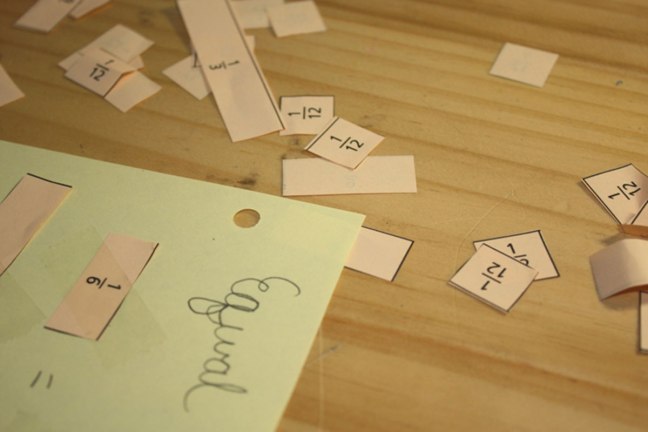
Homeschool math - photo

Homeschool Memories…

Can your students solve this problem?

There are 20% more girls than boys in the senior class. What percent of the seniors are girls?

This is from an old discussion of the semantics of percent problems and why students have trouble with them, going on over at MathNotations. (Follow-up post here.)

Our homeschool co-op prealgebra class had just finished a chapter on percents, so I thought my son might have a chance at this one. Nope! He leapt without thought to the conclusion that 60% of the class must be girls.

After I explained the significance of the word “than”, he solved the follow-up problem just fine.

Continue reading Memories: Percent Problems

New Podcast: Notice and Wonder

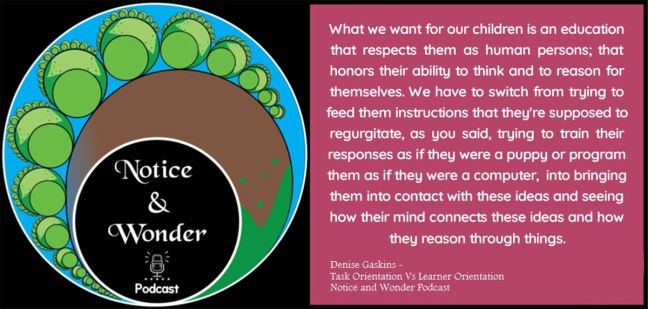
Quotation from Notice and Wonder podcast

When I was a novice homeschooler, our local Moms’ Night Out provided mentoring and kept me sane. We’d leave the children home with their dads and meet up at a local restaurant for a cup of coffee, a slice of pecan pie, and a robust discussion of educational philosophy.

This spring, my friend Sonya Post launched a new podcast called “Notice & Wonder” — and it captures that same feeling perfectly.

Sonya explains: “What is Notice, Wonder, Discover? It’s the development of cognitive skills, without which you have never learned anything in your life. We are developing the underlying skills that will make anyone more proficient at learning anything.”

I’ve had the privilege to join Sonya for three episodes of the podcast so far, and I’ve thoroughly enjoyed our conversations.

Here’s a taste…

Continue reading New Podcast: Notice and Wonder

If Not Methods: Fraction Multiplication

Father and son doing math homework together

This is the last post (for now, at least) in our If Not Methods series about how to help children figure out tough calculations.

By the time students reach the topic of multiplying fractions, they have become well-practiced at following rules. After some of the complex procedures they’ve learned, a simple rule like “tops times tops, and bottoms times bottoms” comes as a relief.

But we know that relying on rules like that weakens understanding, just as relying on crutches weakens physical muscles.

If we want our students to think, to make sense of math, to figure things out, what can we do with a problem like 5/6 × 21 ?

Continue reading If Not Methods: Fraction Multiplication

If Not Methods: Mixed Numbers

A family doing math homework together

Continuing our series on teaching the tough topics of arithmetic

Our own school math experiences led many of us to think that math is all about memorizing and following specific procedures to get right answers. But that kind of math is obsolete in our modern world.

The math that matters today is our ability to recognize and reason about numbers, shapes, and patterns, and to use the relationships we know to figure out something new.

But what if our children get stumped on a mixed-number calculation like 2 5/12 + 1 3/4?

Continue reading If Not Methods: Mixed Numbers

If Not Methods – Subtracting Fractions

Father and daughter doing math homework

We’re continuing our series of posts on how to build robust thinking skills instead of forcing our children to walk with crutches.

When we say, “Use this method, follow these steps,” we teach kids to be mathematical cripples.

If your student’s reasoning is, “I followed the teacher’s or textbook’s steps and out popped this answer,” then they’re not doing real math. Real mathematical thinking says, “I know this and that are both true, and when I put them together, I can figure out the answer.”

But what if our kids get stumped on a fraction calculation like 7/8 − 1/6?

Continue reading If Not Methods – Subtracting Fractions

If Not Methods: Scary Division

Father and son working on math homework

We’ve been exploring the many ways to help children reason about tough math problems, without giving them rules to follow.

As always, real math is not about the answers but the thinking.

But what about division with scary, big numbers? What if our kids get stumped on a calculation like 3840 ÷ 16?

When kids say, “I don’t know how”

We can teach without crippling children’s understanding if we follow the Notice-Wonder-Create cycle:

  • Notice everything about the problem.
  • Wonder about the possibilities.
  • Create something new: perhaps a solution or a math journal entry, or perhaps just a deeper level of understanding.

“Notice, Wonder, Create” is not a three-step method for solving math problems. It’s the natural, spiraling cycle by which our minds learn anything.

Continue reading If Not Methods: Scary Division

If Not Methods: Multi-Digit Multiplication

Mother helping her daughter with math homework

As we’ve seen in earlier posts, there are more ways to solve any math problem than most people realize. Teaching children to follow memorized steps and procedures actually cripples their understanding of number relationships and patterns.

But what if our children get stumped on a multi-digit multiplication calculation like 36 × 15?

Continue reading If Not Methods: Multi-Digit Multiplication

If Not Methods: Dividing Fractions

Mother and daughter working together on math homewrok

As I said in an earlier post, we don’t want to give our children a method because that acts as a crutch to keep them from making sense of math.

But what if our children get stumped on a tough fraction calculation like 1 1/2 ÷ 3/8?

Continue reading If Not Methods: Dividing Fractions

FAQ: My Playful Math Books

Playful math books by Denise Gaskins

Number Neighborhoods game  book by Denise GaskinsIn the weeks since I opened my new Playful Math Store, I’ve been getting a lot of questions about how all the books relate to each other.

For example…

Q: Your books look so interesting! Is the material in the books all different?

    A: There is a bit of overlap between books, but not much in most cases.

Continue reading FAQ: My Playful Math Books

If Not Methods: Reasoning About Subtraction

Father and son reasoning about subtraction

We’ve been examining the fact that, while there may be only one right answer to a math problem, but there’s never only one right way to get that answer.

What matters in math is the journey. How do your children make sense of the problem and reason their way to that answer?

As always, real math is not about the answers but the thinking.

But if we don’t want to give our children a method, how can we teach? What if we pose a problem and the child doesn’t know how to solve it?

What if our children get stumped on a subtraction calculation like 431 – 86?

Continue reading If Not Methods: Reasoning About Subtraction