Thinking Thursday: Half Plus Three

Thinking Thursday math journal prompt

Writing to Learn Math: When students create their own math, they forge a personal connection to mathematical concepts and relationships. And it’s fun!

Do you want your children to develop the ability to reason creatively and figure out things on their own?

Help kids practice slowing down and taking the time to fully comprehend a math topic or problem-solving situation with these classic tools of learning: Notice. Wonder. Create.

Continue reading Thinking Thursday: Half Plus Three

Musings: Math is Communication

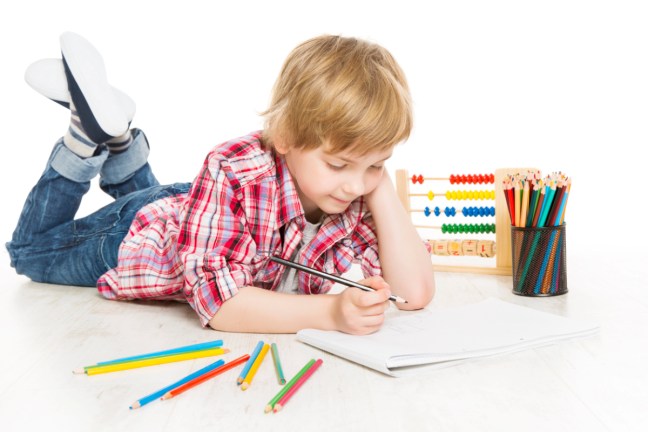
Young boy writing math expressions

The question came up on a homeschool math forum:

“My first grader and I were playing with equivalent expressions. We were trying to see how many ways we could write the value ‘3.’

    “He wrote down 10 – 2 × 3 + 1.

      “When I tried to explain the problem with his calculation, he got frustrated and didn’t want to do math.

        “How can I help him understand order of operations?”

        [If you think this sounds like too complex of a math expression for a first grader, you may want to read my blog post about math manipulatives and big ideas.]

        Order of operations doesn’t matter in this instance. What matters is communication.

        The mother didn’t know how to read what her son wrote.

        He could help her understand by putting parentheses around the part he wanted her to read first.

        He doesn’t need to know abstract rules for arbitrary calculations, or all the different ways we might possibly misunderstand each other. He just needs to know how to say what is in his mind.

        Continue reading Musings: Math is Communication

        Math Game Monday: Nine Cards

        Learn a new math game every week, for free

        This game helps young children build mental math skills. And it’s fun for older kids or adults to play along!

        Many parents remember struggling to learn math. We hope to provide a better experience for our children.

        And one of the best ways for children to enjoy learning is through hands-on play.

        Nine Cards

        Math Concepts: addition, number bonds for ten.

        Players: two or more.

        Equipment: one deck of playing cards, face cards and jokers removed.

        Continue reading Math Game Monday: Nine Cards

        Thinking Thursday: John Allen Paulos

        Thinking Thursday math journal prompt

        Writing to Learn Math: What did the author mean? Put the thought in your own words. Do you agree or disagree? Why?

        Do you want your children to develop the ability to reason creatively and figure out things on their own?

        Help kids practice slowing down and taking the time to fully comprehend a math topic or problem-solving situation with these classic tools of learning: Notice. Wonder. Create.

        Continue reading Thinking Thursday: John Allen Paulos

        FAQ: The Value of Math Rebellion

        Math Rebels fight for truth, justice, and creative reasoning

        I’ve been getting questions about my Math Journaling Adventures books:

        “I’m so excited to try math journaling! We bought your Logbook Alpha, and my 11-year-old math-averse son is trying to be a math rebel at every turn.

          “But I feel uncomfortable with the idea of rebellion. Doesn’t he need to learn how to solve math problems the right way?”

          One of my favorite things about math is that there really is no “right” way to solve math problems.

          As I pointed out in my ongoing Mental Math series, even a problem as basic as 6+8 can be approached from many directions. So perhaps I should say, the “right” way is however the student wants to make sense of the problem.

          In math, sense-making and reasoning are always the most important things.

          Continue reading FAQ: The Value of Math Rebellion

          Math Game Monday: Hidden Hexagon

          Learn a new math game every week, for free

          This game offers a fun twist on the old classic Battleship. Can you discover your opponent’s secret shape before they find yours?

          Many parents remember struggling to learn math. We hope to provide a better experience for our children.

          And one of the best ways for children to enjoy learning is through hands-on play.

          Hidden Hexagon

          Math Concepts: coordinate graphing (first quadrant), simple linear equations, irregular polygons.

          Players: two players or two teams.

          Equipment: printed gameboard or square grid paper for each player, pencils, ruler or other straightedge.

          Continue reading Math Game Monday: Hidden Hexagon

          Mental Math: Do’s and Don’ts

          Father and son working on math homework

          Over the course of this series, we’ve seen how mental math relies on a child’s own creative ways of thinking. In mental math, children develop understanding of how numbers interact with each other in many ways.

          In this way, they learn the true 3R’s of math: to Recognize and Reason about the Relationships between numbers.

          And the principles that underlie mental calculation are also fundamental to algebra, so that flexibility and confidence in mental math is one of the best predictors of success in high school math and beyond.

          But as we went through the various example problems, did you find the written-out calculations hard to follow?

          Don’t force your children to write down their mental math. It looks dreary when I write the calculations out step by step, but that’s not how it works in a child’s mind. With regular practice, this sort of thinking becomes second nature.

          Continue reading Mental Math: Do’s and Don’ts

          FAQ: Playful Math Journaling

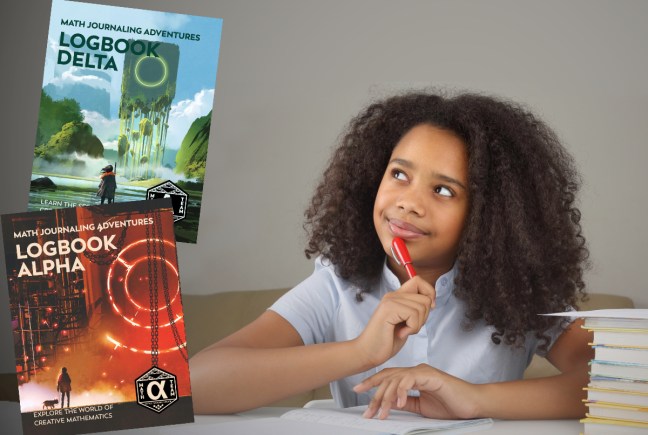
          Girl student thinking about her math journal prompt

          Ever since the school year started, I’ve been getting questions about how to use my new Math Journaling Adventures logbooks.

          [SIDE NOTE: These logbooks are included in this month’s Thanksgiving Sale! You’ll get an automatic 10% discount off all print books, applied at checkout, no special code required.]

          “I love the way your math books get my children thinking.

            “Finally, they are having fun with math!

              “But sometimes I have no idea what the journaling prompt is all about or how to teach it. Where can I buy a solutions manual?”

              Um, that’s not how math journals work.

              The cool thing about journaling prompts is that they have no “right” answer. They are explorations into different parts of the world of math, nature walks in the land of numbers, shapes, and patterns. Springboards into whatever our children want to investigate, whatever sparks their interest.

              A few of the problem-solving prompts may have specific answers, but it really doesn’t matter if our kids find the exact solution a math professional might give. If they write what makes sense to them, they’ve accomplished the goal.

              If later, they think of something they hadn’t noticed, or they want to change their answer — well, that is mathematical thinking, too.

              Continue reading FAQ: Playful Math Journaling

              Mental Math: Advanced Subtraction

              mother and daughter talking about math homework

              As our children grow and develop their math skills, the mental math strategies grow with them.

              The basics of mental math don’t change:

              • Use friendly numbers.
              • Estimate and adjust the answer.

              But we have new ways to help children do math in their heads as the numbers get bigger and the problems more challenging.

              For example, how might kids figure out a multi-digit subtraction like 67 − 38?

              First, we need to adjust our mindset…

              Continue reading Mental Math: Advanced Subtraction

              Geometric Math Art, Recovered

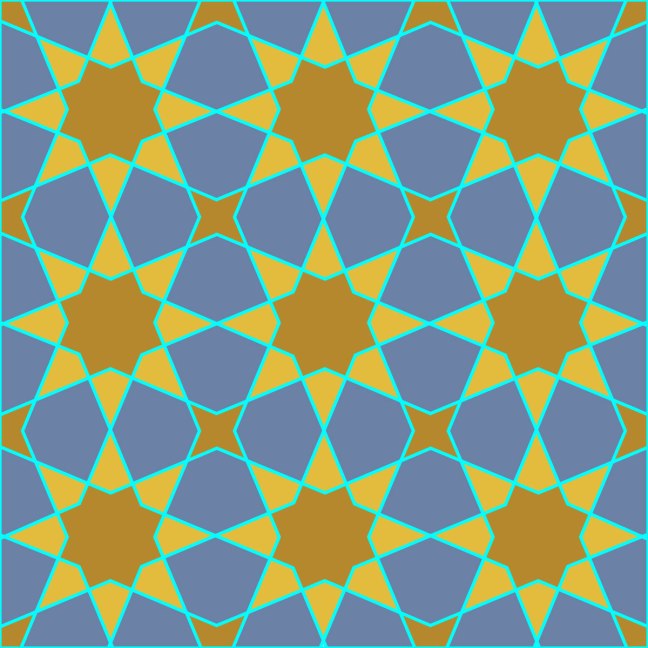
              Geometric pattern by Denise Gaskins

              I’ve been updating my old book files to a new publishing program, and in the process discovering anew how often websites change and disappear. So frustrating!

              Thankfully, the Internet Archive keeps some things that we can look back at. It doesn’t always work, but today it came to the rescue and let me recover the wonderful workbook from the Metropolitan Museum of Art, Islamic Art And Geometric Design, plus some of the pattern pages at the old School of Islamic Geometric Design.

              I reference these pages in my Geometric Coloring Designs series (available at my Playful Math Store), so I was glad to find they weren’t lost forever.

              Math Art = a great way to spark energy when your students hit the mathematical doldrums.

              If you’d like to play around with math art patterns, each image below links to Eric Broug’s step-by-step instructions for creating the design. Also, Broug made printable pages to get students started, which you can download here. No compass construction required!

              Pattern 1

              Geometric design pattern by Eric Broug

              Pattern 2

              Geometric design pattern by Eric Broug

              Pattern 3

              Geometric design pattern by Eric Broug

              There are two more patterns on the old SIGD site, but I can’t get those instructions to load. That might be my antique rural internet connection, however, so feel free to do some exploring on your own.

              And have fun drawing math with your kids!

               
              * * *

              Are you looking for more creative ways to play math with your kids? Check out all my books, printable activities, and cool mathy merch at Denise Gaskins’ Playful Math Store. Or join my email newsletter.

              This blog is reader-supported. If you’d like to help fund the blog on an on-going basis, then please join me on Patreon for mathy inspiration, tips, and an ever-growing archive of printable activities.

              “Geometric Math Art, Recovered” copyright © 2025 by Denise Gaskins. Image at the top of the post copyright © Denise Gaskins.