Math Teachers at Play 102 at Fraction Fanatic

Check out the new carnival of playful math for all ages at Fraction Fanatic blog. Each month’s carnival brings you a great new collection of puzzles, math conversations, crafts, teaching tips, and all sorts of mathy fun.

This month’s post features algebra games, calculus tips, paper folding, pattern blocks, arithmetic puzzles, triangle doodling, and much more.

Click Here to Go Read the Carnival Blog!

Hey, Blogger, Can You Spare a Time?

Do you write an education or family blog? Classroom teacher, math coach, homeschooler, parent, college professor, unschooler — anyone interested in helping kids play around with math? Please consider volunteering to host the MTaP blog carnival for one month.

We need volunteer hosts for most of 2017.

You choose the month that fits your schedule and decide how much effort you want to put in. Writing the carnival can take a couple of hours for a simple post — or you can spend several days searching out and polishing playful math gems to share.

If you want more information, read the MTaP Math Education Blog Carnival home page. Then let me know which month you want.
Count Up to Christmas

secondary-starBack when we were still homeschooling, I always dropped the “regularly scheduled program” in December. School plus holiday prep added up to one stressed-out mom.
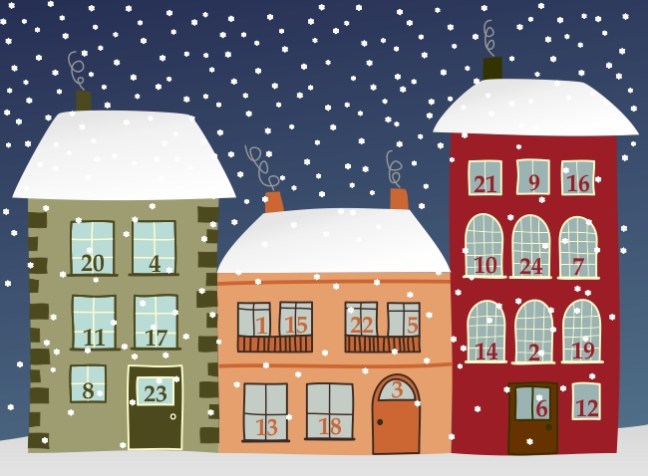
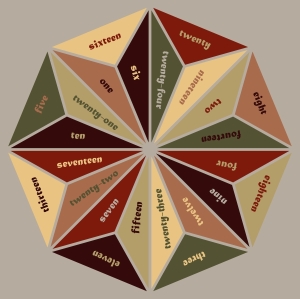
Instead, we read plenty of library books. And we played around with informal activities like the NrichMaths Advent Calendars:

For older students and adults, the online Plus Magazine offers a calendar of daily tidbits from their “Maths in a minute” series, explaining important mathematical concepts in just a few words”

And for still more winter fun, check out the links in my old Christmas Math Puzzles and Activities post.

And a Question for You

How do you handle schoolwork during this busy season? I’m collecting new links for an updated Holiday Math post next month. I’d love to hear your ideas!

Prof. Triangleman’s Abbreviated List of Standards for Mathematical Practice

How can we help children learn to think mathematically? Live by these four principles.

PTALSMP 1: Ask questions.

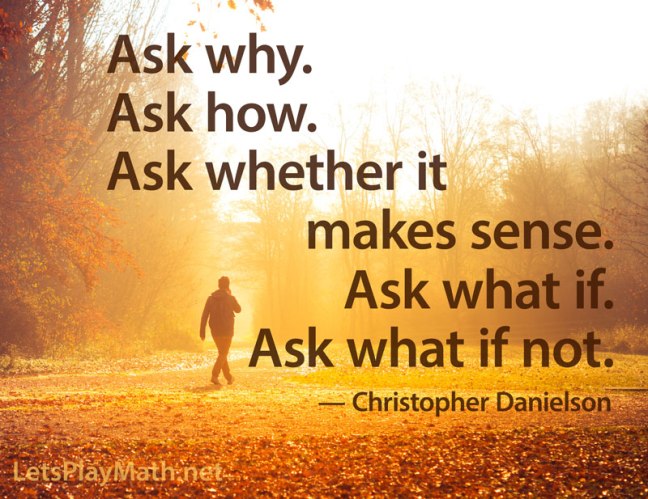
Ask why. Ask how. Ask whether your answer is right. Ask whether it makes sense. Ask what assumptions you have made, and whether an alternate set of assumptions might be warranted. Ask what if. Ask what if not.

PTALSMP 2: Play.

See what happens if you carry out the computation you have in mind, even if you are not sure it’s the right one. See what happens if you do it the other way around. Try to think like someone else would think. Tweak and see what happens.

PTALSMP 3: Argue.

Say why you think you are right. Say why you might be wrong. Try to understand how someone else sees things, and say why you think their perspective may be valid. Do not accept what others say is so, but listen carefully to it so that you can decide whether it is.

PTALSMP 4: Connect.

Ask how this thing is like other things. Try your ideas out on a new problem. Ask whether and how these ideas apply to other situations. Look for similarities and differences. Seek out the boundaries and limitations of your techniques.

— Christopher Danielson

And a Puzzle

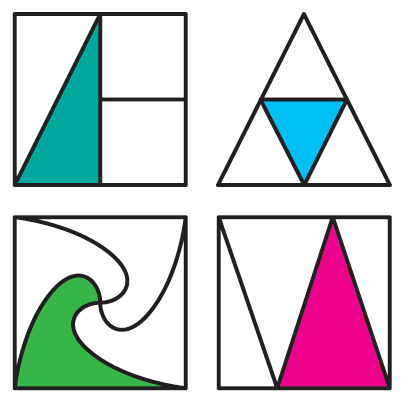
Practice applying Professor Triangleman’s Standards to the puzzle below. Which one doesn’t belong? Can you say why someone else might pick a different one?

wodb

multfrac-300CREDITS: An expanded version of the standards originally posted in Ginger ale (also abbreviated list of Standards for Mathematical Practice). Feature photo by Alexander Mueller via Flicker (CC-BY 2.0, text added). This post is an excerpt from my book Multiplication & Fractions: Math Games for Tough Topics, available now at your favorite online book dealer.

The Value of Math Games

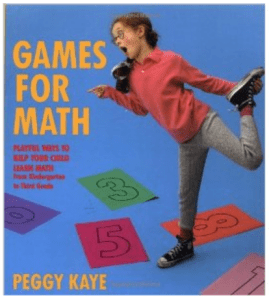
From Peggy Kaye’s classic book Games for Math:

Kaye-Games4Math

“Games put children in exactly the right frame of mind for learning difficult things.

“Children relax when they play — and they concentrate. They don’t mind repeating certain facts or procedures over and over, if repetition is part of the game.

“Children throw themselves into playing games the way they never throw themselves into filling out workbook pages.

“The games solidify the achievements of children who are already good at math, and they shore up children who need shoring up. They teach or reinforce many of the skills that a formal curriculum teaches, plus one skill that formal teaching sometimes leaves out — the skill of having fun with math, of thinking hard and enjoying it.

“If you play these games and your child learns only that hard mental effort can be fun, you will have taught something invaluable.”

Peggy Kaye
Games for Math

Sample Peggy’s Games for Math

 
* * *

This blog is reader-supported.

If you’d like to help fund the blog on an on-going basis, then please join me on Patreon for mathy inspiration, tips, and an ever-growing archive of printable activities.

If you liked this post, and want to show your one-time appreciation, the place to do that is PayPal: paypal.me/DeniseGaskinsMath. If you go that route, please include your email address in the notes section, so I can say thank you.

Which I am going to say right now. Thank you!

“The Value of Math Games” copyright © 2016 by Denise Gaskins.

Playful Math Carnival 101 at Arithmophobia No More

Check out the new carnival of playful math for all ages at Arithmophobia No More blog. You’re sure to enjoy this great collection of puzzles, math conversations, crafts, teaching tips, and all sorts of mathy fun.

The carnival features prime numbers, multiplication, arithmetic puzzles, magic, word problems, picture puzzles, games, mathematical conversations, and much more.

Click here to go read the carnival blog!

Do You Want More Ways to Play with Math?

Past carnivals are still full of mathy treasure. See them all on Pinterest:

Making Sense of Arithmetic

Homeschoolers have an advantage in teaching math: As our students grow, our own understanding of math grows with them because we see how the ideas build on each other.

This is especially true for those of us with large families. We pass through the progression of concepts with each student, and every pass lays down another layer in our own minds.

If you’d like to short-cut that process, check out Graham Fletcher’s Making Sense of Elementary Math video series. He’ll walk you through the topics, showing how manipulatives help build early concepts and gradually give way to abstract calculations.

“Understanding the vertical progression of mathematics is really important in the conceptual development of everyone’s understanding. This whole Making Sense Series has truly forced me to be a better teacher.”

— Graham Fletcher

Continue reading Making Sense of Arithmetic

Join the Fun: Math & Magic Virtual Book Club

Math-Magic-WonderlandEleven weeks of mathematical playtime kicks off this week over at Learners in Bloom blog.

Each week, we’ll be playing with the math, language, and logic topics found in a single chapter. I’ll be posting ideas for extension activities, videos demonstrating the concepts for the week, and additional resources. I’m really excited for the opportunity to share all the extra ideas that have been floating around my brain which I didn’t have room to include in the book (as in Marco Polo’s famous words: “I did not tell half of what I saw.”)

— Lilac Mohr

Here’s a Quick Taste of Week One

This Week’s Activities

Lilac’s blog post includes a full schedule for the eleven-week book club, featuring plenty of classic math puzzlers to play with. Here are the topics for this week.

  • Read Chapter 1: Mrs. Magpie’s Manual
  • Alliteration
  • Memorizing digits of Pi
  • Palindromes
  • Calculating your age on other planets

It looks like a lot of fun. I highly recommend the book (read my review), and I’m sure you and your children will enjoy discovering math and magic with Lulu and Elizabeth.

Check it out: Math & Magic in Wonderland Virtual Book Club, Week One.

 
* * *

This blog is reader-supported.

If you’d like to help fund the blog on an on-going basis, then please join me on Patreon for mathy inspiration, tips, and an ever-growing archive of printable activities.

If you liked this post, and want to show your one-time appreciation, the place to do that is PayPal: paypal.me/DeniseGaskinsMath. If you go that route, please include your email address in the notes section, so I can say thank you.

Which I am going to say right now. Thank you!

“Join the Fun: Math & Magic Virtual Book Club” copyright © 2016 by Denise Gaskins.

Puzzle: Exploding Dots

I’m planning ahead for my fall semester homeschool co-op math class. Definitely going to try this with the kids…

Encourage your children to have some fun this week with this Exploding Dots math puzzle from The Global Math Project. What do they notice? Does it make them wonder?

More Explosive Math

You may recognize the connection between Exploding Dots and binary numbers. Or not — the puzzle is accessible to people at almost any age and level of mathematical sophistication.

But what I find amazing is that this puzzle can help us understand all sorts of topics in elementary arithmetic and algebra. So cool!

If you’d like to investigate Exploding Dots in depth, check out James Tanton’s free G’Day Math online course.

FAQ: Trouble Finding the Right Math Program

“I can’t find a home school math program my son likes. We’ve tried Singapore Math, Right Start, Saxon, and Math Mammoth. We subscribed to a month of IXL Math to keep him in practice, but he hates that, too. I know I shouldn’t have changed so many times, but this was our first year of homeschooling, and I was trying to please him. But I’m running out of things to try. Do you think Life of Fred might work?”

Rock-Surfing

You’ve tried all those math programs in one year? Many people recommend that new homeschoolers take a few months off to “detox” from the classroom setting, to relax and enjoy the freedom of making their own choices. But your son might want a few months to detox from his homeschool experience.

I suggest you set aside all those books and focus on games and informal math. Try to avoid schoolish lessons until your son starts to enjoy learning for its own sake.

Continue reading FAQ: Trouble Finding the Right Math Program

Playful Math Carnival 100 via Three J’s Learning

Check out the new carnival of playful math for all ages at Three J’s Learning blog. You’re sure to enjoy this great collection of puzzles, math conversations, crafts, teaching tips, and all sorts of mathy fun.

Wow, the 100th Math Teachers at Play! Such an honor to put together this milestone edition.

I asked the 3J’s for observations and facts about 100:

  • It is written with a 1 and two 0s
  • Square number (10 x 10)
  • It is a sum of two squares 64 + 36


Click here to go read the carnival blog!

It’s so cool to see carnival number 100. Thank you to ALL the hosts and to everyone who has participated over the years!

Do You Want More Ways to Play with Math?

Past carnivals are still full of mathy treasure. See them all on Pinterest: