Playful Math Carnival #95 via Life Through A Mathematician’s Eyes

MTAP95

Check out the new playful math education carnival at Life Through A Mathematician’s Eyes. Parabolas, fractions, numbers square puzzles, edible math manipulatives, and all sorts of mathy fun:

Excitement!! The MTaP Math Educational Blog Carnival is at its 95 issue and I am extremely excited to host it. Moreover, February is one of my favorite months so I am extra excited for the opportunity.
First thing, let us think a little about the interesting properties of the number 95…

Click here to go read the carnival post.

Understanding Math: Conclusion

Click to read the earlier posts in this series: Understanding Math, Part 1: A Cultural Problem; Understanding Math, Part 2: What Is Your Worldview?; Understanding Math, Part 3: Is There Really a Difference?; Understanding Math, Part 4: Area of a Rectangle; Understanding Math, Part 5: Multiplying Fractions; and Understanding Math, Part 6: Algebraic Multiplication.
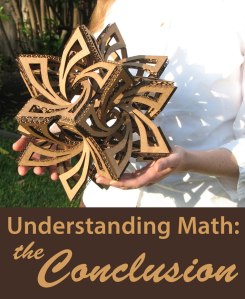
Understanding-Math-Conclusion

Earlier in this blog post series, I gave you three middle-school math rules. But by exploring the concept of rectangular area as a model of multiplication, we discovered that in a way they were all the same.

The rules are not arbitrary, handed down from a mathematical Mount Olympus. They are three expressions of a single basic question: what does it mean to measure area?

There was only one rule, one foundational pattern that tied all these topics together in a mathematical web.

What Is Your Worldview?

Many children want to learn math instrumentally, as a tool for getting answers. They prefer the simplicity of memorizing rules to the more difficult task of making sense of new ideas. Being young, they are by nature short-term thinkers. They beg, “Just tell me what to do.”

But if we want our children to truly understand mathematics, we need to resist such shortcuts. We must take time to explore mathematics as a world of ideas that connect and relate to each other in many ways. And we need to show children how to reason about these interconnected concepts, so they can use them to think their way through an ever-expanding variety of problems.

Our kids can only see the short term. If we adults hope to help them learn math, our primary challenge is to guard against viewing the mastery of facts and procedures as an end in itself. We must never fall into thinking that the point of studying something is just to get the right answers.

We understand this in other school subjects. Nobody imagines that the point of reading is to answer comprehension questions. Back to SchoolWe know that there is more to learning history than winning a game of Trivial Pursuit. But when it comes to math, too many parents (and far too many politicians) act as though the goal of our children’s education is to produce high scores on a standardized test.

What If I Don’t Understand Math?

If you grew up (as I did) thinking of math as a tool, the instrumental approach may feel natural to you. The idea of math as a cohesive system may feel intimidating. How can we parents help our children learn math, if we never understood it this way ourselves?

Don’t panic. Changing our worldview is never easy, yet even parents who suffer from math anxiety can learn to enjoy math with their children. All it takes is a bit of self-discipline and the willingness to try.

You don’t have to know all the answers. In fact, many people have found the same thing that Christopher Danielson described in his blog post “Let the children play” — the more we adults tell about a topic, the less our children learn. With the best of intentions we provide information, but we unwittingly kill their curiosity.

  • If you’re afraid of math, be careful to never let a discouraging word pass your lips. Try calling upon your acting skills to pretend that math is the most exciting topic in the world.
  • Encourage your children to notice the math all around them.
  • Search out opportunities to discuss numbers, shapes, symmetry, and patterns with your kids.
  • Investigate, experiment, estimate, explore, measure — and talk about it all.

The Science of Patterns

Patterns are so important that American mathematician Lynn Arthur Steen defined mathematics as the science of patterns.

As biology is the science of life and physics the science of energy and matter, so mathematics is the science of patterns. We live in an environment steeped in patterns — patterns of numbers and space, of science and art, of computation and imagination. Patterns permeate the learning of mathematics, beginning when children learn the rhythm of counting and continuing through times tables all the way to fractals and binomial coefficients.

— Lynn Arthur Steen, 1998
Reflections on Mathematical Patterns, Relationships, and Functions

If you are intimidated by numbers, you can look for patterns of shape and color. Pay attention to how they grow, and talk about what your children notice. For example, some patterns repeat exactly, while other patterns change as they go (small, smaller, smallest, or loud, louder, loudest).

Nature often forms fractal-like patterns: the puffy round-upon-roundness of cumulus clouds or broccoli, or the branch-upon-branchiness of a shrub or river delta. Children can learn to recognize these, not as a homework exercise but because they are interesting.

Math the Mathematician’s Way

Here is the secret solution to the crisis of math education: we adults need to learn how to think like mathematicians.

For more on what it means to think about math the mathematician’s way, check out my Homeschooling with Math Anxiety blog post series:

As we cultivate these characteristics, we will help our children to recognize and learn true mathematics.
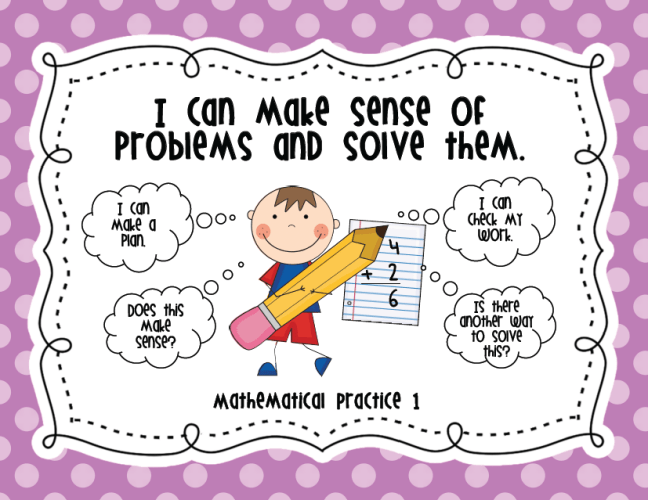
MathPractices1

CREDITS: “Frabjous 01” photo (top, text added) by Windell Oskay and “Back to School” photo (middle) by Phil Roeder via Flicker (CC BY 2.0). “I Can Solve Problems” poster by Nicole Ricca via Teachers Pay Teachers. LPM-ebook-300This is the final post in my Understanding Math series, adapted from my book Let’s Play Math: How Families Can Learn Math Together—and Enjoy It, available at your favorite online book dealer.
Understanding Math: Algebraic Multiplication

Click to read the earlier posts in this series: Understanding Math, Part 1: A Cultural Problem; Understanding Math, Part 2: What Is Your Worldview?; Understanding Math, Part 3: Is There Really a Difference?; Understanding Math, Part 4: Area of a Rectangle; and Understanding Math, Part 5: Multiplying Fractions.

Understanding-AlgebraWe’ve examined how our vision of mathematical success shapes our children’s learning. Do we think math is primarily a tool for solving problems? Or do we see math as a web of interrelated concepts?
Instrumental understanding views math as a tool. Relational understanding views math as an interconnected system of ideas. Our worldview influences the way we present math topics to our kids. And our children’s worldview determines what they remember.

In the past two posts, we looked at different ways to understand and teach rectangular area and fraction multiplication. But how about algebra? Many children (and adults) believe “math with letters” is a jumble of abstract nonsense, with too many formulas and rules that have to be memorized if you want to pass a test.

Which of the following sounds the most like your experience of school math? And which type of math are your children learning?

Instrumental Understanding: FOIL

Every mathematical procedure we learn is an instrument or tool for solving a certain kind of problem. To understand math means to know which tool we are supposed to use for each type of problem and how to use that tool — how to categorize the problem, remember the formula, plug in the numbers, and do the calculation.

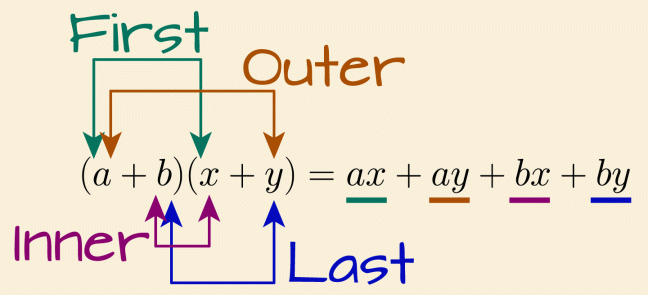
When you need to multiply algebra expressions, remember to FOIL: multiply the First terms in each parenthesis, and then the Outer, Inner, and Last pairs, and finally add all those answers together.

The FOIL method for multiplying two binomials.

Relational Understanding: The Area Model

Each mathematical concept is part of a web of interrelated ideas. To understand mathematics means to see at least some of this web and to use the connections we see to make sense of new ideas.

The concept of rectangular area has helped us understand fractions. Let’s extend it even farther. In the connected system of mathematics, almost any type of multiplication can be imagined as a rectangular area. We don’t even have to know the size of our rectangle. It could be anything, such as subdividing a plot of land or designing a section of crisscrossed colors on plaid fabric.

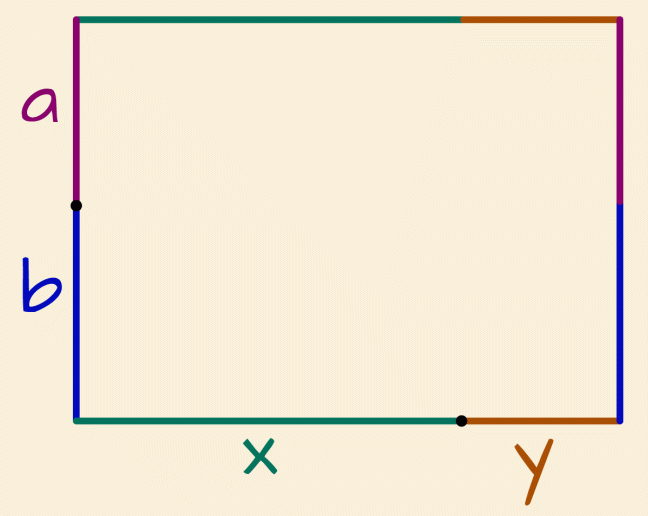
We can imagine a rectangle with each side made up of two unknown lengths. One side has some length a attached to another length b. The other side is x units long, with an extra amount y stuck to its end.

We don’t know which side is the “length” and which is the “width” because we don’t know which numbers the letters represent. But multiplication works in any order, so it doesn’t matter which side is longer. Using the rectangle model of multiplication, we can see that this whole shape represents the area \left ( a+b \right )\left ( x+y \right ) .

An algebraic rectangle: each side is composed of two unknown lengths joined together.

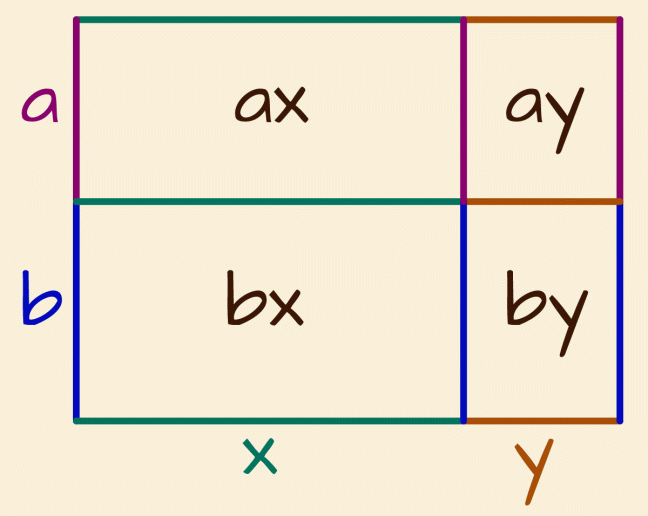
But since the sides are measured in pieces, we can also imagine cutting up the big rectangle. The large, original rectangle covers the same amount of area as the four smaller rectangular pieces added together, and thus we can show that \left ( a+b \right )\left ( x+y \right )=ax+ay+bx+by .

Four algebraic rectangles: the whole thing is equal to the sum of its parts.

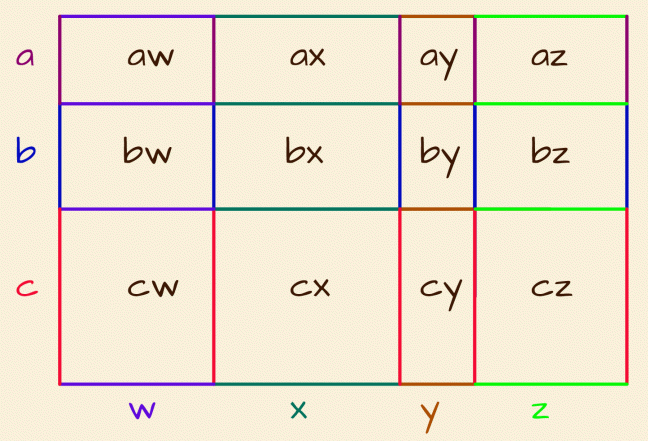
With the FOIL formula mentioned earlier, our students may get a correct answer quickly, but it’s a dead end. FOIL doesn’t connect to any other math concepts, not even other forms of algebraic multiplication. But the rectangular area model will help our kids multiply more complicated algebraic expressions such as \left ( a+b+c \right )\left ( w+x+y+z \right ) .

The rectangle model of multiplication helps students keep track of all the pieces in a complex algebraic calculation.

Not only that, but the rectangle model gives students a tool for making sense of later topics such as polynomial division. And it is fundamental to understanding integral calculus.

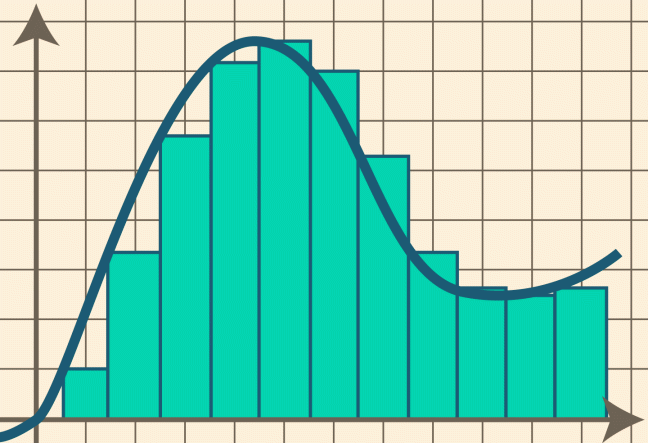
In calculus, students use the rectangle model of multiplication to find irregular areas. The narrower the rectangles, the more accurate the calculation, so we imagine shrinking the widths until they are infinitely thin.

To be continued. Next up, Understanding Math Part 7: The Conclusion…

CREDITS: “Math Workshop Portland” photo (top) by US Department of Education via Flicker (CC BY 2.0, text added). LPM-ebook-300This is the sixth post in my Understanding Math series, adapted from my book Let’s Play Math: How Families Can Learn Math Together—and Enjoy It, available at your favorite online book dealer.

Math Teachers at Play #94 via mathematicsandcoding

94

Check out the new math education carnival at Tom Bennison’s blog. Games, puzzles, teaching tips, and all sorts of mathy fun:

If you enjoy this carnival, why not send in a blog post of your own for next month? We love posts on playful ways to explore and learn math from preschool discoveries through high school calculus.

Entries accepted at any time!

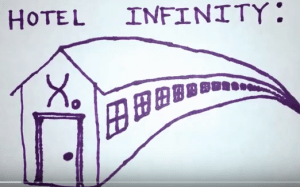
Hotel Infinity: Part Five

Hotel Infinity1Tova Brown concludes her exploration of the Hilbert’s Hotel Paradox with a look at the cardinality of the real numbers.
You run a hotel with an infinite number of rooms. You pride yourself on accommodating everyone, even guests arriving in infinitely large groups — but some infinities are more infinite than others, as it turns out.

Tova Brown
Hotel Infinity: Part Five

Check out Tova Brown’s growing collection of videos that explore advanced math concepts through story-telling.

Hotel Infinity: Part Four

Hotel Infinity1Tova Brown dives deeper into Hilbert’s Hotel Paradox, considering the difference between rational numbers and reals.

You run an infinitely large hotel, and are happy to realize that you can accommodate an infinite number of infinite groups of guests.

However, a delicate diplomatic situation arises when a portal to another universe opens, introducing a different kind of guest, in a different kind of group.

Can you make room for them all?

Tova Brown
Hotel Infinity: Part Four

Click here to read Part Five…

Hotel Infinity: Part Three

Hotel Infinity1Tova Brown continues to examine Hilbert’s Hotel Paradox, pondering infinite sets of infinite sets.

As the proprietor of an infinitely large hotel, you pride yourself on welcoming everyone, even when the rooms are full. Your hotel becomes very popular among infinite sports teams, as a result.

Recruitment season presents a challenge, however, when many infinite teams arrive at once. How many infinite teams can stay in a single infinite hotel?

Tova Brown
Hotel Infinity: Part Three

Click here to read Part Four…

Hotel Infinity: Part Two

Hotel Infinity1Tova Brown explores the second part of Hilbert’s Hotel Paradox. What’s infinity plus infinity?

Running an infinite hotel has its perks. Even when the rooms are full you can always find space for new guests, so you proudly welcome everyone who appears at your door.

When two guests arrive at once, you make room. When ten guests arrive, you accommodate them easily. When a crowd of hundreds appears, you welcome them all.

Is there no limit to your hospitality?

Tova Brown
Hotel Infinity: Part Two

Click here to read Part Three…

Hotel Infinity: Part One

Hotel Infinity1Tova Brown’s introduction to Hilbert’s Hotel Paradox, a riddle about the nature of infinity…

Once upon a time, there was a hotel with an infinite number of rooms. You might be thinking this is impossible, and if so you’re right. A hotel like this could never exist in the real world.

But fortunately we’re not talking about the real world, we’re talking about math. And when we do math we can make up whatever rules we want, just to see what happens.

Tova Brown
Hotel Infinity: Part One

Click here to read Part Two…

2016 Mathematics Game

[Feature photo above from the public domain, and title background (below) by frankieleon (CC BY 2.0) via Flickr.]

2016-math-game

Have you made a New Year’s resolution to spend more time with your family this year, and to get more exercise? Problem-solvers of all ages can pump up their (mental) muscles with the Annual Mathematics Year Game Extravaganza. Please join us!

For many years mathematicians, scientists, engineers and others interested in math have played “year games” via e-mail. We don’t always know whether it’s possible to write all the numbers from 1 to 100 using only the digits in the current year, but it’s fun to see how many you can find.

Math Forum Year Game Site

Rules of the Game

Use the digits in the year 2016 to write mathematical expressions for the counting numbers 1 through 100. The goal is adjustable: Young children can start with looking for 1-10, middle grades with 1-25.

  • You must use all four digits. You may not use any other numbers.
  • Solutions that keep the year digits in 2-0-1-6 order are preferred, but not required.
  • You may use +, -, x, ÷, sqrt (square root), ^ (raise to a power), ! (factorial), and parentheses, brackets, or other grouping symbols.
  • You may use a decimal point to create numbers such as .2, .02, etc., but you cannot write 0.02 because we only have one zero in this year’s number.
  • You may create multi-digit numbers such as 10 or 201 or .01, but we prefer solutions that avoid them.

My Special Variations on the Rules

  • You MAY use the overhead-bar (vinculum), dots, or brackets to mark a repeating decimal. But students and teachers beware: you can’t submit answers with repeating decimals to Math Forum.
  • You MAY use a double factorial, n!! = the product of all integers from 1 to n that have the same parity (odd or even) as n. I’m including these because Math Forum allows them, but I personally try to avoid the beasts. I feel much more creative when I can wrangle a solution without invoking them.

Click here to continue reading.