Pi Makes a River Bend

From Numberphile: “Sinuosity is a measure of how ‘bendy’ a river is. It is the length of the river divided by the direct route. Featuring Dr. James Grime.”

Update

After posting this video, Dr. Grimes and Lawrence Roberts began collecting and analyzing data about real-world rivers. It turns out the pi theory of sinuosity is too simple. Read about their results:

Math Teachers at Play #83 via CavMaths

The new Math Teachers at Play math education blog carnival is up for your browsing pleasure. Each month, we feature activities, lessons, and games about math topics from preschool through high school. Check it out!

[Photo by Steve Bowbrick. (CC BY 2.0)]

8010607157_7fe42cf461_z

Hello, and welcome to the 83rd Edition of the monthly blog carnival “Math(s) Teachers at Play”.

It is traditional to start with some number facts around the edition number, 83 is pretty cool, as it happens. Its prime, which sets it apart from all those lesser compound numbers. Not only that, its a safe prime, a Chen prime and even a Sophie Germain prime, you can’t get much cool than that can you? Well yes, yes you can, because 83 is also an Eisenstein prime!!!!

Those of you who work in base 36 will know it for its famous appearance in Shakespeare’s Hamlet: “83, or not 83, that is the question…..”

Click here to go read the whole post.

The Math Student’s Manifesto

[Feature photo above by Texas A&M University (CC BY 2.0) via Flickr.]

Note to Readers: Please help me improve this list! Add your suggestions or additions in the comment section below…

What does it mean to think like a mathematician? From the very beginning of my education, I can do these things to some degree. And I am always learning to do them better.

(1) I can make sense of problems, and I never give up.

  • I always think about what a math problem means. I consider how the numbers are related, and I imagine what the answer might look like.
  • I remember similar problems I’ve done before. Or I make up similar problems with smaller numbers or simpler shapes, to see how they work.
  • I often use a drawing or sketch to help me think about a problem. Sometimes I even build a physical model of the situation.
  • I like to compare my approach to the problem with other people and hear how they did it differently.

Continue reading The Math Student’s Manifesto

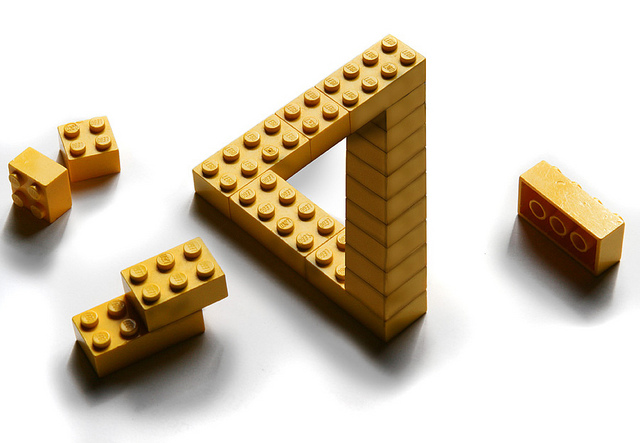
Fun with the Impossible Penrose Triangle

I found this delightful animation today:

Ball-travels-around-impossible-triangle

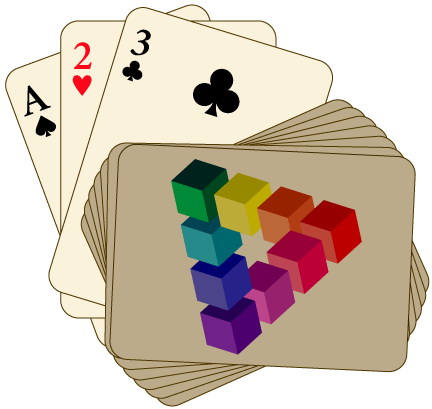
The ball is traveling around a shape that can’t exist in our real world: the Penrose triangle. This illusion is the basis for some cool art, like Escher’s Waterfall. And I’m using it in my Math You Can Play books as a design on the back of my playing cards:

A-2-3deck

Want to Play Around with the Penrose Triangle?

Here’s a few links so you can try it for yourself:

Penrose Lego by Erik Johansson (CC BY 2.0)

Book Update

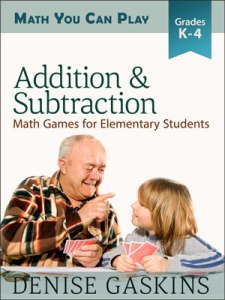
Addition-Games

I’ve sent the first two Math You Can Play books to a copy editor (she edits the text part), so my focus this month is on finishing the illustrations and downloadable game boards. And designing the book covers — I think I’ll call this latest iteration done.

If everything stays on schedule, both Counting & Number Bonds and Addition & Subtraction should be available by mid- to late-spring. Fingers crossed…

Math Teachers at Play #82 via Mrs. E Teaches Math

MTaP 82

The January math education blog carnival is now posted for your browsing pleasure, featuring 23 playful ways to explore mathematics from preschool to high school:

Highlights include:

Young children making bar graphs.
A wide variety of math games.
Fractions on a clothesline.
Quadrilaterals on social media.
Non-transitive dice.
Writing in math class.
Negative number calculations made physical.
Inverse trig graphing.
Function operations.
And much more!

Click here to go read Math Teachers at Play #82.

Two Ways to Do Math

Two-Ways-to-Do-Math

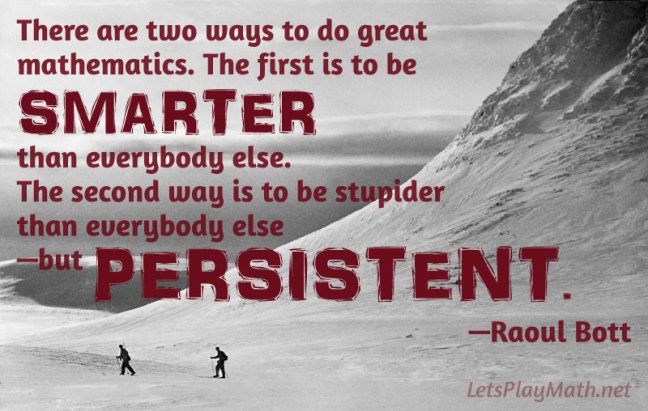
There are two ways to do great mathematics. The first is to be smarter than everybody else. The second way is to be stupider than everybody else — but persistent.

— Raoul Bott

CREDITS: Today’s quote is from Raoul Bott, via The MacTutor History of Mathematics archive. Background photo courtesy of Swedish National Heritage Board (no known copyright restrictions) via Flickr.