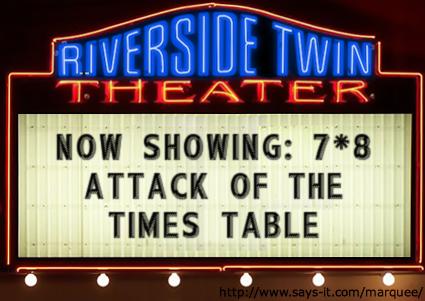
Happy Multiplication Day!
For help learning the Times Table facts, check out my multiplication blog post series:
Encourage your family to play with math every day:
For help learning the Times Table facts, check out my multiplication blog post series:
Encourage your family to play with math every day:
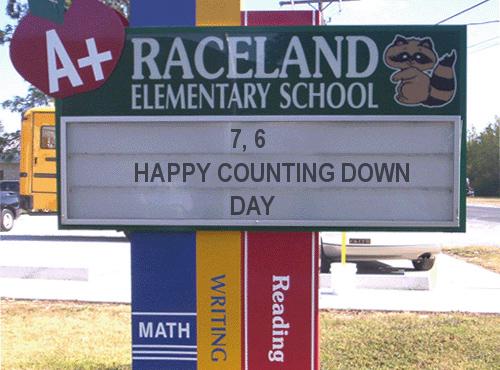
To create your own Happy Mathematics Day sign, see yesterday’s post.
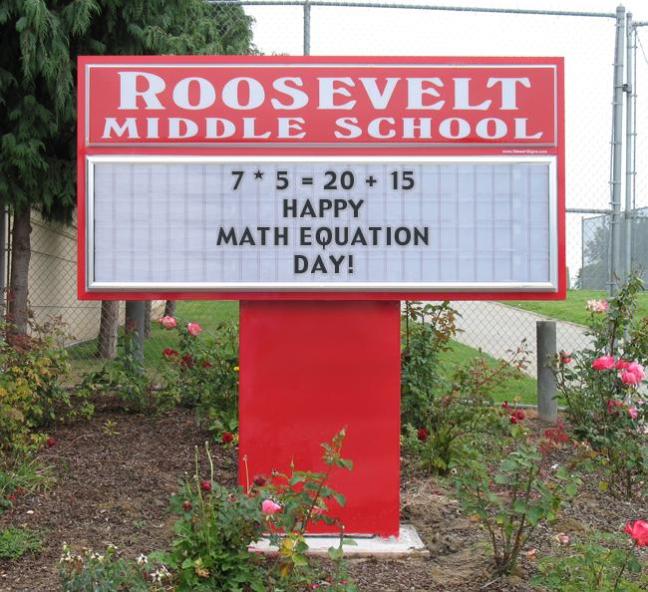
I’m still having fun with David Coffey’s meme, which started a couple of years ago with this blog post:
Would you like to create a math holiday, too? Try one of these sign generators:
What kind of math will you celebrate? Leave a link to your Happy Math Day post in the comments below!
Puzzles, comics, problem-solving, and mathy conversations with kids—you’ll find all this and more at the new math education blog carnival. Check it out, click some links, and enjoy!
“Hello, and welcome to the 87th Edition of the monthly blog carnival “Math(s) Teachers at Play”. For those of you unaware, a blog carnival is a periodic post that travels from blog to blog. They take the form of a compilation post and contain links to current and recent posts on a similar topic. This is one of two English language blog carnivals around mathematics…
This month has been fairly busy in the way of maths blogs and we have a treat for you, so to start the carnival here are the submissions we received…”

Math Concepts: division as equal sharing, naming fractions, adding fractions, infinitesimals, iteration, limits
Prerequisite: able to identify fractions as part of a whole
This is how I tell the story:

Continue reading Infinite Cake: Don Cohen’s Infinite Series for Kids

Socks Are Like Pants, Cats Are Like Dogs by Malke Rosenfeld and Gordon Hamilton is filled with a diverse collection of math games, puzzles, and activities exploring the mathematics of choosing, identifying and sorting. The activities are easy to start and require little preparation.
The publisher’s crowdfunding goal is $4,000. The book is almost ready to go to press, and I can hardly wait to see it!

Math Concepts: basic facts of addition, multiplication.
Players: one.
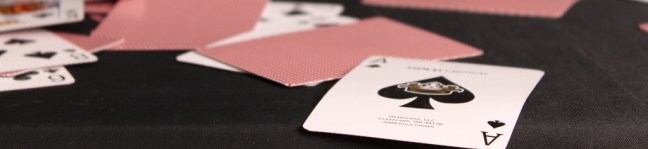
Equipment: one deck of math cards (poker- or bridge-style playing cards with the face cards and jokers removed).
The best way to practice the math facts is through the give-and-take of conversation, orally quizzing each other and talking about how you might figure the answers out. But occasionally your child may want a simple, solitaire method for review.

The Internet boasts a wide-ranging assortment of math websites, and for years I maintained (or mostly neglected) a huge page of reference links. This spring I’ve been working on the paperback edition of my book—with its appendix of favorite books and internet sites—and I decided to revise my blog links to match.

So this week, I’m in Jeju, South Korea, visiting my daughter who teaches English there. In between seeing touristy sites and gorging ourselves on amazingly delicious food, she took me to a beautiful coffee shop that overlooks the beach in Aewol.
Great place to work on my blog!
The long monster list morphed into eight topical pages. I hope you find something useful.

I will try to keep these pages up to date, but the Internet is volatile. If you find a broken link, you can search for the website by name or enter the defunct URL into the Internet Wayback Machine at Archive.org.

And if you know of a fantastic website I’ve missed, please send me an email (LetsPlayMath@gmail.com, or use the comment form on my “About” page). I appreciate your help.
Feature photo above by Fractal Ken via Flickr (CC BY 2.0). Korea photos ©2015 Denise Gaskins, all rights reserved. For more math resource suggestions, check out my Math with Living Books pages. They’re not finished yet, but I’ll be working on them next.
There’s a feast of mathematical games and activities at this month’s Math Teachers at Play blog carnival Enjoy!
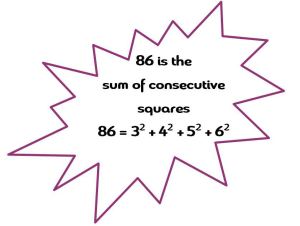
“Math Teachers at Play is a monthly blog carnival that compiles posts from several blogs under the theme of teaching math in unique and innovative ways. We’re thrilled to partner with them this edition and couldn’t help ourselves from including some interesting trivia and riddles centered on our edition number – Happy Number 86!
Happy Numbers are numbers whose digits are such that – when squared and added iteratively, the number 1 is reached. For example,
82 + 62 = 100
12 + 02 + 02 = 1
So 86 is a happy number!…”

In the land of Fantasia, where people communicate by crystal ball, Wizard Mathys has been placed in charge of keeping the crystal connections clean and clear. He decides to figure out how many different ways people might talk to each other, assuming there’s no such thing as a crystal conference call.
Mathys sketches a diagram of four Fantasian friends and their crystal balls. At the top, you can see all the possible connections, but no one is talking to anyone else because it’s naptime. Fantasians take their siesta very seriously. That’s one possible state of the 4-crystal system.

On the second line of the diagram, Joe (in the middle) wakes up from siesta and calls each of his friends in turn. Then the friends take turns calling each other, bringing the total number of possible connection-states up to seven.
Finally, Wizard Mathys imagines what would happen if one friend calls Joe at the same time as the other two are talking to each other. That’s the last line of the diagram: three more possible states. Therefore, the total number of conceivable communication configurations for a 4-crystal system is 10.
For some reason Mathys can’t figure out, mathematicians call the numbers that describe the connection pattern states in his crystal ball communication system Telephone numbers.

Hint: Don’t forget to count the state of the system when no one is on the phone crystal ball.
Feature photo at top of post by Christian Schnettelker (web designer) and wizard photo by Sean McGrath via Flickr (CC BY 2.0). This puzzle was originally featured in the Math Teachers At Play (MTaP) math education blog carnival: MTaP #76.

