Mondays come every week. Bleh! Here are some puzzles I found this weekend, to brighten up your day…
[Update + Forgetful Waiter Puzzle from singingbanana.]
Mondays come every week. Bleh! Here are some puzzles I found this weekend, to brighten up your day…
Remember the Math Adventurer’s Rule: Figure it out for yourself! Whenever I give a problem in an Alexandria Jones story, I will try to post the answer soon afterward. But don’t peek! If I tell you the answer, you miss out on the fun of solving the puzzle. So if you haven’t worked these problems yet, go back to the original posts. If you’re stuck, read the hints. Then go back and try again. Figure them out for yourself — and then check the answers just to prove that you got them right.
This post offers hints and answers to puzzles from these blog posts:
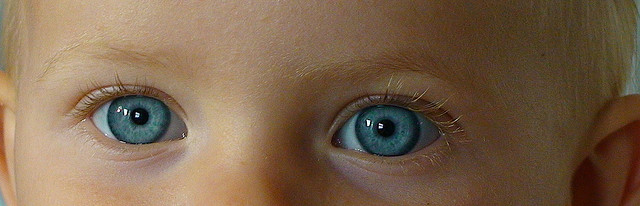
[Photo by audi_insperation.]
[In The Birthday Surprise, Alex discovered her family was expecting a new member…]
What will the baby look like, Alex wondered. “Dad, is there any way to tell whether the baby will have blue eyes like I do, or brown like the rest of the family?”
Dr. Jones shuffled the papers on his desk and found a blank page. “Over 100 years ago, the Austrian monk Gregor Mendel studied genetics, or how various traits are passed down from one generation to another.” He began to draw a diagram as he talked.
 [Photo by D Sharon Pruitt.]
[July 27th is Alex’s birthday, which she shares with Johann Bernoulli, an irascible mathematician from the late 17th century.]
The guests had gone. Alex and her family sat around the table, sharing the last tidbits of birthday cake and ice cream. Alex smiled at her parents.
“Thanks, Mom and Dad,” she said. “It was a great party.”
Maria Jones, Alex’s mother, leaned back in her chair. “I do have one more surprise for you, Alex. But you will have to share this one with the whole family.”
Leon groaned. “I know what it is: Let’s all pitch in to clean up.”
“That wouldn’t be a surprise,” Alex said.
“I hate fractions.”
“They probably hate you, too. The question is, which one of you will be master.”
— Jonathan, jd2718
“I hate fractions”
[Photo by Micah Sittig.]
I used to fill the margins of my math newsletter with quotations and tidbits of math history. Here are some quotes from the July/August 1999 issue on probability, along with a few others I’ve stumbled on while browsing the internet.
No knowledge of probabilities helps us to know what conclusions are true. There is no direct relation between the truth of a proposition and its probability.
The 50-50-90 rule: Anytime you have a 50-50 chance of getting something right, there’s a 90% probability you’ll get it wrong.
[Photo by Ella’s Dad.]
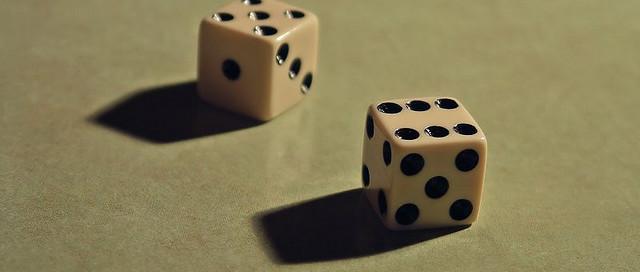
Throughout history, around the world, people in every culture have enjoyed playing games of chance. Strangely, mathematicians did not begin to study chance and probability until the 17th century.

It’s high time I got back on track with my Alexandria Jones posts, so I’ve been working hard on a short introduction to probability, to go along with The Birthday Surprise. Or, more honestly, I’ve been procrastinating on a short intro … well, anyway, here’s a little of what I’ve been reading around the interwebs lately.
Continue reading A Little Bit of This, a Little Bit of That…
There’s plenty to enjoy at this month’s Math Teachers at Play blog carnival. Check it out:
This is a Math teachers at play carnival, issue #…which I am going to reveal shortly. See if you can make it from what is known as a single image stereogram. Try focusing your eyes behind the screen.
In this month’s issue: What is the number of this issue? … Sad news … Interesting and relevant news … From the trenches … Math curiosities … Jokes … P.S. … Read more
via CTK Insights
The new math carnival is up, and it’s a good one. Check it out!
Also, remember that Wednesday’s the deadline to send in your submission for the Math Teachers at Play carnival, coming this Friday now posted at CTK Insights.


 Denise Gaskins' Let's Play Math