Only by Thinking

The full quote, as it appears in my new book:

When we give students a rule, we give them permission not to think. All they need to do is remember our instructions.

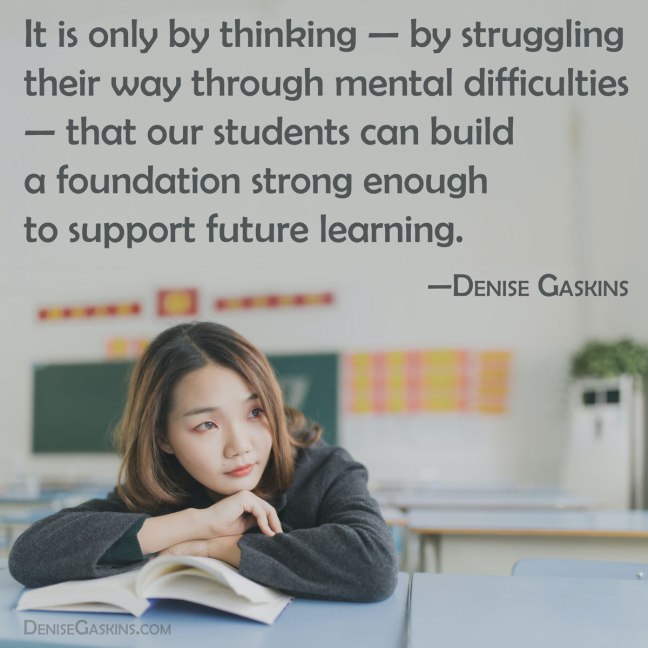
But it is only by thinking — by struggling their way through mental difficulties — that our students can build a foundation of mathematical knowledge strong enough to support future learning.

—Denise Gaskins
Prealgebra & Geometry: Math Games for Middle School

 
* * *
Excerpted from my upcoming book, Prealgebra & Geometry: Math Games for Middle School, scheduled for publication in early 2021. Sign up for my newsletter to get updates.

This blog is reader-supported.

If you’d like to help fund the blog on an on-going basis, then please join me on Patreon for mathy inspiration, tips, and an ever-growing archive of printable activities.

If you liked this post, and want to show your one-time appreciation, the place to do that is PayPal: paypal.me/DeniseGaskinsMath. If you go that route, please include your email address in the notes section, so I can say thank you.

Which I am going to say right now. Thank you!

“Only by Thinking” copyright © 2020 by Denise Gaskins. Image at the top of the post copyright © Sean Kong on Unsplash.

Morning Coffee – 10 August 2020

Morning Coffee image

One of the best ways we can help our children learn mathematics (or anything else) is to always be learning ourselves.

Here are a few stories to read with your morning coffee this week:

“The happy truth about doing math with your kids is that it’s way more fun than you’re expecting it to be. It’s not about right answers, and it’s not about speed. It’s about playing, counting, building, sorting, and studying the wonderful, colorful world around us.”

—Dan Finkel and Katherine Cook
How to help your kids fall in love with math: a guide for grown-ups

Continue reading Morning Coffee – 10 August 2020

Mathematicians Play

The full quote, as it appears in my Math You Can Play books:

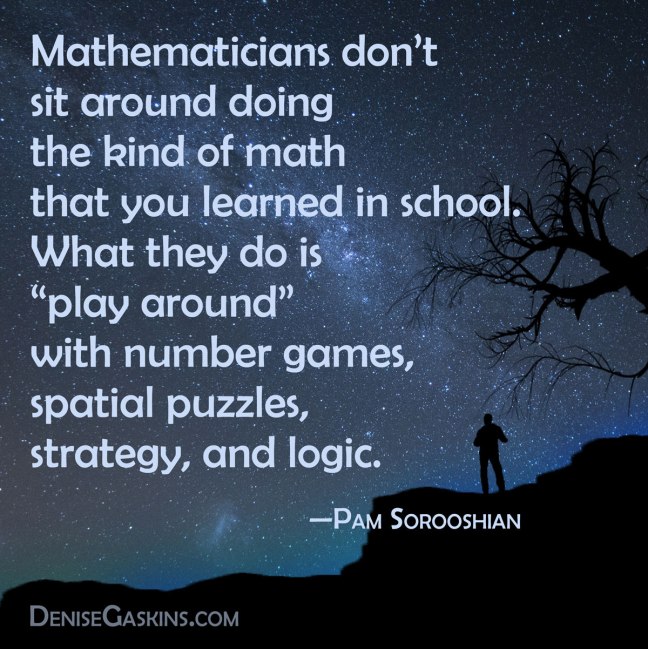
Mathematicians don’t sit around doing the kind of math that you learned in school. What they do is “play around” with number games, spatial puzzles, strategy, and logic.

They don’t just play the same old games, though. They change the rules a little, and then they look at how the game changes.

So, when you play games, you are doing exactly what mathematicians really do — IF you fool with the games a bit, experiment, see how the play changes if you change a rule here and there.

Oh, and when you make up games and they flop, be sure to examine why they flop — that is a big huge part of what mathematicians do, too.

—Pam Sorooshian
Games and Math

Excerpted from my upcoming book, Prealgebra & Geometry: Math Games for Middle School, scheduled for publication in early 2021. Sign up for my newsletter to get updates.

CREDIT: “Blue night” photo by Vincent Chin on Unsplash.

The Experience of Mathematical Thinking

The full quote:

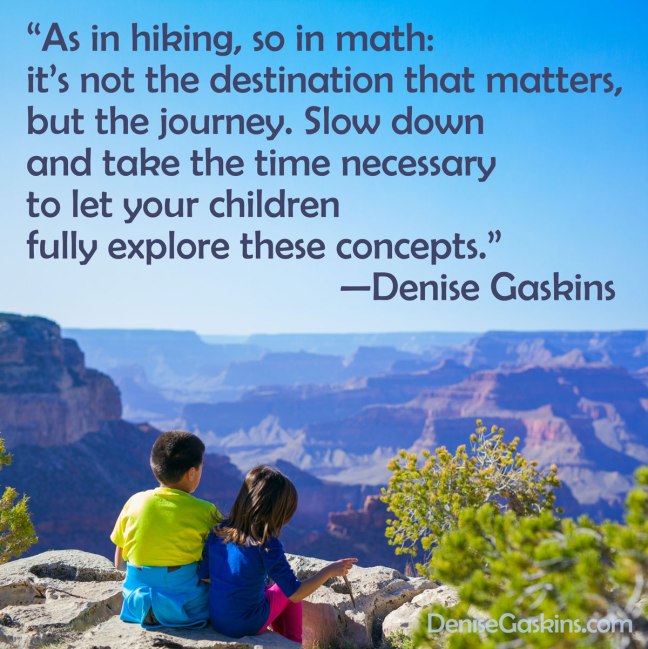
For children (and adults) who have always considered math to be memorized rules, the experience of mathematical thinking — though difficult at first — can be as refreshing as a hike in pure mountain air.

As in hiking, so in math: It’s not the destination that matters, but the journey. Yes, you could give your students a rule that would help them get correct answers, but that’s no better than riding a helicopter up the mountain.

Slow down and take the time necessary to let your children fully explore these concepts.

— Denise Gaskins
Prealgebra & Geometry: Math Games for Middle School

Excerpted from my upcoming book, Prealgebra & Geometry: Math Games for Middle School, scheduled for publication in early 2021. Sign up for my newsletter to get updates.

CREDIT: “On the edge” photo by Joseph Gonzalez on Unsplash.

A Gentle Reminder

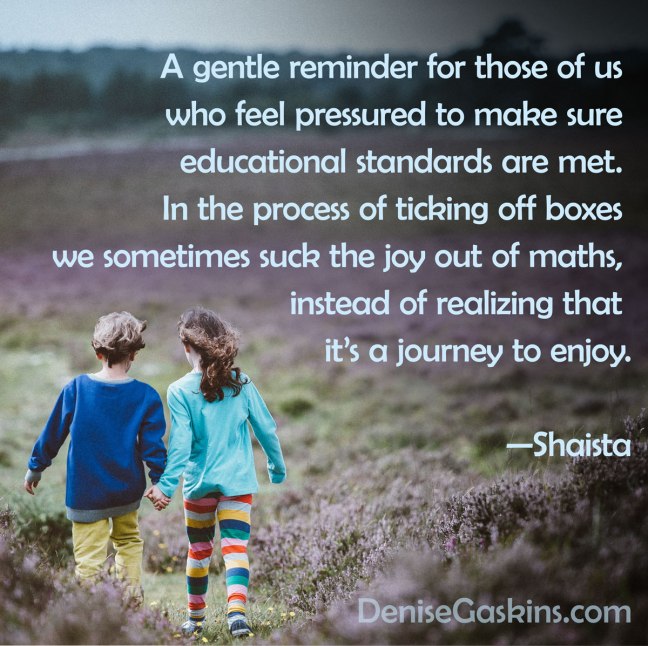
Shaista is a homeschooling mom who read an advance copy of my new book. Her response:

“I want to shout from the rooftops about it. It’s a wonderful read on the importance of play in maths — and a gentle reminder for those of us who know but feel pressured to make sure educational standards are met … and in the process of ticking off boxes we sometimes suck the joy out of maths, instead of realizing that it’s a journey to enjoy.”

— Shaista

Prealgebra & Geometry: Math Games for Middle School is scheduled for publication in early 2021. Sign up for my newsletter to get updates.

PHOTO CREDIT: “Outdoors kids” courtesy of Annie Spratt on Unsplash.

Morning Coffee – 4 November 2019

Morning Coffee image

One of the best ways we can help our children learn mathematics (or anything else) is to always be learning ourselves.

Here are a few stories to read with your Monday morning coffee:

“Games aren’t just about practice and fluency. My favorite games create opportunities for learning, too. They spark discourse, promote the use of strategies, and allow students to dig into the mathematics.”

—Jenna Laib
The Simple-but-High-Leverage Game Collection: Making Games Routine

  • Have you read Pam Harris’s Development of Mathematical Reasoning series? Check out Part 1, Part 2, and Part 3. Well worth your time!

“The teacher’s role is to help students change the way they think, in increasingly sophisticated ways. The goal is not answers. The goal is development. We don’t need students who can just answer a multiplication question, we need students who can reason multiplicatively.”

—Pam Harris
The Development of Mathematical Reasoning

CREDITS: Feature photo (top) by Kira auf der Heide via Unsplash. “Morning Coffee” post format inspired by Nate Hoffelder at The Digital Reader.

New Math Board Game: MULTI on Kickstarter

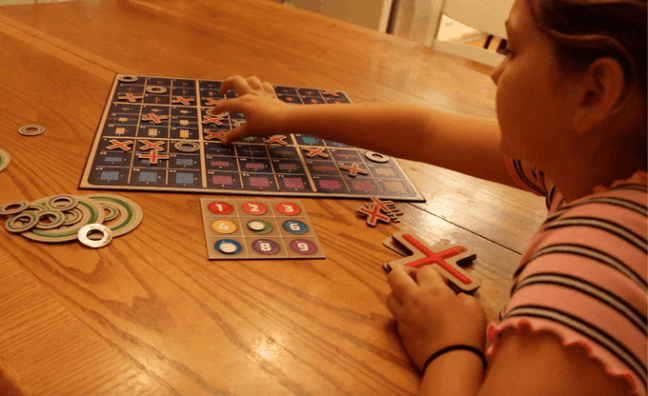
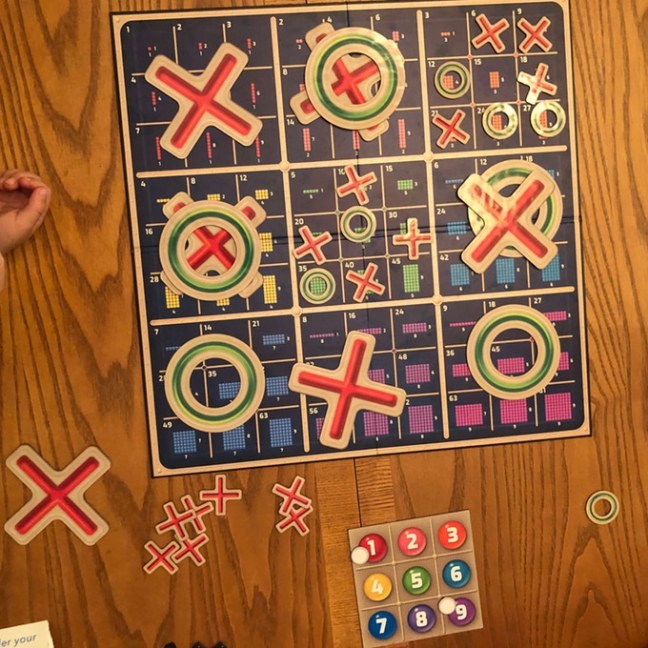
If the math classic The Product Game got together with Ultimate Tic-Tac-Toe, this game would be their child.

According to game creator Federico Chialvo, “MULTI is a fantastic 2-player math game designed with the joy of mathematics in mind. This game is so fun your kids won’t want to stop playing, and neither will you!”

Originally designed for students in 2nd-5th grade, MULTI helps children develop fluency with multiplication facts and the relationship between multiples and factors. Even better, the rich strategy and gameplay can be enjoyed by people of all ages.

If you want to play math with an elementary-age child, check out the Kickstarter:

Click Here for the MULTI Game on Kickstarter

“Mathematics is a polarizing topic! For some, it is a fountain of wonder, beauty, and intrigue. For others, it is a cold dark thing, something to be avoided or even feared. Yet, my experience has shown that everyone can find joy in mathematics when it is presented in the right way.”

—Federico Chialvo
MULTI – Math Board Game – Fun For All Ages!

Morning Coffee – 28 October 2019

Morning Coffee image

One of the best ways we can help our children learn mathematics (or anything else) is to always be learning ourselves.

Here are a few stories to enjoy with your Monday morning coffee:

“When you’re working every day, you’re not thinking, ‘What impact is this going to have on the world?’ You’re thinking, ‘I’ve got to get this right.’”

—Gladys West
quoted in Dr. Gladys West: The Black Woman Behind GPS Technology

  • I like to keep a quick game in reserve for spare time in my homeschool co-op class. Kent Haines explains Sprouts and suggests ways to launch math discussions.

“I don’t get irritated by these mistakes. I desperately wait for such mistakes. Yes! Because I think it is a golden opportunity for the teacher to spot a student thinking this way. It presents just the right context and time for driving an enriching mathematical conversation in the whole class.”

—Rupesh Gesota
Part-2: Re-learning and Enjoying Polynomial Division with students

“To teach students SSS congruence without pointing out why this is so interesting is harmful for two reasons. First of all, this is an amazing result. It is the our job to point out amazing results! Triangles are rigid figures in a way that other polygons are not.”

—Rachel Chou
Teaching the Distributive Property

CREDITS: Feature photo (top) by Kira auf der Heide via Unsplash. “Morning Coffee” post format inspired by Nate Hoffelder at The Digital Reader.

Morning Coffee – 4 October 2019

Morning Coffee image

One of the best ways we can help our children learn mathematics (or anything else) is to always be learning ourselves.

Here are a few stories to read with your Friday morning coffee:

  • In the spirit of cracking eggs to make omelets, Michael Pershan cracks open some of the ideas around Equations and Equivalence and relational thinking.

“My experience is that when I have vague hope that children will learn something from an activity that is related to the mathematics I want them to learn, they usually don’t.”

—David Wees
Hands on or minds on?

CREDITS: Feature photo (top) by Kira auf der Heide via Unsplash. “Morning Coffee” post format inspired by Nate Hoffelder at The Digital Reader.

Morning Coffee – 30 September 2019

Morning Coffee image

One of the best ways we can help our children learn mathematics (or anything else) is to always be learning ourselves.

Here are a few stories to read with your Monday morning coffee:

  • Kathy Iwanicki’s students explore an unsolved math puzzle: the Hailstone Sequence. I think my co-op class might enjoy this activity, too.
  • If you want to understand how number concepts develop through the school years, Graham Fletcher’s Progression Videos are a great place to start. Watch, re-watch, and learn.

“Learning occurs when we get something wrong and have to correct it. This is analogous to the much better known fact that when we subject our bodies to physical strain, say by walking, jogging, or lifting weights, the muscles we strain become stronger — we gain greater fitness.

“Indeed, the learning is better if the correction occurs some time after the error is made. Stewing for a while in frustration at being wrong, and not seeing how to fix it, turns out to be a good thing. Cracking your ego is an unavoidable part of learning.”

—Keith Devlin
On making omelets and learning math

CREDITS: Feature photo (top) by Kira auf der Heide via Unsplash. “Morning Coffee” post format inspired by Nate Hoffelder at The Digital Reader.