The Value of Puzzles

I love puzzles. Don’t you?

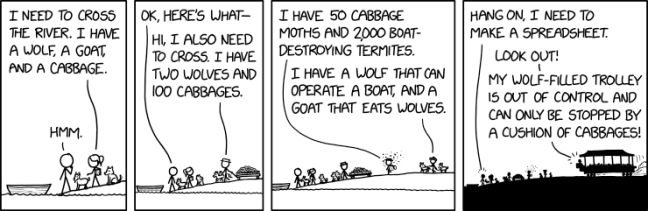
Here are several examples of river-crossing puzzles you and your kids can try. They date back at least to the time of Alcuin, the famous scholar from the court of Charlemagne.

I wish someone would write a whole math curriculum devoted entirely to puzzles.

W.W. Sawyer on the Value of Puzzles

Master teacher W.W. Sawyer didn’t write a curriculum, but he often used puzzles in the classroom.

“It is quite possible to use simultaneous equations as an introduction to algebra. Within a single lesson, pupils who previously did not know what x meant can come not merely to see what simultaneous equtions are, but to have some competence in solving them.

“No rules need to be learnt; the work proceeds on a basis of common sense.

“The problems the pupils solve in such a first lesson will not be of any practical value. They will be in the nature of puzzles.

“Fortunately, nature has so arranged things that until the age of twelve years or so, children are more interested in puzzles than in realistic problems.”

—W. W. Sawyer, Vision in Elementary Mathematics
Then he gives this example:

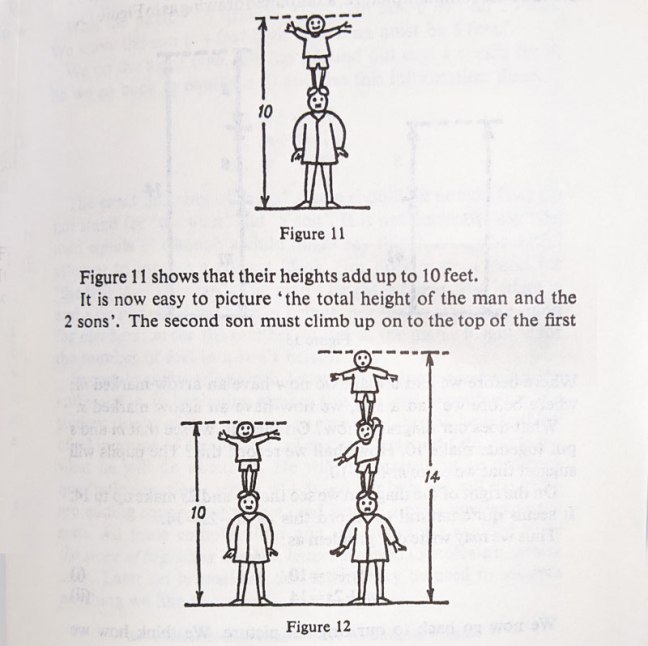
“A man has two sons. The sons are twins; they are the same height. If we add the man’s height to the height of one son, we get 10 feet. The total height of the man and the two sons is 14 feet. What are the heights of the man and his sons?”
Try This at Home

Not only can children solve puzzles like this, but even better — they can make up story puzzles of their own. You could spend a whole week or more making up silly height puzzles for each other to solve. By the time you were done, your kids would have a great introduction to algebra!

Maybe I never grew up. Because I still prefer puzzles over “real world” math problems.

What are your favorite kinds of puzzles? Please share in the comments section.

CREDITS: “Boat puzzles” comic from xkcd.com.
[THE FINE PRINT: I am an Amazon affiliate. If you follow the book link and buy something, I’ll earn a small commission (at no cost to you). But this book is a well-known classic, so you should be able to order it through your local library.]
More Dover Samples

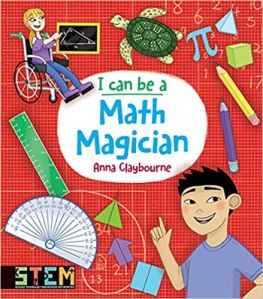
“Without mathematics you can’t do anything! Everything around you is mathematics. Everything around you is numbers.”

—Anna Claybourne, I Can Be a Math Magician


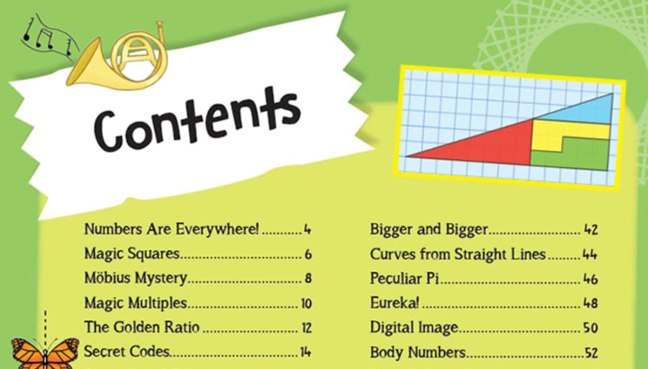
Dover Publications sent out a new email today with fun coloring and craft samples. And several puzzles from I Can Be a Math Magician: Fun STEM Activities for Kids by Anna Claybourne.

Enjoy!

If you’d like to receive future Dover Sampler emails, you can sign up here.

THE FINE PRINT: I am an Amazon affiliate. If you follow the book link above and buy something, I’ll earn a small commission (at no cost to you).

W.W. Sawyer’s Rules of Mathematics

“In the beginnings of arithmetic and algebra, the main purpose is not to get the pupil making calculations. The main purpose is to get him into the habit of thinking, and to show him that he can think the problems out for himself.

“Pupils ask ‘Am I allowed to do this?’ as if we were playing a game with certain rules.

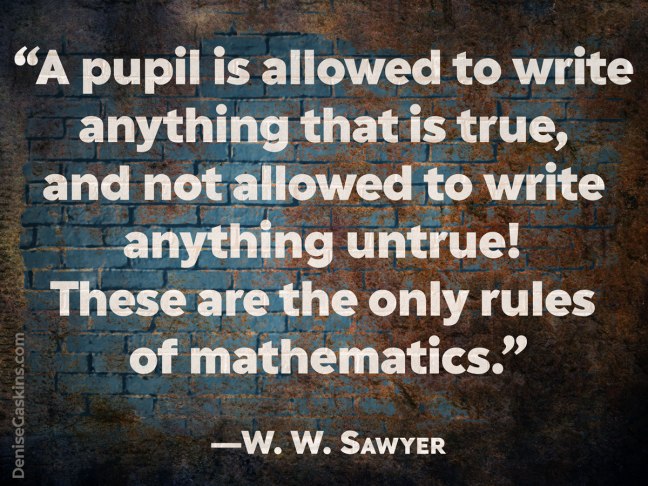
“A pupil is allowed to write anything that is true, and not allowed to write anything untrue!

“These are the only rules of mathematics.”

—W. W. Sawyer, Vision in Elementary Mathematics

[THE FINE PRINT: I am an Amazon affiliate. If you follow the link and buy something, I’ll earn a small commission (at no cost to you). But this book is a well-known classic, so you should be able to order it through your local library.]
Inspired by Sawyer’s Two Rules

I love this quote so much, I turned it into a printable math activity guide. I hope it helps inspire your students to deeper mathematical thinking.

Here’s the product description…

Join the Math Rebellion: Creative Problem-Solving Tips for Adventurous Students

Take your stand against boring, routine homework.

Fight for truth, justice, and the unexpected answer.

Join the Math Rebellion will show you how to turn any math worksheet into a celebration of intellectual freedom and creative problem-solving.

Help your students practice thinking for themselves as they follow the Two Rules of the Math Rebellion: “A pupil is allowed to write anything that is true, and not allowed to write anything untrue! These are the only rules of mathematics.”

Find Out More

Magical Mathematics

In fact, mathematics is the closest that we humans get to true magic. How else to describe the patterns in our heads that — by some mysterious agency — capture patterns of the universe around us?

— Ian Stewart
The Magical Maze

CREDITS: Photo by Greg Rakozy via Unsplash.com. I am an Amazon affiliate. If you follow the book link and buy something, I’ll earn a small commission (at no cost to you).

FAQ: I’ve Ruined My Daughter

My daughter is only eleven, but I’m afraid I’ve ruined her chance of getting into college because she is so far behind in math. We’ve tried tutors, but she still has trouble, and standardized testing puts her three years below grade level. She was a late reader, too, so maybe school just isn’t her thing. What else can I do?

Standardized tests are not placement tests. They cannot tell you at what level your daughter should be studying. They aren’t designed that way. The “placement” they give is vague and general, not indicative of her grade level but rather a way of comparing her performance on that particular test with the performance of other students.

There can be many different reasons for a low score. I’ve listed a few of them in my post In Honor of the Standardized Testing Season.

Continue reading FAQ: I’ve Ruined My Daughter

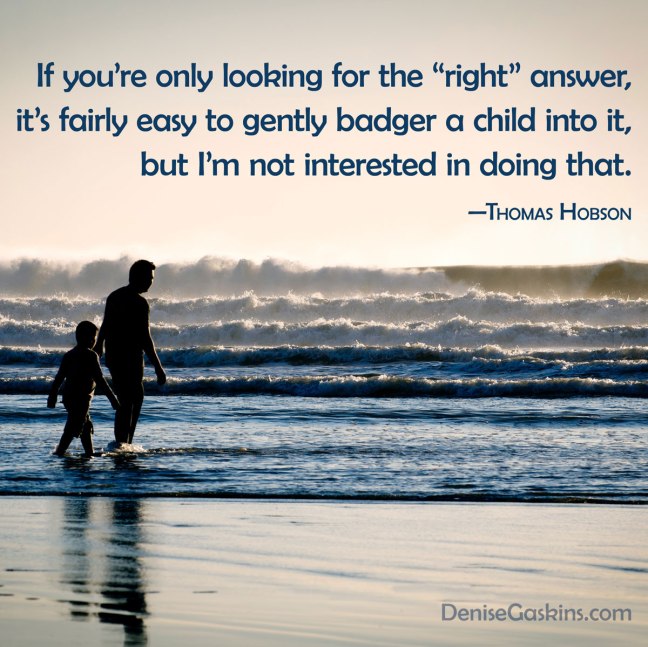
To Badger a Child

Here’s the full quote:

Audrey seemed, for once, at a loss for words. She was thinking about the question.

I try to stay focused on being silent after I ask young children questions, even semi-serious accidental ones. Unlike most adults, they actually take time to think about their answers and that often means waiting for a response, at least if you want an honest answer.

If you’re only looking for the “right” answer, it’s fairly easy to gently badger a child into it, but I’m not interested in doing that.

—Thomas Hobson
Thank You For Teaching Me

CREDITS: “Pismo Beach, United States” photo by Tim Mossholder on Unsplash.

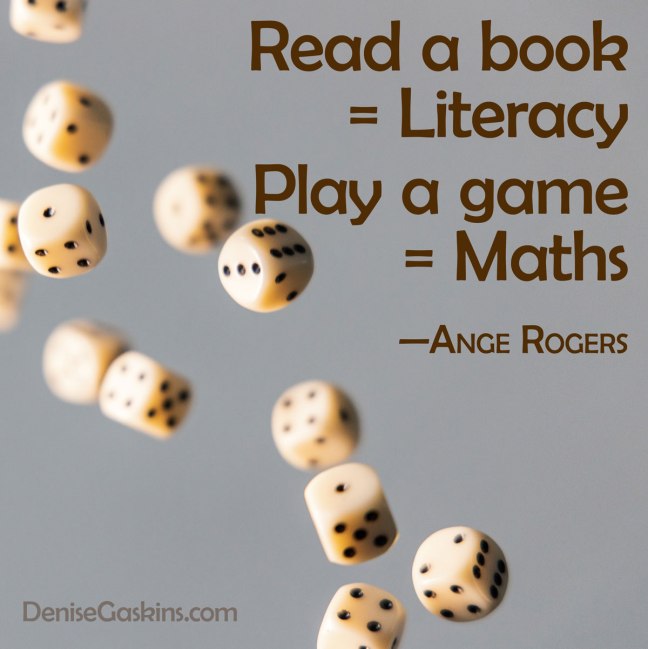
How to Build Math Literacy

Here’s the full quote:

We all know reading a book each day to our child develops their love of literacy… well, playing games is the equivalent in maths.

Through playing card games and board games (just short and sweet ones) children develop problem solving, counting and so many other skills.

Imagine if every time you play a game you say, “Let’s do some maths.” What a positive association your child will develop with maths!

—Ange Rogers
Instagram post

Discover more creative ways to play math with young children at the Number Doctors blog.

CREDITS: “Falling dice” photo by Riho Kroll on Unsplash.

Morning Coffee – 31 August 2020

Morning Coffee image

One of the best ways we can help our children learn mathematics (or anything else) is to always be learning ourselves.

Here are a few stories to read with your morning coffee this week:

  • David Butler’s post Twelve matchsticks: focus or funnel presents an interesting puzzle. But even better, it opened up a rabbit hole of thought-provoking posts about how to talk with children — or anyone.

“The approach where you have an idea in your head of how it should be done and you try to get the student to fill in the blanks is called funnelling. It’s actually a rather unpleasant experience as a student to be funnelled by a teacher. You don’t know what the teacher is getting at, and often you feel like there is a key piece of information they are withholding from you, and when it comes, the punchline feels rather flat.”

—David Butler
Twelve matchsticks: focus or funnel

Continue reading Morning Coffee – 31 August 2020

Morning Coffee – 24 August 2020

Morning Coffee image

One of the best ways we can help our children learn mathematics (or anything else) is to always be learning ourselves.

Here are a few stories to read with your morning coffee this week…

“We are all mathematicians. We all have the power to notice, describe, and generalize patterns. You have all had this ability since birth. If we believe this then every day we must plan lessons that allow students to act as mathematicians. We must put something in front of our students to notice. We must put something in front of our students to describe, to generalize.”

—Sara VanDerWerf
What is Math? What do Mathematicians do?

Continue reading Morning Coffee – 24 August 2020

How Mathematics Works

The full quote, as it appears in my new book:

Make a conjecture. A conjecture is a statement that you think might be true.

For example, you might make a conjecture that “All odd numbers are…” How would you finish that sentence?

Make another conjecture. And another. Does thinking about your conjectures make you wonder about math?

Can you think of any way to test your conjectures, to discover if they will always be true?

This is how mathematics works. Mathematicians notice something interesting about certain numbers, shapes, or ideas. They play around and explore how those relate to other ideas. After collecting a set of interesting things, they think about ways to organize them. They wonder about patterns and connections. They make conjectures and try to imagine ways to test them.

And mathematicians talk with one another and compare their ideas. In real life, math is a very social game.

—Denise Gaskins
Prealgebra & Geometry: Math Games for Middle School

Excerpted from my new book, Prealgebra & Geometry: Math Games for Middle School. Look for it at your favorite online bookstore.

CREDITS: “Three girls counting” photo by Charlein Gracia on Unsplash.