Build Mathematical Skills by Delaying Arithmetic, Part 1

To my fellow homeschoolers,

It’s counter-intuitive, but true: Our children will do better in math if we delay teaching them formal arithmetic skills. In the early years, we need to focus on conversation and reasoning — talking to them about numbers, bugs, patterns, cooking, shapes, dinosaurs, logic, science, gardening, knights, princesses, and whatever else they are interested in.

In the fall of 1929 I made up my mind to try the experiment of abandoning all formal instruction in arithmetic below the seventh grade and concentrating on teaching the children to read, to reason, and to recite — my new Three R’s. And by reciting I did not mean giving back, verbatim, the words of the teacher or of the textbook. I meant speaking the English language.

— L. P. Benezet
The Teaching of Arithmetic I: The Story of an experiment

Continue reading Build Mathematical Skills by Delaying Arithmetic, Part 1

PUFM 1.2 Place Value

Photo by Chrissy Johnson1 via flickr. In this Homeschooling Math with Profound Understanding (PUFM) Series, we are studying Elementary Mathematics for Teachers and applying its lessons to home education.

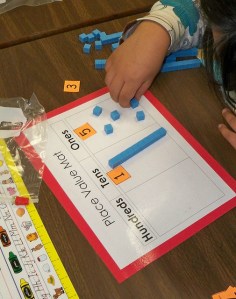
Our decimal system of recording numbers is ingenious. Once learned, it is a simple, versatile, and efficient way of writing numbers. … But the system is not obvious nor easily learned. The use of place value is subtle, and mastering it is the single most challenging aspect of elementary school mathematics.

Ironically, these challenges are largely invisible to untrained parents and teachers — place value is so ingrained in adults’ minds that it is difficult to appreciate how important it is and how hard it is to learn.

— Thomas H. Parker & Scott J. Baldridge
Elementary Mathematics for Teachers

In other words, we take place value for granted. I know this was true of me when I started teaching my kids. Every year, their textbooks would start with the obligatory chapters on place value, which seemed to me just busywork. I began to appreciate the vital importance of place value when I read Liping Ma’s book and saw how the American teachers were unable to properly explain subtraction or multi-digit multiplication.

Place value is the heart of our number system, the foundation on which all the rest of arithmetic must be built. Because of place value, “The simplest schoolboy is now familiar with facts for which Archimedes would have sacrificed his life.”

Continue reading PUFM 1.2 Place Value

Update: My Math Books

photo by goXunuReviews via Flickr

Are you a homeschooler? Are you happy with your current curriculum, or would you like to break out of the textbook mold and explore math through “living” books and activities? Whether you hope to replace your math program or just to supplement it, I can show you ways to turn math into a learning adventure for the whole family. Your children will build a stronger foundation of understanding when you teach math as a game, playing with ideas.

Nearly a year ago, I wrote:

This blog originally grew out of my books, and now it’s coming full circle: New, expanded editions of my long-out-of-print books are ripening on the vine, growing out of the blog. To bring them to harvest, I’m going to need your help.

It has taken much longer than I had hoped to whip the manuscripts into form. My new goal is to publish ebook editions, since I will be able to sell them for about half what the original books cost twelve years ago. I’m hoping that I can finish at least a couple of the ebooks by mid-summer.

Continue reading Update: My Math Books

PUFM 1.1 Counting

Photo by Iain Watson via flickr. In this Homeschooling Math with Profound Understanding (PUFM) Series, we are studying Elementary Mathematics for Teachers and applying its lessons to home education.

Many things in mathematics need to be understood relationally — that is, in relationship to other concepts. But some things just need to be memorized. How do you know which is which? A homeschooling friend pointed out that one thing children definitely need to memorize is the counting sequence from 1-100 and beyond. While there are some patterns that make counting easier, one does just have to memorize which “nonsense sounds” we have attached to each number.

Another sort-of counting that young students should master is subitizing — recognizing at a glance how many items are in a small group. Children do this instinctively, but we can help them develop the skill by playing subitizing games.

[Aside: In writing this blog post, I ran into some nostalgia. Back when we first did these PUFM lessons, my daughter Kitten was only a toddler. I wrote, “I’ve tried to do lots of counting with my youngest, who hasn’t quite gotten beyond, ‘…eleven, twelve, firteen, firteen, nineteen, seven,…’ The numbers tend to start appearing randomly after she gets past 10.” Ah, memories.]

Continue reading PUFM 1.1 Counting

Working on My Let’s Play Math! Books

Workplace stress caused by an unsuitable work ...
Image via Wikipedia

This blog originally grew out of my books, and now it’s coming full circle: New, expanded editions of my long-out-of-print books are ripening on the vine, growing out of the blog. To bring them to harvest, I’m going to need your help.

The Books

I’m working on the games books first because I think they will be the most helpful supplements to any math program.

  • Let’s Play Math! Number Games for All Ages
    This book will include games like Tens Concentration and Hit Me, as well as tips for teaching negative numbers, the times table, and more. Never before published, because it was planned as the fifth book in my earlier how-to-teach-homeschool-math series, but my self-publishing experiment ended after book four.
  • Others to be announced, if I ever get the first two done…

Continue reading Working on My Let’s Play Math! Books

Planning a New Math Club

[Photo by Waponi.]

A few years ago, I had several (potentially) future engineers in our homeschool math club, and we enjoyed the challenge of MathCounts and AMC puzzles — but the current crop of local homeschool students is another story.

Last year’s contest-based club meetings dwindled to one student. Even before the recent MathCounts rule changes, I knew I needed a new plan. The final straw was Kitten, whose moaning complaint that she “hates math” has begun to drive me crazy.

So, what’s a homeschool math teacher to do?

Continue reading Planning a New Math Club

MathCounts: Grandfather Clause for Existing Homeschool Teams

Click here for the official update. Small schools are not mentioned, but it seems logical that their existing teams would also be grandfathered in. Maybe? and according to Mathmom’s comment below, small schools are left out in the cold.

… After taking all concerns into account, a compromise was crafted that would grandfather in homeschools and virtual schools that participated in the 2009-2010 program year to allow them to participate on teams in this year’s Competition Program. All new homeschool and virtual school participants must abide by the new eligibility rules that require those participants to register only as individuals. This compromise was brought to the MATHCOUNTS Board of Directors and approved unanimously.

Therefore, for the 2010-2011 school year, all homeschool and virtual school groups that registered for the MATHCOUNTS Competition Program either as teams OR individuals during the 2009-2010 program year will be allowed to register teams or as individuals for the upcoming 2010-2011 program year, following all of the 2009-2010 requirements for participation.

MathCounts: No More Homeschool Teams

MATHCOUNTSIf you’ve heard rumors about the new ruling, here is the official take.

I try to avoid ranting on this blog, but I’m deeply disappointed. My students always enjoyed the team aspect of working/suffering together. I don’t know if any of them will be willing to participate as individuals.

Update: MathCounts: Grandfather Clause for Existing Homeschool Teams

My New Project: Blogging 2 Learn

Beginning in January, I will teach a 4th-12th grade Blogging 2 Learn class through our local homeschool co-op. For now, here is my research blog, testing ideas and trying to imagine myself as a new blogger:

Have you used blogs with your students? If so, I would love to hear your suggestions and comments. And whether you are an experienced or a wanna-be blogger, please share: What do you think a “Blogging to Learn” class should cover?

April Math Calendar

april-math-calendar

My homeschool co-op classes had a lot of fun creating this April calendar to hand out at our end-of-semester party on Friday. It’s not as easy to read as a traditional calendar — it is more like a puzzle. The expression in each square simplifies to that day’s date, so families can treat each day like a mini-review quiz: “Do you remember how to calculate this?”

Download your own copy:

If you’ve been wanting to start your own math club, you will find plenty of helpful ideas here:

Update

Check out my May Math Calendar post for more ideas about how to use these puzzles.

 
* * *

This blog is reader-supported.

If you’d like to help fund the blog on an on-going basis, then please join me on Patreon for mathy inspiration, tips, and an ever-growing archive of printable activities.

If you liked this post, and want to show your one-time appreciation, the place to do that is PayPal: paypal.me/DeniseGaskinsMath. If you go that route, please include your email address in the notes section, so I can say thank you.

Which I am going to say right now. Thank you!

“April Math Calendar” copyright © 2009 by Denise Gaskins.