In my previous post, I examined fingers and found items (beans, buttons, leaves, and so on) as tools that can help our children learn math. This time, we move on to the kinds of math manipulatives you’ll find in stores or packaged with your favorite curriculum.
Standard base ten blocks
The standard base ten blocks consist of plastic or wooden cubes, a rod with the length of ten cubes, a flat shape the size of ten rods side-by-side, and a large cube equivalent to ten of the flat shapes stacked atop each other.
These are used primarily for modeling place value as a means of developing the standard arithmetic algorithms for addition and subtraction.
They can also be used for modeling decimals as a place value notation, without relying on fraction concepts. And with a bit of imagination (“Pretend the rods are stretchy, so we don’t know how long they really are”) they can model simple algebraic expressions.
I stumbled across another blogger’s post on the common question, “What are the best math manipulatives for homeschooling?”
My answer to this question has changed over the years, as I’ve grown in my understanding of math and of education. As my current stance is far different from much of what I read from other homeschoolers, I’m going to lay out my reasoning below.
I’d love to hear your thoughts, especially if you disagree, because comparing ideas with one another is a great way to learn.
What is a “living book”? English education reformer Charlotte Mason introduced this term for any book that brings the reader directly into contact with the major ideas that have fascinated humans across the ages.
We know that reading aloud helps build our children’s love for books. But did you know it works for math as well?
And that it can transform the parent’s attitude as well as the child’s?
A playful math book fleshes out the bones of abstract math, brings it alive, makes it human, relatable, interesting to readers of all ages, opening our eyes to the wonderful world of big ideas, where concepts meet and topics intertwine in a beautifully intricate dance of understanding.
We live in an age of abundance, with more new creative math books being published every year, so many that I can’t keep track of them all, not to mention the older classics, some out of print, that can still be found in public libraries.
Here are a few of my favorite books of playful, living math, both old and new:
I was asked to do an interview for a new podcast called Learning is Disruptable, and that got me thinking…
Is Math Education Ripe for Disruption?
Math education is not working. Too many people come out of school with math avoidance, math anxiety or even phobia, a profound conviction that math is not for them.
Generally, humans enjoy success, the feeling that things make sense, that they are capable of understanding big ideas. People like subjects that give them this type of success, where they are meeting and making sense of new ideas, growing in mastery.
But they hate subjects that make them feel like a failure, where things don’t make sense and there seems to be no real chance of success.
Therefore, understanding our students’ attitude toward math gives us a solid indication of how well they are learning.
There’s a great new homeschool math program that can radically transform your children’s experience of math, building understanding through creative exploration.
First, a bit of history…
What Is Algebra Before Arithmetic?
Back when I was still homeschooling, I read a couple of articles by Keith Devlin about the benefits of teaching children algebra, even before they study numbers.
As a homeschooler leaning toward Charlotte Mason-style education, I found the notion of algebra-first math intriguing. What if we could introduce students to the big ideas of math, the foundational concepts that explain how numbers relate, before they get distracted by details like math facts and memorized rules?
“I think the most important thing that we need to change…we need to radically change what our idea is of what it means to learn math.
“Our biggest failure, both in the classroom and in homeschool settings, is that we’ve given our children a totally wrong idea of what math is all about.
The Playful Math Education Carnival (formerly “Math Teachers at Play”) is a monthly collection of mathy fun: tips, tidbits, games, activities, and more.
It’s like a free online magazine of mathematical adventures. If you like to learn new things and play around with ideas, you are sure to find something of interest.
Normally, I post a blog about each month’s carnival as it goes live. But this year has been anything but normal!
First there was my daughter’s medical issue, which took up months of my time. Happily, that is resolved and she’s doing well, back to all her normal-life activities.
Then there was the big storm that dropped a tree on our house. (Don’t worry, we’re all fine!) Cleaning up from that has taken months of work and more than a dozen bonfires — and we’re still far from done.
But I have climbed out from under the To-Do list enough to notice my blogging negligence. So without further ado, here are all the carnivals I missed, full of great mathy activities and games to play with your kids…
Playful Math Carnival 163 at 1001 Math Problems
First up, Sian’s delightful collection of math projects, puzzles, and games posted in March. Don’t worry that these may be out-of-date, because playful math is evergreen.
Playful Math Carnival 165 at Nature Study Australia
Jo put together an especially varied carnival, full of mathy goodness. She writes, “If you have always thought math is about right and wrong, yes and no, be prepared to be stretched and amazed at the fun ways math can be played with!”
Sue filled our summer break (or winter, for those down under) with puzzles, games, and more — even a peek at three upcoming math novels. And if you struggle with fractions, don’t miss Henri Picciotto’s Fractions on Grids.
The carnival is a joint effort. We need more volunteers.
Classroom teachers, homeschoolers, college professors, unschoolers, or anyone who likes to play around with math — if you would like to take a turn hosting the carnival, please speak up!
Are your students doing anything special for Pi Day?
Back when we were homeschooling, my kids and I always felt stir-crazy after two months with no significant break. We needed a day off — and what better way could we spend it than to play math all afternoon?
I love any excuse to celebrate math!
Pi Day is March 14. If you write dates in the month/date format, then 3/14 at 1:59 is about as close as the calendar can get to 3.14159etc.
(Otherwise, you can celebrate Pi Approximation Day on July 22, or 22/7.)
Unfortunately, most of the activities on teacher blogs and Pinterest focus on the pi/pie wordplay or on memorizing the digits. With a bit of digging, however, I found a few puzzles that let us sink our metaphorical teeth into real mathematical meat.
What’s the Big Deal? Why Pi?
In math, symmetry is beautiful, and the most completely symmetric object in the (Euclidean) mathematical plane is the circle. No matter how you turn it, expand it, or shrink it, the circle remains essentially the same.
Every circle you can imagine is the exact image of every other circle there is.
This is not true of other shapes. A rectangle may be short or tall. An ellipse may be fat or slim. A triangle may be squat, or stand upright, or lean off at a drunken angle. But circles are all the same, except for magnification. A circle three inches across is a perfect, point-for-point copy of a circle three miles across, or three millimeters.
What makes a circle so special and beautiful? Any child will tell you, what makes a circle is its roundness. Perfectly smooth and plump, but not too fat.
The definition of a circle is “all the points at a certain distance from the center.” Can you see why this definition forces absolute symmetry, with no pointy sides or bumped-out curves?
One way to express that perfect roundness in numbers is to compare it to the distance across. How many times would you have to walk back and forth across the middle of the circle to make the same distance as one trip around?
The ratio is the same for every circle, no matter which direction you walk.
That’s pi!
Puzzles with Pi
For all ages:
Sarah Carter created this fun variation on the classic Four 4s puzzle for Pi Day:
Using only the digits 3, 1, 4 once in each calculation, how many numbers can you make?
You can use any math you know: add, subtract, multiply, square roots, factorials, etc. You can concatenate the digits, putting them together to make a two-digit or three-digit number.
1. Imagine the Earth as a perfect sphere with a long rope tightly wrapped around the equator. Then increase the length of the rope by 10 feet, and magically lift it off the Earth to float above the equator. Will an ant be able to squeeze under the rope without touching it? What about a cat? A person?
2. If you ride a bicycle over a puddle of water, the wheels will leave wet marks on the road. Obviously, each wheel leaves a periodic pattern. How the two patterns are related? Do they overlap? Does their relative position depend on the length of the puddle? The bicycle? The size of the wheels?
3. Draw a semicircle. Along its diameter draw smaller semicircles (not necessarily the same size) that touch each other. Because there are no spaces in between, the sum of the diameters of the small semicircles must equal the diameter of the large one. What about their perimeter, the sum of their arc lengths?
4. Choose any smallish number N. How can you cut a circular shape into N parts of equal area with lines of equal lengths, using only a straight-edge and compass? Hint: The lines don’t have to be straight.
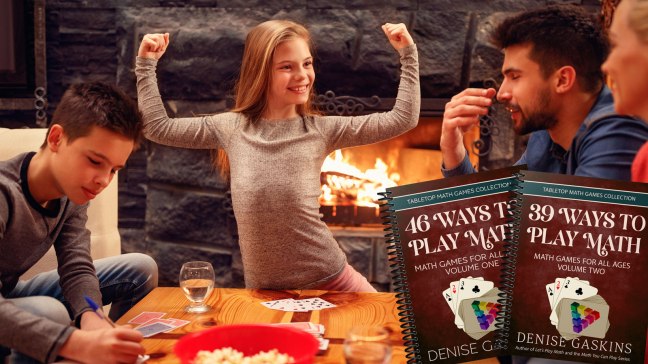
Most of my books eventually show up in the regular online bookstores, making it easy to delay purchasing.
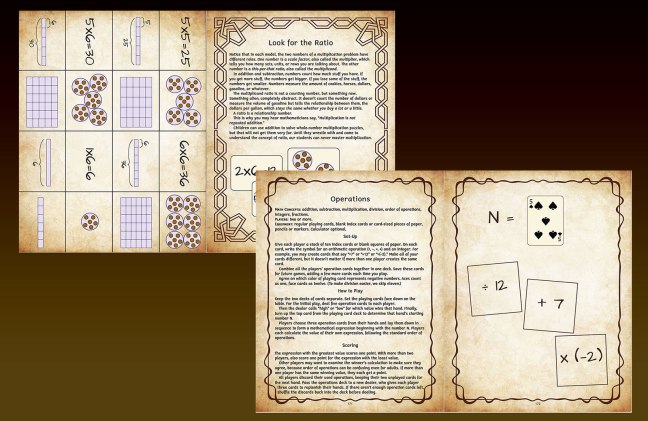
But these are not typical paperback or hardcover books. Instead, they’re designed to lay flat so players can use the gameboards or easily refer to rules as they play.
I don’t know whether the online bookstores will stock these titles.
But I do know we’re counting down the hours on our Tabletop Math Games Collection Kickstarter campaign.
Do you really want to miss out?
Scroll down for a peek at what other people say about my math games.
Then order your copy today, and have fun playing math with your kids!
Readers Love These Games
👍 “When I’m asked about resources for math games, Denise Gaskins is one of the first names I mention.” —Dan Finkel, creator of the Prime Climb math board game
❤️ “If I could go back in time, I would play a lot more games.” —Carla Roesler, homeschooling parent
👍 “The directions are clear, it is easy for parents to pick up and use, yet it gets to the heart of mathematical thinking in a fun, engaging way.” —Casey Maupin, homeschooling parent
❤️ “The games are easy to put into practice (even for a mom of 4 with 2 toddlers) and something my daughter would participate in willingly or even enjoy (which is saying a lot for a teen who doesn’t always appreciate a challenge). Clever, helpful, and creative in ways I’d never come up with.” —Casey Baldwin, homeschooling parent