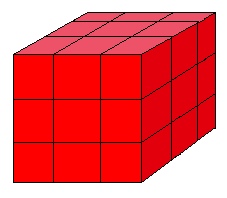
In the first section of George Lenchner’s Creative Problem Solving in School Mathematics, Lechner poses this problem. If you have seen it before, be patient — his point was much more than simply counting blocks.
A wooden cube that measures 3 cm along each edge is painted red. The painted cube is then cut into 1-cm cubes as shown below. How many of the 1-cm cubes do not have red paint on any face?
My book business had been on hiatus for nearly 15 years, as I focused on homeschooling five children. I posted on forums and blogged off and on, but the old books fell into (not entirely undeserved) oblivion.
Now my older kids were moving out into their adult lives, and I’d begun to think about publishing again. I dusted off the old manuscripts to see what could be salvaged and began my adventure of indie publishing.
And all the gurus agreed, every author needed an email newsletter.
Share a playful math activity every month? Sure I could do that!
So while I revised and edited the manuscript for Let’s Play Math, to be published in paperback that fall, I launched my first “Playful Math” email, with an idea that’s still fun all these years later: Play math on your calendar.
[Memories from 20 years ago. Like our kids’ childhood, the homeschooling season passes faster than we expect.]
Spring cleaning has made my desk look worse than before. Nobody feels like studying. The kids would rather be outside, and their mom would rather take a nap. Sound familiar? It is our annual attack of homeschool burnout.
If you, too, are suffering from lethargy and can’t face another day of school work, here are some ideas that have helped me:
(1) Re-read the homeschooling books on your shelves.
Or get some new ones from the library. Try to read about one a month, if you can, to help get your enthusiasm back. And then read at least one new homeschooling book per year to help you stay inspired.
Now that we’re a few months into the year, many of our New Near’s resolutions have probably fallen by the wayside. It’s inevitable, according to Mark Twain, that we shall “cast our reformation to the winds and go to cutting our ancient shortcomings considerably shorter than ever.”
But there is one resolution that I enjoy keeping—the resolve to play more math.
My favorite way to celebrate at any time of the year is by playing the Year Game. It’s a prime opportunity for players of all ages to fulfill the two most popular resolutions: spending more time with family and friends, and getting more exercise.
So grab a partner, slip into your workout clothes, and pump up those mental muscles!
“When we do our daily lessons, my son does great. Everything seems to click. But when he sees the same topic later, in a review or on a test, it’s like he’s never heard of it before. How can I help him pull math up from the dregs of lost memory?”
This is a common problem, and there’s no easy answer.
You see, it’s easy for humans to convince ourselves we understand something when someone else explains it. It seems to make sense, but it doesn’t stick in our minds.
If you think of times when you’ve tried to learn something new, you can probably remember the feeling—you thought you had it, but then when you tried to do it yourself, your mind went blank.
So how can we help our kids when they can’t remember what to do?
Welcome to the 184th edition of the Playful Math Education Blog Carnival — a smorgasbord of delectable tidbits of mathy fun. It’s like a free online magazine devoted to learning, teaching, and playing around with math from preschool to high school.
With all the links, a blog carnival can feel overwhelming. Bookmark this article, so you can take your time reading the posts.
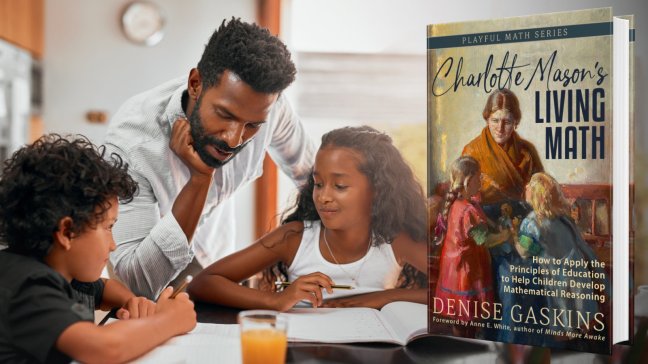
“Living math” means bringing our children face-to-face with the big ideas of mathematics to help them develop their reasoning skills. When the ideas of math come to life for our children, their minds delight in seeing how numbers and shapes connect to each other and exploring these relationships.
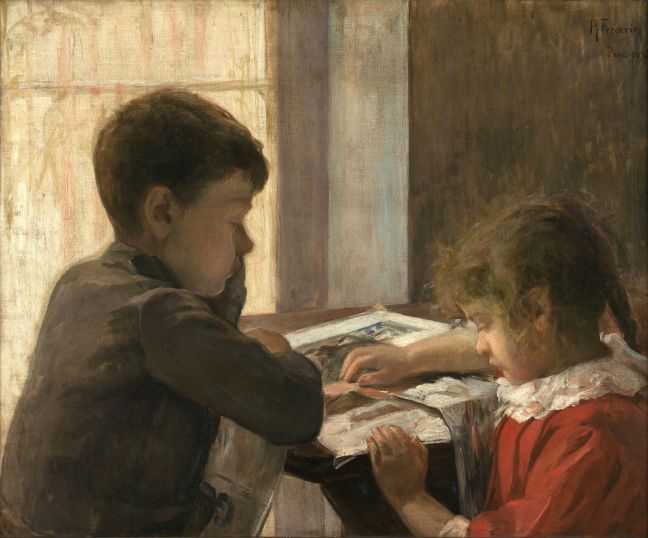
Scattered between the playful math links below, you’ll find quotations from my new book Charlotte Mason’s Living Math, along with several paintings of children playing and learning which I considered for the book but ran out of room.
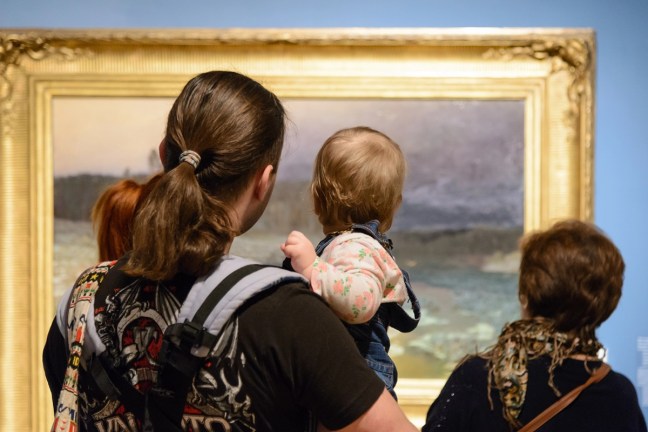
“The lesson” by Rafael Frederico, 1895.
By tradition, we start the carnival with a puzzle/activity in honor of our 184th edition. But if you’d rather jump straight to our featured blog posts, click here to see the Table of Contents.
Give them confidence they can learn and make sense of things.
Develop intuition and creative thinking about math.
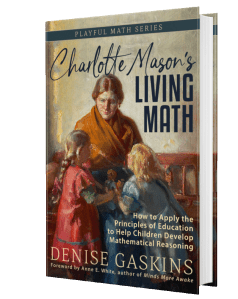
You’ll love how Charlotte Mason’s Living Math transforms your children’s experience of math, awakening their imagination about numbers, shapes, and patterns.
It’s a fun way to enrich any math curriculum, and great for unschoolers, too.
But as I’m working on my new book, I wanted to add another valuable supplement that we often overlook. So here’s a preview excerpt from Charlotte Mason’s Living Math…
Over the next two weeks, you’ll be hearing a lot about Kickstarter and my Charlotte Mason’s Living Math project. I’m proud of the book, and I want to spread the news as far and wide as possible.
You’ll love how Charlotte Mason’s Living Math transforms your children’s experience of math, awakening their imagination about numbers, shapes, and patterns.
But I know there are many readers who don’t know much about crowdfunding. Some people even think that a campaign like this is just online begging.
So I want to share what I totally love about Kickstarter and how much it offers you, the customer:
(1) It’s the “New World” of publishing.
In the old days, traditional publishing companies paid writers in advance to write the books the publisher wanted to see. In this new world, you get to choose and support the writers creating books you want to read.
One of the stretch goals for my Charlotte Mason’s Living MathKickstarter campaign is to add a math journaling prompt to the end of each chapter. So, I’ve been playing around with ideas to get readers writing.
Since the book’s all about how to build mathematical reasoning, I’m looking for ways to prompt creative thinking and flexibility in math calculations.
I found some fun ideas in Guy Gattegno and Martin Hoffman’s Handbook of Activities for the Teaching of Mathematics (which you can download here), including the following riff off a puzzle created by Lewis Carroll.