Math History Tidbits: Agnesi, Euler, and China

Alexandria JonesI’ve fallen behind on my project of transcribing my Alexandria Jones stories. Finally, here are a few more tidbits from math history, along with links to relevant Internet sites and a few math puzzles for your students to try.
I hope you find them interesting.

Continue reading Math History Tidbits: Agnesi, Euler, and China

Answers: Euclid’s Geometric Algebra

Remember the Math Adventurer’s Rule: Figure it out for yourself! Whenever I give a problem in an Alexandria Jones story, I will try to post the answer soon afterward. But don’t peek! If I tell you the answer, you miss out on the fun of solving the puzzle. So if you haven’t worked these problems yet, go back to the original post. Figure them out for yourself — and then check the answers just to prove that you got them right.

Euclid’s Geometric Algebra

Continue reading Answers: Euclid’s Geometric Algebra

Euclid’s Geometric Algebra

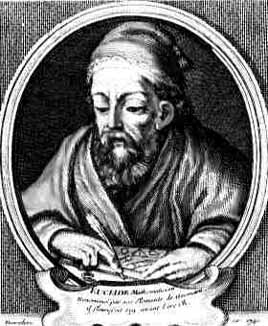
Picture from MacTutor Archives.

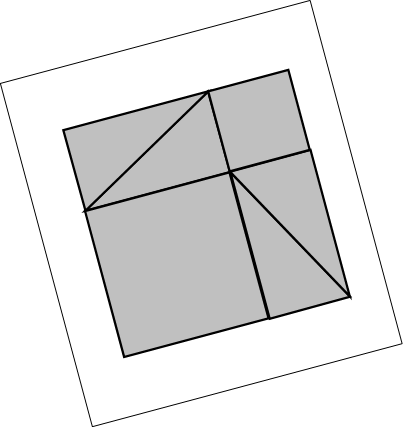
After the Pythagorean crisis with the square root of two, Greek mathematicians tried to avoid working with numbers. Instead, the Greeks used geometry to demonstrate mathematical concepts. A line can be drawn any length, so straight lines became a sort of non-algebraic variable.

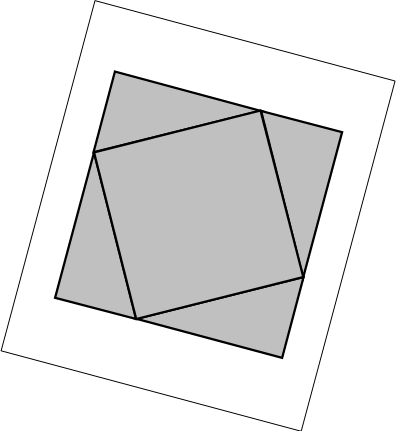
You can see an example of this in The Pythagorean Proof, where Alexandria Jones represented the sides of her triangle by the letters a and b. These sides may be any length. The sizes of the squares will change with the triangle sides, but the relationship a^2 + b^2 = c^2 is always true for every right triangle.
Continue reading Euclid’s Geometric Algebra

The Mosaic Tile Mystery

Dear Alexandria Jones,

We continue to excavate the ancient building complex, which I believe may have been Pythagoras’s school. Yesterday, one of our digging crews uncovered a mosaic tile floor in the courtyard. The pattern of the tiles alternates between two square designs. (See enclosed sketches.)

During your family’s recent visit, you expressed an interest in the mathematical ideas of Pythagoras. Could you or your father offer us any insight into what these tile designs may represent?

I look forward to your response.

Sincerely,
Sofia Theano, Ph.D.
Crotone, Italy

Continue reading The Mosaic Tile Mystery

Alexandria’s Dog is Now a Teacher


Photo by alex-s.

A reader of Indian descent has been kind enough to write to me about a difference in our cultures. In the US, or at least in the parts with which I am familiar, it is common to name one’s pet after a famous person. In India, however, to name a dog after a human is a very deep insult.

I am sorry! It was not intended that way.

Therefore, I have re-named Alexandria Jones‘s dog after a Westerner. I would like to keep the tradition of naming the characters in my Alex stories after people in math history, so I am hoping this one will not offend anyone.

Continue reading Alexandria’s Dog is Now a Teacher

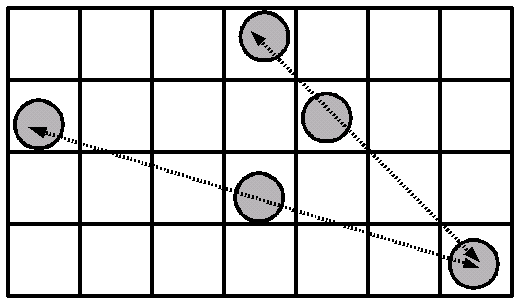
Game: Avoid Three, or Tic-Tac-No!

Math concepts: slope, logical strategy
Number of players: 2 or more
Equipment: 4×4 or larger grid, pebbles or other tokens to mark squares

Set Up

Alexandria Jones and her brother Leon played Avoid Three with pebbles on a grid scratched in the sand, but you can also use pencils or markers on graph paper. You need a rectangular playing area at least 4×4 squares large. The bigger your grid, the longer your game.

Continue reading Game: Avoid Three, or Tic-Tac-No!

Answers to Leon’s Figurate Number Puzzles

Remember the Math Adventurer’s Rule: Figure it out for yourself! Whenever I give a problem in an Alexandria Jones story, I will try to post the answer soon afterward. But don’t peek! If I tell you the answer, you miss out on the fun of solving the puzzle. So if you haven’t worked these problems yet, go back to the original post. Figure them out for yourself — and then check the answers just to prove that you got them right.

Continue reading Answers to Leon’s Figurate Number Puzzles

Puzzle: Figuring Out Figurate Numbers


Photo by frumbert.

Alexandria Jones‘s parents decided that the family needed to relax after the excitement of tracking Simon Skulk, so they spent the next day at a beach on the Mediterranean coast. Leon collected pebbles and tried to build up figurate numbers — numbers that make a figure, or shape — the way Dr. Theano had shown them.

Continue reading Puzzle: Figuring Out Figurate Numbers

The Puzzling Pythagorean Pebbles

Alexandria Jones and her family flew to Italy for spring break. Her father, the famous archaeologist, had to visit an excavation.

It was late when their plane landed in Crotone, a small coastal city near the instep of Italy’s boot. Dr. Jones had used the Internet to find a hotel that allowed pets, so Alex was able to snuggle down with her favorite pillow — her trusty dog, Ramus.

The Original School of Mathematics

The next day, Dr. Jones introduced his family to Sonya Theano, a former student of his and the director of this dig. “Come, let me show you around,” Dr. Theano said. “We’ve uncovered several buildings of a small compound, set apart from the city of Crotona, as it was called then. From the pottery and trade goods, we estimate these buildings were in use around 550-500 BCE.”

Continue reading The Puzzling Pythagorean Pebbles