Math History Tidbits: The Battling Bernoullis

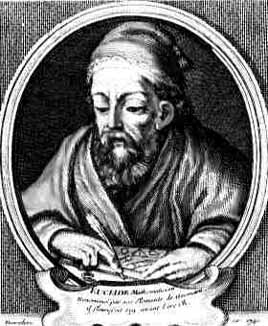
July 27th is Alex’s birthday. She shares it with Johann Bernoulli, an irascible mathematician from the late 17th century. This coincidence intrigued her enough that she wrote a research paper on Johann and his mathematical brother, titled “Jeering Jacob and Jealous Johann.”

Of course, to make the alliteration work, she had to mispronounce Johann’s name — but she figured he kinda deserved that. Read the historical tidbits below to find out why one writer said the Bernoulli brothers were “the kind of people who give arrogance a bad name.”*

Continue reading Math History Tidbits: The Battling Bernoullis
Probability Issue: Hints and Answers

Remember the Math Adventurer’s Rule: Figure it out for yourself! Whenever I give a problem in an Alexandria Jones story, I will try to post the answer soon afterward. But don’t peek! If I tell you the answer, you miss out on the fun of solving the puzzle. So if you haven’t worked these problems yet, go back to the original posts. If you’re stuck, read the hints. Then go back and try again. Figure them out for yourself — and then check the answers just to prove that you got them right.

This post offers hints and answers to puzzles from these blog posts:

Continue reading Probability Issue: Hints and Answers

Probability and Baby Blues


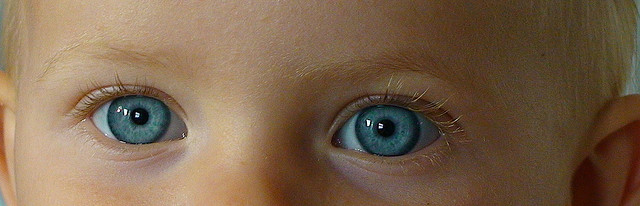
[Photo by audi_insperation.]

[In The Birthday Surprise, Alex discovered her family was expecting a new member…]

What will the baby look like, Alex wondered. “Dad, is there any way to tell whether the baby will have blue eyes like I do, or brown like the rest of the family?”

Dr. Jones shuffled the papers on his desk and found a blank page. “Over 100 years ago, the Austrian monk Gregor Mendel studied genetics, or how various traits are passed down from one generation to another.” He began to draw a diagram as he talked.

Continue reading Probability and Baby Blues

Alexandria Jones and the Birthday Surprise

[Photo by D Sharon Pruitt.]

[July 27th is Alex’s birthday, which she shares with Johann Bernoulli, an irascible mathematician from the late 17th century.]

The guests had gone. Alex and her family sat around the table, sharing the last tidbits of birthday cake and ice cream. Alex smiled at her parents.

“Thanks, Mom and Dad,” she said. “It was a great party.”

Maria Jones, Alex’s mother, leaned back in her chair. “I do have one more surprise for you, Alex. But you will have to share this one with the whole family.”

Leon groaned. “I know what it is: Let’s all pitch in to clean up.”

“That wouldn’t be a surprise,” Alex said.

Continue reading Alexandria Jones and the Birthday Surprise

Math History Tidbits: Agnesi, Euler, and China

Alexandria JonesI’ve fallen behind on my project of transcribing my Alexandria Jones stories. Finally, here are a few more tidbits from math history, along with links to relevant Internet sites and a few math puzzles for your students to try.

I hope you find them interesting.

Continue reading Math History Tidbits: Agnesi, Euler, and China

Answers: Euclid’s Geometric Algebra

Remember the Math Adventurer’s Rule: Figure it out for yourself! Whenever I give a problem in an Alexandria Jones story, I will try to post the answer soon afterward. But don’t peek! If I tell you the answer, you miss out on the fun of solving the puzzle. So if you haven’t worked these problems yet, go back to the original post. Figure them out for yourself — and then check the answers just to prove that you got them right.

Euclid’s Geometric Algebra

Continue reading Answers: Euclid’s Geometric Algebra

Euclid’s Geometric Algebra

Picture from MacTutor Archives.

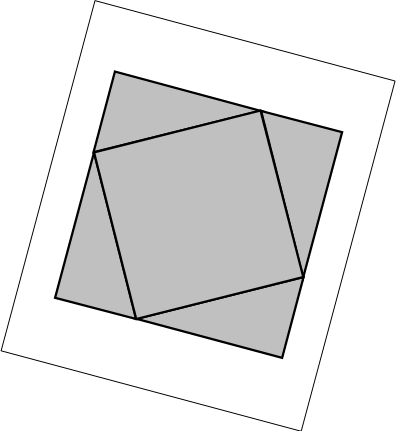
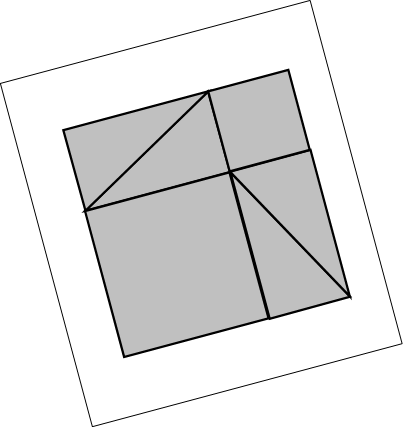
After the Pythagorean crisis with the square root of two, Greek mathematicians tried to avoid working with numbers. Instead, the Greeks used geometry to demonstrate mathematical concepts. A line can be drawn any length, so straight lines became a sort of non-algebraic variable.

You can see an example of this in The Pythagorean Proof, where Alexandria Jones represented the sides of her triangle by the letters a and b. These sides may be any length. The sizes of the squares will change with the triangle sides, but the relationship a^2 + b^2 = c^2 is always true for every right triangle.
Continue reading Euclid’s Geometric Algebra

The Mosaic Tile Mystery

Dear Alexandria Jones,

We continue to excavate the ancient building complex, which I believe may have been Pythagoras’s school. Yesterday, one of our digging crews uncovered a mosaic tile floor in the courtyard. The pattern of the tiles alternates between two square designs. (See enclosed sketches.)

During your family’s recent visit, you expressed an interest in the mathematical ideas of Pythagoras. Could you or your father offer us any insight into what these tile designs may represent?

I look forward to your response.

Sincerely,
Sofia Theano, Ph.D.
Crotone, Italy

Continue reading The Mosaic Tile Mystery

Alexandria’s Dog is Now a Teacher


Photo by alex-s.

A reader of Indian descent has been kind enough to write to me about a difference in our cultures. In the US, or at least in the parts with which I am familiar, it is common to name one’s pet after a famous person. In India, however, to name a dog after a human is a very deep insult.

I am sorry! It was not intended that way.

Therefore, I have re-named Alexandria Jones‘s dog after a Westerner. I would like to keep the tradition of naming the characters in my Alex stories after people in math history, so I am hoping this one will not offend anyone.

Continue reading Alexandria’s Dog is Now a Teacher